What the electronics OEM needed
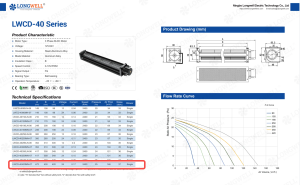
An electronics OEM developing compact control cabinets needed a control cabinet cooling fan delivering 194 m3/h.
Their enquiry was short and precise. Usually that means the engineering team has already done the thinking, and wants a component to design around rather than a consultation.
The constraints
- First, a 24 VDC supply.
- Next, PWM speed regulation, for dynamic thermal management.
- Meanwhile total assembly length under 405mm, with 350mm of active impeller.
- A slim profile, pointing at roughly a 45mm impeller diameter.
- Finally, 2D drawings and 3D models, so they could finalize the enclosure and prototype.
Notably the phrase that shaped everything was low-velocity airflow across sensitive components. In other words a broad, gentle sweep rather than a blast at one hot part.
Why this control cabinet cooling fan fits
An existing control cabinet cooling fan matched exactly, so no development was needed. Even so, the reasoning behind the fit is worth setting out.
Why the fan type was decided already
An axial fan produces a cone of air, which leaves corners of a component array under-cooled while the center gets more than it needs.
Meanwhile a centrifugal blower discharges from a point and would need a plenum to spread the air, costing depth this cabinet does not have.
A cross-flow impeller draws and discharges along its whole length. Consequently the airstream arrives already shaped like the component row it has to cool.
The diameter trade
The 45mm impeller is a deliberate compromise. Certainly a larger wheel would build more pressure, though it would also take more depth.
At 45mm this control cabinet cooling fan produces 24 Pa, enough to beat the internal resistance while staying slim. Anything larger needs a bigger housing, and the enclosure was already fixed.
Speed set for the acoustics
Factory speed is 2000 RPM. Consequently it reaches 194 m3/h at 42 dB(A), quiet enough to sit in a room with people.
Running faster would give headroom that is not needed and noise that is.
The motor and what comes with it
Meanwhile a three-phase brushless DC motor connects straight to their 24V bus, so no inverter is needed.
Here the integrated driver accepts PWM, letting their master controller modulate speed against real thermal load. It also provides a tachometer output, which matters more than it sounds. In a closed cabinet a failed fan is invisible until something overheats, so the FG signal turns that into an alarm.
What it cost
Pressure, again inherent to cross-flow. At 24 Pa this fan circulates air inside a cabinet and cannot draw it through a filter.
That is fine for a sealed enclosure relying on internal circulation and conduction through the walls. It is not fine if the design later adds a filtered intake, and that is a decision worth making before the enclosure is finalized rather than after.
Technical Specifications
The power figure below is the one worth noticing. Nine watts is what a well-matched selection costs to run.
| Parameter | Value |
|---|---|
| Model | LWCD-45350MN-06 |
| Voltage | 24 VDC |
| Current | 0.38 A |
| Input Power | 9.12 W |
| Speed | 2000 RPM |
| Max. Air Volume | 194 m³/h |
| Max. Static Pressure | 24 Pa |
| Noise | 42 dB(A) |
| Dimensions (Overall L x Housing L x Impeller L) | 405 x 360 x 350 mm |
| Bearing Type | Ball Bearing |
| Insulation Class | B |
| Operating Temperature | -25°C to +60°C |
| Speed Control | PWM |
| Signal Output | FG (Tachometer) |
| Housing Material | Steel / Aluminum Alloy |
| Impeller Material | Aluminum |
| Certifications | CE, RoHS |
Technical Documentation
Meanwhile the final approved drawings and specification sheets are critical for system integrators. Below are the key documents for this project.
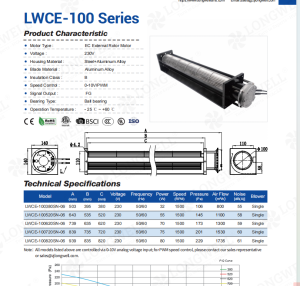
Official Specification Sheet (PDF): This document contains all final electromechanical specifications, performance curves, and compliance information needed by procurement and compliance teams.
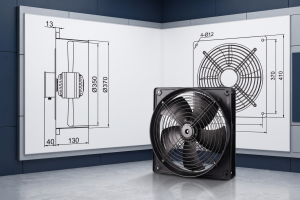
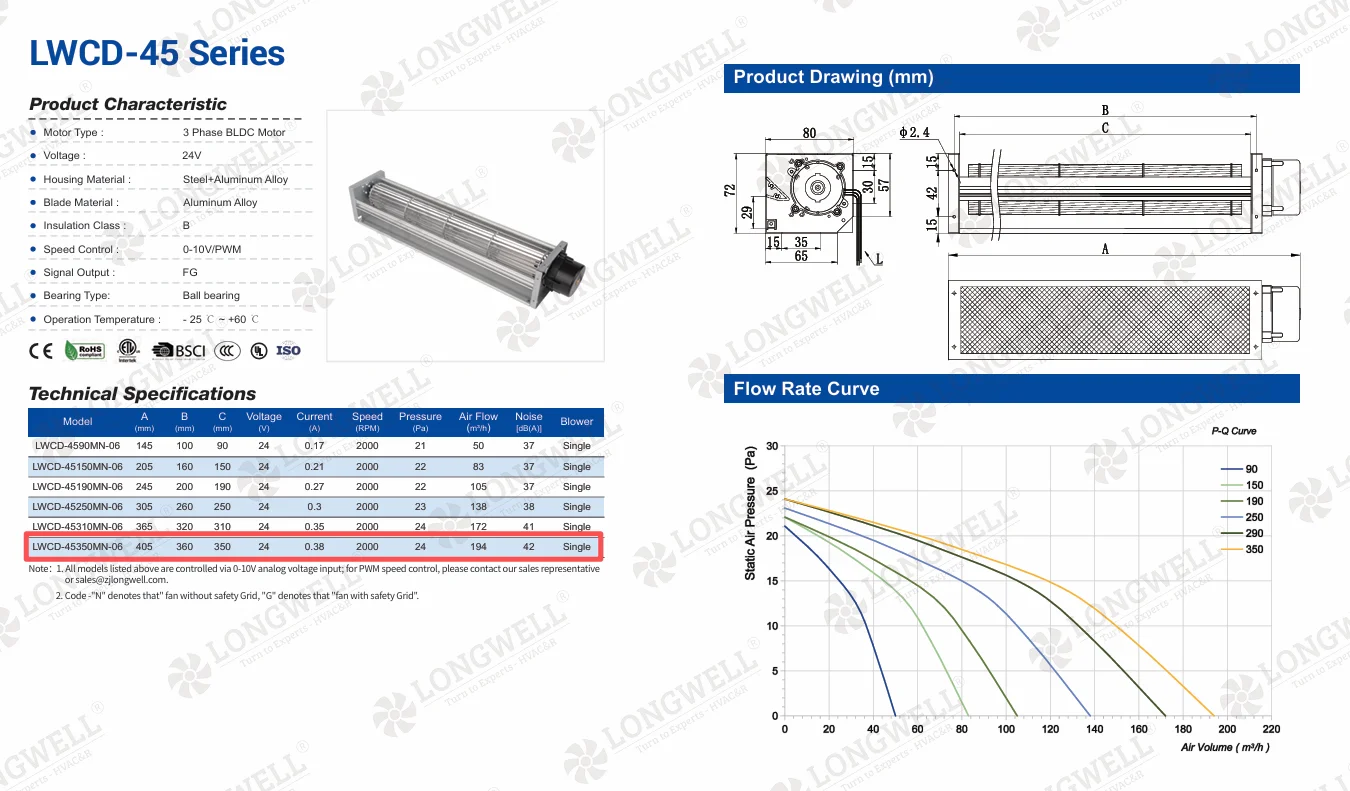 This consolidated image includes the mechanical drawing with critical mounting dimensions required by design engineers for CAD integration.
If you are cooling a control cabinet
A control cabinet cooling fan is where over-specification is most common and least useful.
- Size for the duty, not for reassurance. This control cabinet cooling fan uses 9.12 watts because it is matched to the job. By contrast an oversized fan at full speed wastes energy, makes noise and stirs dust. None of that improves component temperature.
- Take the tachometer output and wire it in. A fan that stops in a sealed cabinet gives no warning. The FG signal costs nothing extra and converts a silent failure into a maintenance alert.
- Match the impeller length to the component row. Active length is what determines coverage. A fan that fits the space but is shorter than the array leaves an unswept section that becomes the thermal limit for the whole cabinet.
- Settle the filtration question early. Cross-flow fans work at tens of pascals. If dust ingress is a concern, either seal the cabinet and rely on circulation, or plan for a centrifugal fan from the start.
See our cross flow fan range, the DC cross flow fan section, or DC cooling fans. Ingress ratings follow IEC 60529.
Questions about this fan
What is the difference between PWM and 0-10V control?
Only the signaling method. PWM sends a square wave whose duty cycle sets the speed, which suits a microcontroller output directly. By contrast a 0-10V input needs an analog voltage, often meaning a DAC or filter stage. So choose whichever your controller produces natively. The fan behaves the same either way.
What does the FG tachometer output actually give me?
A pulse train proportional to speed. Your controller can confirm the fan is turning, measure how fast, and alarm if it slows or stops. In a sealed cabinet that is the only warning you will get before temperatures start climbing.
Is 9.12 watts really enough to cool a cabinet?
For moving 194 m3/h against 24 Pa, yes, and that is the point. Power follows the work being done rather than the size of the enclosure. However, if your heat load needs more airflow or your cabinet is more restrictive, tell us both figures. The answer will be a different control cabinet cooling fan.
Why does low velocity matter for electronics?
Because even coverage matters more than speed. A fast jet cools one spot well and leaves recirculation zones elsewhere, so the hottest component still limits the system. A broad, slow sweep keeps the whole array at a similar temperature, which is what actually raises the allowable load.
Technical Documentation & Resources
Got a duty point you need matched?
Tell us the airflow, the pressure and the space you have. Then we mark your duty point on a tested curve and send the drawing back. Meanwhile samples and custom spec sheets take up to 90 days. Since 1990 we have supplied OEMs across HVAC, refrigeration and industry.
Browse Related Products:
🏆 ISO 9001 / ISO 14001 / ISO 45001 | CE (TÜV) | UL/ETL | ATEX Zone 21/22 | AMCA 210/211 / ISO 5801 tested