What the OEM needed
An OEM building commercial fan coil units and ventilation systems needed a panel-mounted EC fan speed controller.
Their enquiry arrived slightly mixed. It named a simple manual controller, yet it also included a Wi-Fi thermostat datasheet. Evidently they were still weighing how much intelligence the user panel should carry.
What was firm
- First, universal AC input from 85 to 265V, so one part suits every market.
- Next, a standard 86 by 86 mm wall-mount footprint to fit their chassis.
- Meanwhile a clean 0-10V output for the EC fans they already use.
- An operating range of -30C to +55C, covering every installation they sell into.
- Finally, the ability to switch AC line voltage directly for small auxiliary parts.
That last one is the interesting requirement. Switching mains inside the EC fan speed controller removes a relay from the bill of materials on their smaller units.
Choosing the EC fan speed controller
Two things needed settling. First, how much the controller should do. Second, where it gets its power.
Dropping the thermostat option
The Wi-Fi thermostat was ruled out quickly, and not on capability grounds.
Their main system board already handles temperature sensing and mode selection. Consequently a second intelligent controller would duplicate that logic and add cost. Worse, it creates two places where the same decision gets made. So a simple manual EC fan speed controller was the right level.
The decision that actually mattered
We offer two architectures that produce the same 0-10V output.
Here the first draws its 10V supply straight from the EC fan motor. Certainly that is neat when the panel sits close to the fan, since no separate power is needed.
However, this OEM puts the user panel a long way from the fan. Running dedicated low-voltage cable that far means another harness and another routing problem. Furthermore voltage drop becomes a concern. So we rejected it.
Mains-powered instead
The chosen EC fan speed controller runs from any mains supply between 85 and 265V and generates its own regulated 0-10V signal.
Consequently it powers itself from whatever is already at the wall plate. Speed adjusts steplessly through a rotary knob, and the output drops straight onto the SmartEC control input on the fans they were already buying.
Meanwhile the 3.0A AC-rated internal switch settled the auxiliary requirement too. On their smaller variants, a small AC component now runs directly off the controller with no external relay.
What it cost
Simplicity at the panel, paid for by having mains voltage at the user interface. Admittedly that is normal for a wall plate. Even so, the enclosure and the installation must both treat it as a mains device rather than a low-voltage one.
The IP20 rating reflects that. This is an indoor, behind-a-faceplate component, not something to mount in a plant room.
Technical Specifications
Note the input voltage row below. That range is what removes a separate power run from the installation.
| Parameter | Value |
|---|---|
| Model | LWSC-DC-005 |
| Input Voltage | AC 85-265V |
| Output Signal | 0-10V (20mA) |
| Output Current (Switched) | Max 3.0A (AC) |
| IP Rating | IP20 |
| Operating Temperature | -30°C to +55°C |
| Maximum Shell Temperature | +65°C |
| Control Input | Manual Knob |
| Dimming Range | 0-100% |
| Dimensions (W x H x D) | 85.8 x 85.8 x 43.7 mm |
| Net Weight | 0.090 kg |
Technical Documentation
LWSC-DC-005 Speed Controller Datasheet
The PDF provides full electrical specifications, mechanical drawings, and wiring diagrams for the selected AC-powered controller, essential for design engineers and system integrators.
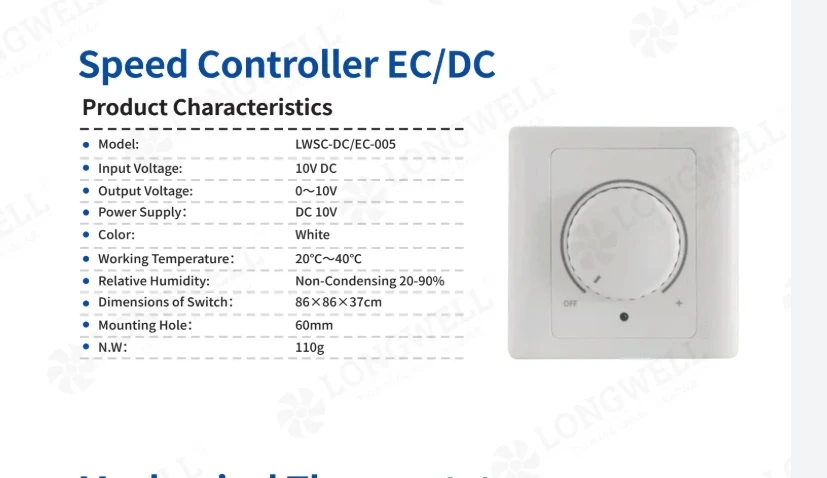
Here the image shows a visually similar DC-powered controller, the LWSC-DC/EC-005, which was evaluated as an alternative during the solution-finding process.
LWTD8686D Thermostat Manual
This manual for a full-featured thermostat was part of the customer’s initial submission, helping our engineers understand the broader scope of their climate control system design.
If you are specifying fan controls
An EC fan speed controller looks interchangeable on a datasheet. In practice a few details decide the installation.
- Decide where the controller gets power before you route anything. Fan-powered controllers save a cable when the panel is near the fan. Mains-powered ones win as soon as there is any distance. Getting this wrong shows up as an extra harness late in the design.
- Check the output is a real 0-10V, not a PWM approximation. Some cheap controllers chop mains and call the result variable speed. That works on an AC shaded-pole motor and does nothing useful on an EC fan, which expects a clean analog reference.
- Look at what else the controller can switch. A few amps of AC switching built in can remove a relay, a socket and some wiring from a small unit. It is a minor spec line with a real effect on the bill of materials.
- Match the footprint to a standard plate. An 86 by 86 mm form factor fits standard back boxes and faceplates across most markets, which keeps the installer on familiar ground.
See our fan speed controller range, the fan accessories section, or EC fans. Efficiency rules follow ASHRAE 90.1.
Questions about this controller
Can this controller run any EC fan?
Any fan that accepts a standard 0-10V analog input, which covers most EC fans including ours. Check the fan input impedance and its minimum speed setting, since some units stop below a threshold rather than continuing down to zero. Send us the fan model and we will confirm.
What is the difference from the fan-powered version?
Only where the 10V comes from. The fan-powered model takes it from the motor, so it needs a low-voltage run between fan and panel. By contrast this one makes its own from mains. Both produce the same signal, so the choice is purely about your wiring layout.
Does the 3.0A switch handle a fan motor directly?
For a small auxiliary component, yes. For a fan motor, check the starting current rather than the running current, since an AC motor draws several times its rated current at start. Where the margin is tight, use a contactor and let the controller drive that instead.
Why does an EC fan need 0-10V rather than a dimmer?
Because an EC fan reads the voltage as a speed instruction, not as power. A dimmer chops the mains waveform to reduce power, which is how you slow an AC shaded-pole motor. Feed that to an EC fan and its internal supply sees a distorted input, which at best does nothing and at worst damages the electronics.
Technical Documentation & Resources
Working on something similar?
Send us the duty point, the envelope and the supply, and our engineers come back with a shortlist rather than a catalog. Meanwhile custom spec sheets and samples run to 90 days. Since 1990 we have built fans for HVAC, cold chain, data center and industrial OEMs.
Browse Related Products:
🏆 ISO 9001 / ISO 14001 / ISO 45001 | CE (TÜV) | UL/ETL | ATEX Zone 21/22 | AMCA 210/211 / ISO 5801 tested
Choose the right speed regulator
Longwell manufactures 5 speed regulators in-house. Send airflow, static pressure and voltage — an engineer replies with a matching model, performance curve and price within one working day.