A cabinet fan and a wide ambient range
An OEM building a new line of industrial control cabinets asked for a specification sheet. Among the requirements was an ambient range of -30C to +60C, which is what drove the motor insulation class discussion.
In short, the request was for documentation and nothing more. What made it non-trivial was that ambient figure.
The fixed points
- First, 380 VAC at 50 Hz, which is what the cabinets are wired for.
- Next, a 280 by 280mm mounting pattern, no deeper than 80mm.
- Meanwhile at least 1600 m3/h free-air delivery.
- Finally, CE marking with RoHS and Reach, plus a 66 dB(A) ceiling.
The requirement doing the real work
Continuous S1 duty at up to +60C ambient is the demanding part, and it is the line that sets the motor insulation class.
S1 means the fan runs and keeps running. There is no cooling-off period built into the duty cycle, so whatever temperature the winding settles at is the temperature it lives at.
Where the 155 degree number goes
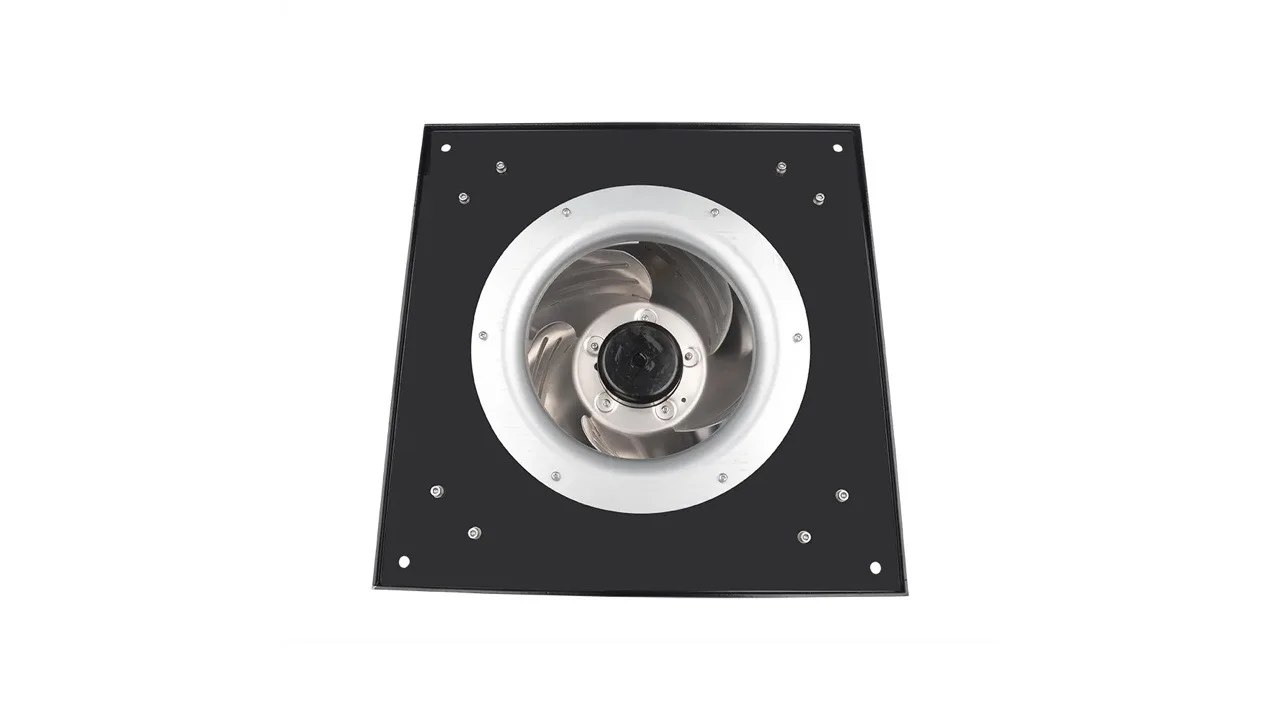
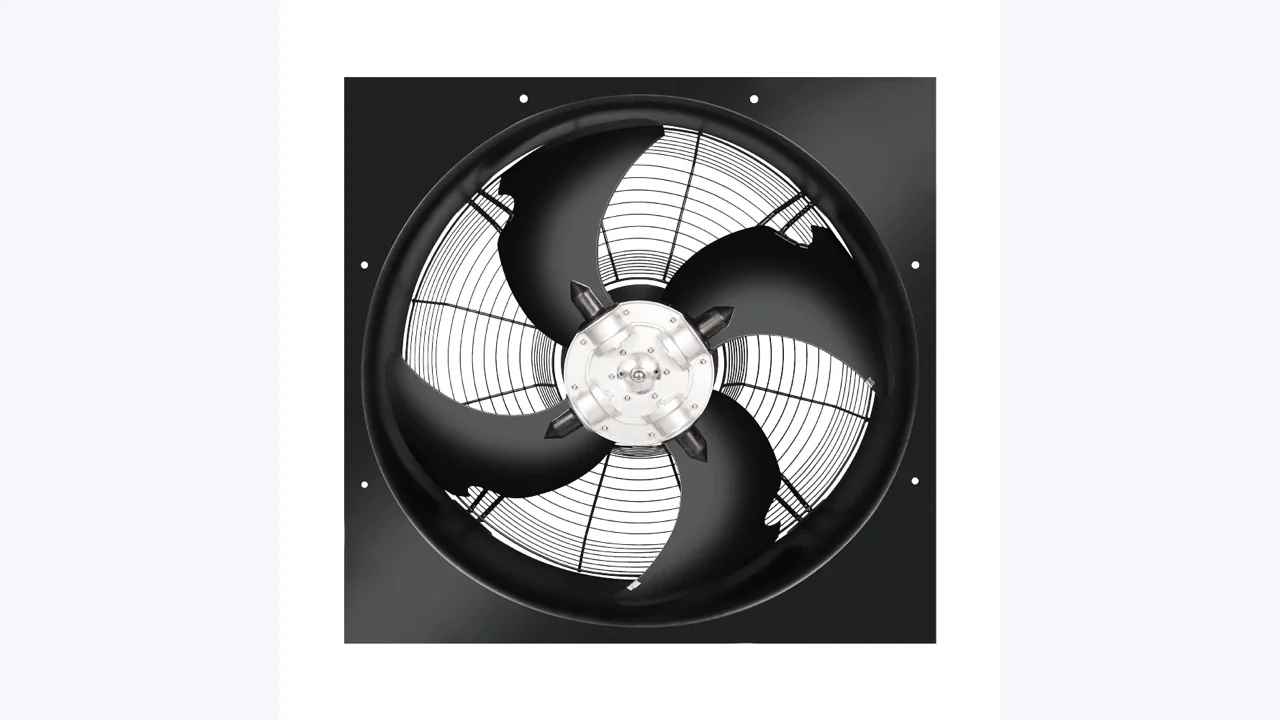
We selected a five-blade steel impeller delivering 1648 m3/h on 100 W, which suits the low system impedance of a ventilated cabinet. Meanwhile the motor still had to survive the ambient.
Why we did not offer EC
Admittedly an EC motor is more efficient and takes a control signal. But this customer switches the fan with a 380 V relay and has no 0-10V or PWM infrastructure anywhere in the cabinet.
So an EC fan would add an AC/DC conversion stage and controls the customer cannot use. That is complexity bought with nothing in return, and we said so rather than selling up.
What the motor insulation class actually rates
Class F is rated to 155C. A control cabinet never reaches that, which is why this motor insulation class looks generous at first sight.
The rating is not the ambient temperature. It is the maximum the winding itself may reach, and the winding always runs hotter than the air around it.
Here the arithmetic goes: ambient, plus the temperature rise the motor generates under load, plus a margin for hot spots inside the winding. Consequently a 60C ambient with a 70C rise already puts you at 130C before any margin at all.
What the margin is for
Even so, a winding that runs near its limit does not fail that day. Insulation ages, and the ageing rate roughly doubles for every 10C above the rated figure.
So the motor insulation class is really a life specification wearing a temperature label. Class B at 130C would still run in this cabinet. It would just not run for as many years.
The rest of the build
Besides the winding, the steel impeller is balanced to G6.3, which keeps vibration down over a long continuous run. Meanwhile IP44 covers the dust a factory cabinet draws in.
Balance grades are defined in ISO 21940, which is worth quoting on a purchase order rather than asking for a fan that is balanced.
Technical Specifications
The insulation class is not in the airflow section, which is roughly why it gets skipped.
| Parameter | Value |
|---|---|
| Model Number | LWAA2D250S-5MKW-46 |
| Nominal Voltage | 380 VAC |
| Voltage Range | 342 ~ 412 VAC |
| Frequency | 50 Hz |
| Airflow (Max) | 1648 m³/h (969 CFM) |
| Speed | 2500 RPM |
| Input Power | 100 W |
| Current | 0.2 A |
| Noise Level (LpA) | 66 dB(A) |
| Operating Temperature | -30°C to +60°C |
| Dimensions | 280 x 280 x 80 mm |
| Insulation Class | Class F |
| Protection Class | IP44 |
| Work System | S1 (Continuous Duty) |
| Life Expectancy (L10) | 30,000 hours @ 40°C |
| Certifications | CE, RoHS, Reach |
Technical Documentation
Meanwhile the complete technical datasheet (PDF) provides performance curves, dimensional drawings, and certification data for engineering review.
View Technical Datasheet (PDF)
The product series summary gives procurement managers a quick overview of available models and their key performance specifications.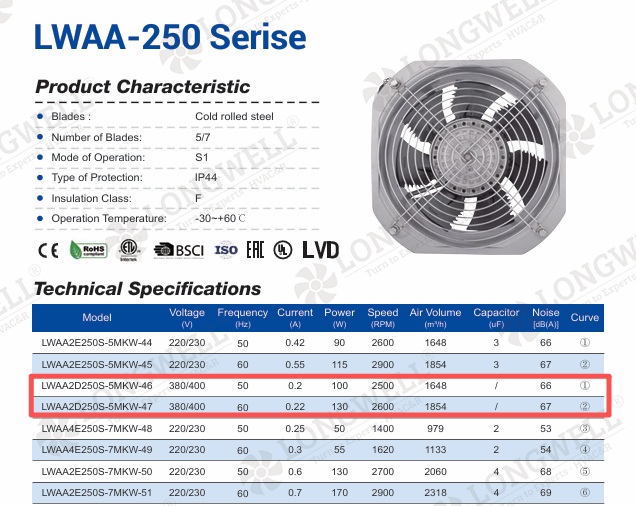
A DOCX version of the specification sheet is available for integration into the customer’s internal documentation system.
Get Specification Sheet (DOCX)
Reading a thermal specification properly
If you are choosing a motor insulation class for a hot enclosure, these four checks matter more than the headline airflow.
- Compare the insulation rating against winding temperature, not ambient. A motor insulation class of 155C does not mean the fan tolerates a 155C room. Add your ambient to the motor temperature rise before deciding whether the margin is real.
- Check the duty cycle, not just the rating. S1 continuous duty gives the winding nowhere to cool down. A motor rated for intermittent duty can carry the same insulation class and still run out of margin in continuous service.
- Treat insulation class as an expected-life question. Insulation ageing roughly doubles with each 10C over the rated temperature. Choosing a lower class saves money and shortens service life, which may be a reasonable trade if you make it knowingly.
- Ask what the cabinet interior actually reaches. The 60C in the specification is often the design assumption rather than a measurement. If the real internal temperature is higher, every number downstream of it is optimistic.
See our axial fans range, the AC axial fans section, or compact axial fans.
Questions about insulation class
Does Class F mean the fan works in a 155C environment?
No, and this is the most common misreading. The figure is the maximum permitted temperature of the motor winding, which includes the heat the motor generates itself. Subtract the temperature rise under load and the usable ambient is far lower than the class number suggests.
Is Class H always better than Class F?
It gives more thermal headroom, so in a hot enclosure it buys life. In a cool one it buys nothing you will ever use, and it costs more. Choose it when your ambient plus temperature rise leaves too little margin, not as a default upgrade.
How much does running hot actually shorten motor life?
As a working rule, insulation life halves for every 10C above the rated temperature. So a motor running 20C hot is not slightly worse off, it is on roughly a quarter of its expected life. That is why margin matters more than the class label alone.
What if my cabinet ambient is higher than 60C?
Then say so before selection rather than after. The options are a higher insulation class, a larger fan running cooler, or reducing the heat load. All three are cheaper decisions at design stage than a run of motors failing in the field.
Technical Documentation & Resources
Have a fan requirement like this one?
Send the datasheet you are working against, or simply the duty point. Then our engineers tell you what fits and what does not. Meanwhile custom spec sheets and samples take up to 90 days. Since 1990 we have been building fans for OEMs worldwide.
Browse Related Products:
🏆 ISO 9001 / ISO 14001 / ISO 45001 | CE (TÜV) | UL/ETL | ATEX Zone 21/22 | AMCA 210/211 / ISO 5801 tested