What the air curtain OEM needed
An OEM building a new line of commercial air curtains needed one integrated cross-flow fan assembly, delivering 3000W of heat.
The brief asked for two specific things. Notably, they differ completely in character.
- The existing cross-flow fan assembly changed to use 6.35mm blade terminals.
- A heating element paired with it, carrying an 85C safety thermostat.
- An overall length under 310mm, since their chassis is fixed.
- 220V at 50Hz, because European mains supplies it.
- Lastly, GB/T13933-2008, as the base for CE marking under the LVD and EN 60335.
Here the terminal request is the one people skip past. Blade terminals push on instead of needing a screw. Consequently assembly time falls, and a whole class of wiring error disappears. Basically it is a make-it-easier request rather than an engineering one.
The thermostat request is the opposite. An air curtain with 3000W of heat and no airflow is a fire. Consequently the customer wanted that interlock written into the specification, not assumed.
Building the cross-flow fan assembly
Meanwhile the ran as light customization. Our engineers took the LWCA series as the starting point, since it was already close.
The fan
At the core sits the LWCA-65300SN-10-43, a 220V AC fan with a 65mm impeller. That shape makes the sheet of air an air curtain needs, inside the length their chassis allows.
Its shaded-pole AC motor is right for the job. An air curtain switches on and off rather than modulating. Consequently the fine control an EC motor offers would go unused, while still adding cost.
Changing the terminations
The first task was replacing the standard lead-wire termination with 6.35mm blade terminals.
That is a small change with a large effect. It cuts connection time on their line, and it removes the chance of a poor joint. On a mains-voltage heater, that is worth having.
The heating module
Meanwhile the second task was the heater itself. Our team built a 3000W element mounting straight onto the fan outlet. Consequently heat goes into the airstream at once, rather than into the surrounding metal.
Into that we built the 85C auto-reset thermostat. It cuts power to the element whenever outlet air passes a safe temperature. The cause might be a blocked grille, or a dead motor.
That interlock is the difference between a heater and a hazard. Consequently we specified it as part of the assembly, rather than leaving the customer to add it.
In the end what shipped was a drop-in cross-flow fan assembly, meeting every size, electrical and safety line in the brief.
Technical Specifications
Two blocks of figures appear below, one for the fan and one for the heater. Together they ship as one cross-flow fan assembly, under one part number.
| Parameter | Value |
|---|---|
| Voltage | 220 V |
| Frequency | 50 Hz |
| Speed | 1800 RPM |
| Input Power | 40 W |
| Current | 0.35 A |
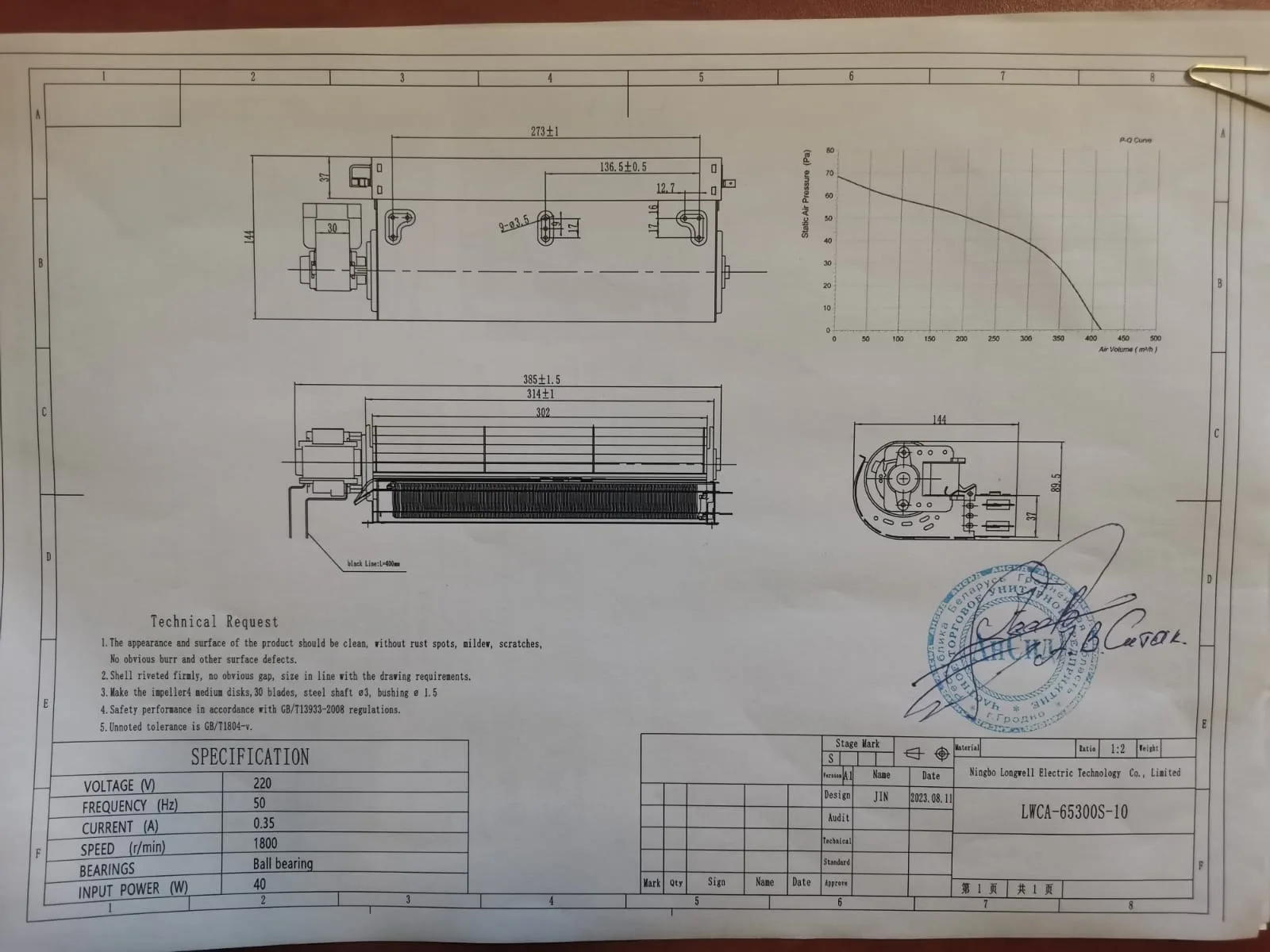
| Max Airflow | ~430 m³/h |
| Max Static Pressure | ~75 Pa |
| Bearings | Ball Bearing |
| Impeller Dimensions | Ø 65 mm x 300 mm |
| Overall Length | 303±1 mm |
| Parameter | Value |
|---|---|
| Voltage | 220 V |
| Frequency | 50 Hz |
| Input Power | 3000 W |
| Safety Control | External Power-off Reset Thermostat (85°C setpoint) |
| Compliance | GB/T13933-2008 |
Technical Documentation
Here the following documents were generated and approved during the project lifecycle, forming the final deliverable package for the customer.
LWCA-65300SN-10-43 Fan Specification Sheet: This document provides the complete performance data, including the P-Q curve and dimensional drawings, for the core cross-flow fan component. It is essential for system integrators and quality assurance teams.
LWHW-AC65300S-3000W-10 Heater Specification Sheet: This drawing details the electrical specifications, dimensions, and safety features of the custom 3000W heating element. Procurement and compliance managers use this for verification.

Assembly Detail: This image shows the key modification—the 6.35mm blade-type terminals on the fan motor, requested by the customer to streamline their manufacturing process.
Why one supplier beat two
For an OEM combining heat and airflow, four things counted.
- One part number instead of two vendors. Rather than buying a fan from one supplier and a heater from another, the customer got a tested cross-flow fan assembly from one source. That removes compatibility risk as well as procurement work.
- Manufacturability requests taken seriously. Blade terminals are a trivial change with a real effect on production efficiency. Our process accommodates that quickly, where many imported European brands route it into a full development cycle. Light modifications like this take weeks.
- European-level safety at a lower cost. This assembly matches European-branded alternatives on performance and safety, at a materially lower unit cost. On a competitive product like an air curtain, that gap decides shelf position.
- A clear route to CE. The whole assembly was designed and built inside our ISO 9001 system, and adherence to GB/T13933-2008 gives the customer a documented path to CE certification on their finished product.
Browse our air curtain range, or the AC cross-flow fan series. Appliance safety requirements come from IEC 60335-1.
Questions about the assembly
What does the 85C thermostat actually do?
It cuts power to the 3000W element whenever outlet air passes that temperature. The point is protection against a blocked airflow path or a failed motor, either of which would let the element heat an enclosure with nothing carrying the heat away. It is what makes the assembly compliant with standards such as EN 60335.
Are other lengths or power ratings available?
Yes. A cross-flow fan assembly sits on our modular platform, so we configure impeller lengths from around 200mm to over 1000mm, and match heating elements to suit. Custom configurations run through our 90-day NPI process, with a first-order MOQ usually between 50 and 100 units.
Can the fan speed be controlled?
Not on this model, which uses a single-speed shaded-pole motor fixed at 1800 RPM on 50Hz. Where variable airflow is needed, we build versions with multi-speed tapped windings, or specify a SmartEC motor with 0-10V and PWM control. Either route is handled as a custom development project.
Why mount the heater on the outlet rather than the inlet?
Because air leaving the fan moves fast and evenly across the full width, which is exactly the condition that carries heat away well. Heating the inlet instead would warm the motor along with the air. Consequently its life would shorten, and part of the energy would be wasted on the wrong side of the fan.
Technical Documentation & Resources
Need the same thing for your own unit?
Give us the numbers and the envelope, and you get a shortlist rather than a catalog. Meanwhile custom spec sheets and samples run to 90 days. Since 1990 Longwell has supplied EC fans and blowers to OEMs in HVAC, cold chain, data center and industrial markets.
Browse Related Products:
🏆 ISO 9001 / ISO 14001 / ISO 45001 | CE (TÜV) | UL/ETL | ATEX Zone 21/22 | AMCA 210/211 / ISO 5801 tested
Choose the right cross flow fan
Longwell manufactures 495 cross flow fans in-house. Send airflow, static pressure and voltage — an engineer replies with a matching model, performance curve and price within one working day.