What the OEM asked for
An OEM building large HVAC systems wanted a match for a European EC axial fan. Specifically, they named an ebm-papst W3G630 series unit.
They sent the competitor datasheet as the benchmark for performance and dimensions alike. In short, they wanted a reliable air mover at lower cost, with nothing given up on quality or integration.
The constraints
- First, two models were needed: one for 230V three-phase and one for 400/460V, covering their global line.
- Second, both had to carry IP55 protection, since these units sit on rooftops and outdoor chillers.
- Meanwhile the chassis fixed an 805mm external dimension, a 750mm mounting pattern and roughly 258mm depth.
- The incumbent 460V fan hit 15,490 m3/h at 329 Pa, and the replacement had to match or beat it.
- Finally, control had to work over 0-10V analog or RS485 Modbus for the building system.
Above all, maximum back pressure in the system was 340 Pa. That figure set the real performance target.
Proposing a bigger EC axial fan
The brief asked for a dimension-for-dimension replacement of a 630mm fan. So we started there, then changed our minds.
The obvious answer worked, and was not good enough
Our existing 630mm EC axial fan series does reach the required airflow and pressure. However, it has to spin faster to get there.
Higher RPM means more power and more noise. Consequently matching the dimensions would have delivered a comparable fan rather than a better one, eroding exactly what the customer came for.
What we proposed instead
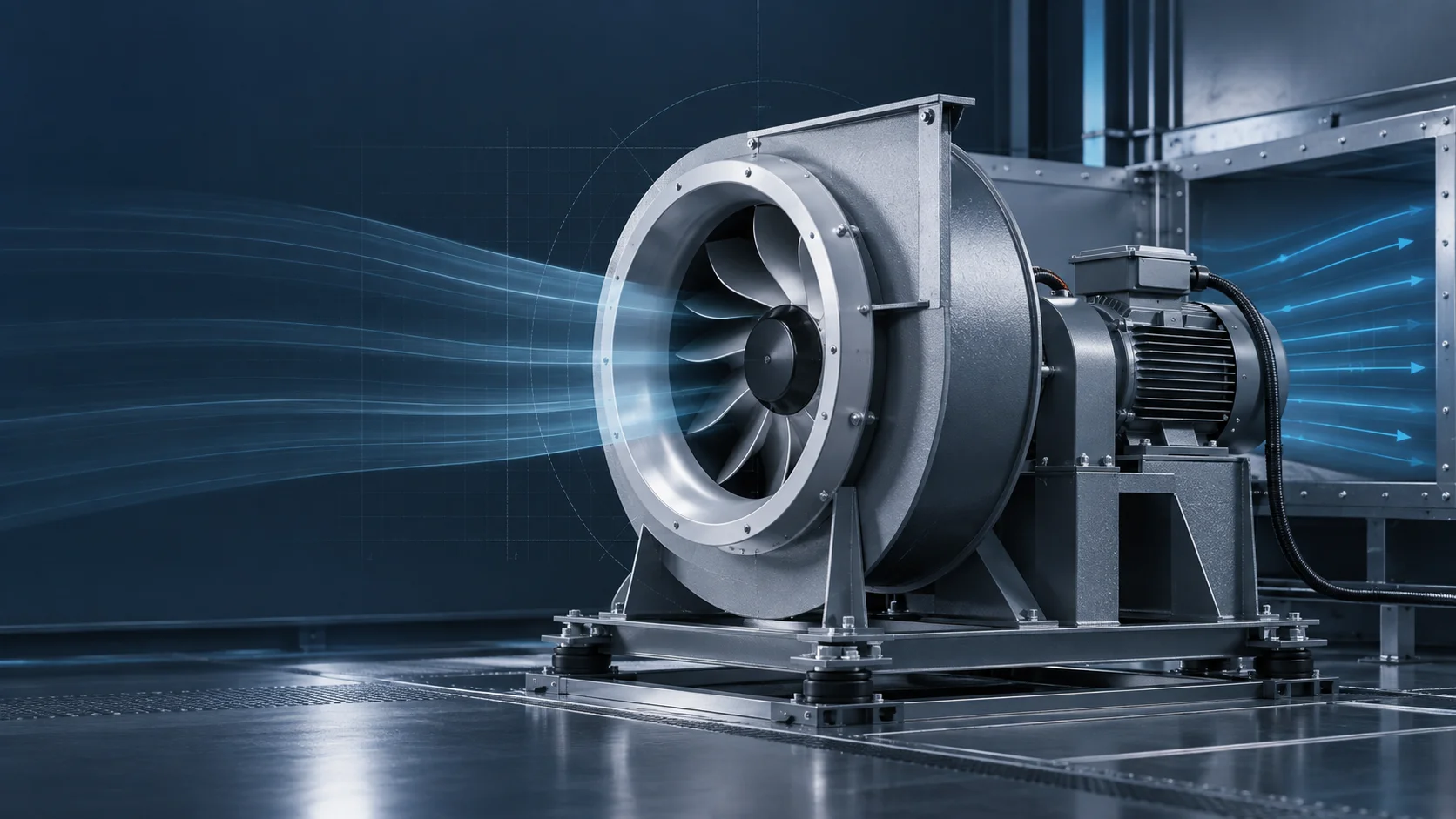
Instead we put forward the LWAE3G710TS-5PKW-04-00, an EC axial fan with a 710mm impeller.
Here the larger diameter reaches the same duty point at 1400 RPM against the competitor 1580 RPM. Slower rotation is the foundation of our AcousticFlow approach, and it cuts noise and energy use together.
The honest downside
The EC axial fan does not fit their existing plate. It uses an 850mm square flange with an 810mm mounting pattern, so their sheet metal tooling needs a one-time update.
We presented that plainly rather than burying it. In essence the trade is one tooling change against years of lower energy bills and a quieter product. Ultimately the customer judged it worth making.
What it delivers
Meanwhile the fan gives 21,919 m3/h maximum airflow and 311 Pa maximum static pressure, which covers the duty point comfortably. Most importantly, input power is 2465 W against the 3700 W benchmark, a 33.5% reduction.
IP55 protection and the SmartEC controller both come as standard. Furthermore 0-10V, PWM and RS485 Modbus RTU are all available for the building system.
Technical Specifications
The power input row below carried this project. Everything else was already achievable.
| Parameter | Value |
|---|---|
| Model Number | LWAE3G710TS-5PKW-04-00 |
| Nominal Voltage [VAC] | 400 (3-Phase) |
| Voltage Range [VAC] | 380 ~ 480 |
| Frequency [Hz] | 50/60 |
| Max Airflow [m³/h] | 21,919 |
| Max Airflow [CFM] | 12,894 |
| Max Static Pressure [Pa] | 311 |
| Speed [RPM] | 1400 |
| Power Input (at max eff.) [W] | 2465 |
| Current (at max eff.) [A] | 2.89 |
| Protection Class | IP55 |
| Insulation Class | Class F |
| Min. Ambient Temperature [°C] | -25 |
| Max. Ambient Temperature [°C] | +65 |
| Weight [Kg] | 41.7 |
| Control Input | 0-10VDC / PWM / RS485 |
| Certifications | CE, RoHS, Reach |
Technical Documentation
Here the following documents were the final deliverables for the project, approved by the customer’s engineering department.
Final Approved Technical Specification (LWAE3G710TS-5PKW-04-00.pdf)
Here the comprehensive document contains full performance curves (P-Q), electrical data, and control protocols for detailed engineering review and system simulation.
Summary Datasheet for Procurement
A summary sheet for procurement and system integration teams, detailing key performance metrics, dimensional data, and material specifications.

The dimensional drawing provided to the customer to evaluate the fitment of the 850mm square flange and 810mm mounting pattern in their existing chassis.

This wiring diagram illustrates the connections for 3-phase power and the SmartEC™ control signals, including RS485, 0-10V, and PWM inputs.
Why the OEM accepted the change
Choosing this EC axial fan gave the OEM several things beyond the hardware itself.
- Two weeks from enquiry to approved drawings. That speed comes from our 90-day NPI framework and a deep standard range. By contrast, imported European brands typically quote 12 to 18 months for a similar change.
- Cost on both sides of the ledger. Acquisition cost landed materially below the European benchmark, while power consumption fell by a third. Together those make a total cost argument the OEM can pass to their own customers.
- Certification handled. CE marking runs through our China-local TUV NORD Notified Body. Consequently the timeline shortens a lot, which protects their production schedule.
- We argued for the better fan. Quoting a one-to-one copy would have been easier, and more profitable in the short run. Even so, proposing the 710mm EC axial fan is what an engineering partner should do.
- Data from a real chamber. Airflow, pressure and power figures all come from chambers verified to AMCA 210/211 and ISO 5801 methods, so they can be used in system modeling with confidence.
See our EC axial fan range, or the EC fan section. Efficiency rules come from the EU ErP directive.
Questions about this replacement
Is this really a drop-in replacement?
No, and we said so from the start. It is a performance upgrade rather than a mechanical drop-in. Moving from a 750mm to an 810mm pattern needs a minor tooling change on the plate. In exchange the larger impeller runs at 1400 RPM, which cuts power by over 33% and lowers noise. Meanwhile we supply 3D models and drawings to make that update easy.
Our current fan is rated to -40C. Is a low-temperature version available?
Yes. The standard model is qualified to -25C. For steady running down to -40C we build a ThermoFlex version, with low-temperature bearings and flexible potting for the electronics. That is a routine request, and it fits inside the standard 90-day NPI process.
What is the 230V equivalent?
The LWAE3G710TS-xPKW-02-00. It shares the identical 710mm impeller, housing and SmartEC control interface, so the design stays consistent across a global product line. Only the motor winding and drive electronics differ, configured for the 200-240V three-phase range. Separate datasheets and curves are available for each.
Why does a bigger fan use less power for the same job?
Because power rises with the cube of speed. A larger impeller reaches the same airflow and pressure at lower RPM, so that cubic relationship works in your favor. In short, it is the whole reason we suggested going up a size rather than matching the original dimensions.
Technical Documentation & Resources
Working on something similar?
Send us the duty point, the envelope and the supply, and our engineers come back with a shortlist rather than a catalog. Meanwhile custom spec sheets and samples run to 90 days. Since 1990 we have built fans for HVAC, cold chain, data center and industrial OEMs.
Browse Related Products:
🏆 ISO 9001 / ISO 14001 / ISO 45001 | CE (TÜV) | UL/ETL | ATEX Zone 21/22 | AMCA 210/211 / ISO 5801 tested
Choose the right axial fan
Longwell manufactures 1,086 axial fans in-house. Send airflow, static pressure and voltage — an engineer replies with a matching model, performance curve and price within one working day.