What the OEM needed
A European HVAC OEM needed a quiet convector fan for a new line of trench heaters and fan convectors, going into offices, hotels and retail.
Their airflow target was modest at 168 m3/h against 14 Pa. The demanding number was the noise limit: 29 dB(A).
How quiet 29 dB(A) actually is
That figure sits close to the background level of a quiet room. In an office or a hotel bedroom, a fan at that level is not so much quiet as effectively inaudible.
- First, 230V AC at 50Hz, fixed for the market.
- Next, overall length no greater than 710mm, in a slim 68 by 54 mm section.
- Meanwhile CE marking for European market entry.
- Finally, airflow verified to ISO 5801, since it feeds their heating capacity figure.
Where a quiet convector fan gets its quiet
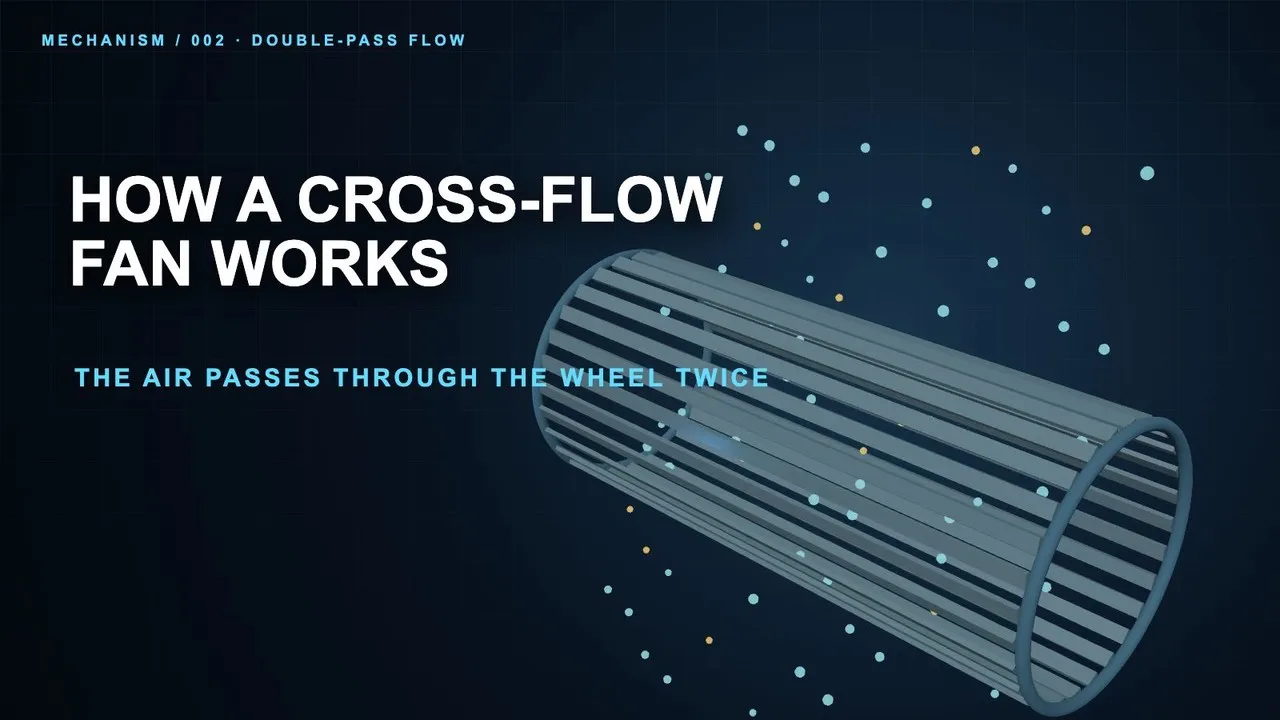
The fan type was never in doubt. A trench convector needs a wide low-velocity sheet of air, which is what cross-flow produces and what an axial array or a centrifugal blower cannot deliver in that section.
Here the interesting question is where a quiet convector fan gets 29 dB(A), since this one turns at 2200 RPM and that sounds fast.
RPM is the wrong number to look at
Noise from a fan tracks blade tip speed, not rotational speed. Tip speed is diameter multiplied by RPM, so a small impeller spinning quickly can be far quieter than a large one turning slowly.
The impeller is 30mm across. At 2200 RPM its tips move slowly in absolute terms, which is exactly why a quiet convector fan can spin fast and still be inaudible.
The other half of the answer
Cross-flow geometry helps too. Air leaves along the full 650mm of impeller length rather than through a small opening, so outlet velocity stays low.
Consequently there is little turbulence at the discharge, and turbulence is what most fan noise actually is.
Why AC, not EC
An EC version would be more efficient and would offer variable speed.
However, this is a fixed-speed design where unit cost drives the decision. An AC shaded-pole motor hits the 168 m3/h target on 14 watts, and 14 watts is already low enough that the efficiency argument is thin. So the cheaper motor was correct.
Ball bearings, deliberately
Sleeve bearings would cost less and start out equally quiet.
We specified dual ball bearings instead, since they hold performance across -25C to +60C and reach commercial service life. Meanwhile a sleeve bearing grows noisier as it wears. In a quiet convector fan that is a slow failure rather than a sudden one.
What it cost
Airflow capability. At 14 Pa maximum this fan cannot push air through anything restrictive.
For a trench convector discharging straight into a room that is exactly right. It also means the design cannot later gain a filter or a longer duct without a different fan.
Technical Specifications
Read the impeller diameter alongside the speed below. Together they explain the noise figure.
| Parameter | Value |
|---|---|
| Model Number | LWCA-30650SN-06 |
| Voltage | 230 V |
| Frequency | 50 Hz |
| Input Power | 14 W (±10%) |
| Speed | 2200 RPM (±5%) |
| Maximum Air Flow | 168 m³/h (±10%) |
| Maximum Static Pressure | 14 Pa |
| Noise Level | 29 dB(A) |
| Overall Length (A) | 710 mm |
| Housing Length (B) | 660 mm |
| Impeller Length (C) | 650 mm |
| Impeller Diameter | 30 mm |
| Bearings | Ball Bearing |
| Motor Type | AC Shaded Pole Motor |
| Operating Temperature | -25°C to +60°C |
| Housing Material | Galvanized Sheet Steel |
| Impeller Material | Aluminum Alloy |
| Mode of Operation | S1 (Continuous) |
| Certifications | CE, RoHS, ISO 9001 |
Technical Documentation
Meanwhile the following documents were approved and provided to the customer, confirming all mechanical and electrical specifications for system integration.
LWCA-30650SN-06-00.pdf
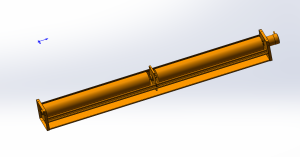
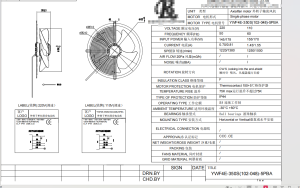
This is the final approved technical drawing, which provides engineers with all critical dimensions, material specifications, and performance parameters required for CAD modeling and assembly.

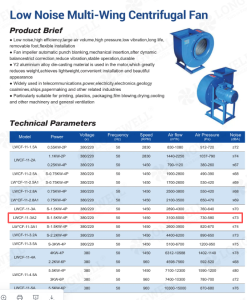
Here the product data sheet gives procurement managers and engineers a quick-reference overview of the entire LWCA-30 series, including the P-Q performance curve for the 650 mm impeller model.
If you are specifying to a noise limit
A quiet convector fan is usually specified by a number written without the conditions that make it meaningful.
- Give the measurement distance with the dB(A) figure. A number without a distance is not comparable between suppliers. One meter in free field is the common convention, and your installed condition will differ from it.
- Look at tip speed, not RPM. A high RPM figure on a small impeller is not a warning sign. Diameter multiplied by speed is what predicts noise, so compare that rather than the headline rotational speed.
- Ask about bearing type if the product is sold on quiet. Sleeve bearings start quiet and get louder with wear. Ball bearings cost more and hold their acoustic performance. On a ten-year appliance that difference outlives the price difference.
- Fix the pressure budget before the noise target. Quiet comes from low velocity, and low velocity means low pressure capability. A design that later adds a filter cannot keep the same acoustic figure.
See our cross flow fan range, the AC cross flow fan section, or silent fans. Appliance safety follows IEC 60335-1.
Questions about fan noise
How can 2200 RPM be quiet?
Because noise follows tip speed rather than rotational speed. On a 30mm impeller the blade tips travel slowly even at 2200 RPM. By contrast the same speed on a 300mm impeller gives ten times the tip velocity and is dramatically louder. So RPM alone tells you very little.
Would an EC motor have been quieter?
Not at the same speed, since the noise comes from the airflow rather than the motor. What EC would give you is the ability to run slower when full output is not needed, and slower is always quieter. On a fixed-speed convector there is no opportunity to use that.
Why not sleeve bearings to save cost?
They would work initially and cost less. However, sleeve bearings wear and grow noisier over time, and they behave less predictably at temperature extremes. In a product whose selling point is that you cannot hear it, an acoustic figure that degrades over years is a real problem.
What happens if I add a filter to this design?
Airflow collapses. Maximum static pressure is 14 Pa, and almost any filter consumes more than that on its own. If filtration is a possibility, say so at the design stage so the fan is chosen for a pressure budget that accommodates it.
Technical Documentation & Resources
Sizing something comparable?
Share the airflow, pressure, voltage and control interface, and we come back with a tested curve and a drawing. Meanwhile custom work runs to 90 days for spec sheets and samples. Since 1990 Longwell has supplied fans to HVAC and industrial OEMs.
Browse Related Products:
🏆 ISO 9001 / ISO 14001 / ISO 45001 | CE (TÜV) | UL/ETL | ATEX Zone 21/22 | AMCA 210/211 / ISO 5801 tested