What the heater OEM was fighting
A European OEM building commercial electric heaters needed a cross-flow blower for a new line of convector units. They sent photographs of their prototype, which paired a third-party fan with their own ribbon-fin heating element.
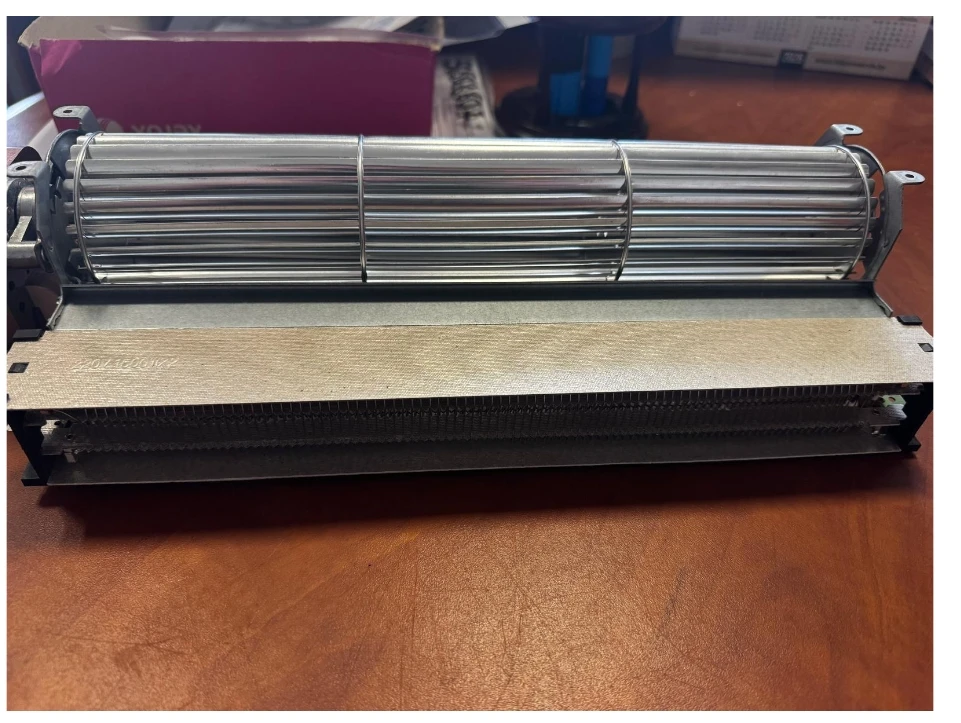
The photographs showed the problem clearly. The blower outlet and the heater inlet did not line up.
That mismatch matters more than it looks. Air leaving unevenly means parts of the element get plenty and parts get almost none. Consequently you get hotspots, and you waste heating capacity.
- 220V at 50Hz, with a target of 40W input power.
- A total length of roughly 385mm, since their chassis was fixed.
- A wide, even sheet of air at 1800 RPM, rather than high pressure.
- An early answer on tooling modification cost and minimum order quantity, before any technical qualification.
That last point is worth noting. Procurement wanted the money answer first. Frankly, that is a sensible way to run a project when a custom part is involved.
Modifying the cross-flow blower housing
Our LWCA-65300SN-10-43 cross-flow blower already met the electrical and performance targets. Consequently the problem was purely mechanical. Fit the housing to their element without spoiling the airflow.
Three options, two rejected
Here the first idea was a smaller 60mm housing, which lines up better. We rejected it at once, since a smaller impeller cannot move the air volume needed. Worse, it would push the customer into redesigning their whole thermal system to suit our fan.
The second idea was to ask the customer to build a new heating element frame matching our standard housing. We dismissed that too, and for a straightforward reason. Adapting to the customer design is our job, not the other way round.
The option we took
Meanwhile the third path was the most direct. We proposed a small change to the existing sheet metal tooling for the 65mm housing. Lowering the outlet geometry lets it meet the heater assembly squarely and seal against it.
Crucially, that keeps the proven 65mm impeller and 40W motor exactly as they are. No aerodynamic requalification, and no change to the customer electrical design.
The commercial answer
So we came back with a one-time tooling fee in the low thousands of RMB, plus a 2,000-unit minimum order against a new custom part number.
That pairing is what makes a custom-fit cross-flow blower sensible rather than aspirational. A tooling change priced in the tens of thousands would simply have sent the customer back to compromising on fit.
Technical Specifications
The model number carries a -43 suffix. That suffix is the modified cross-flow blower housing, and nothing else on this list changed with it.
| Parameter | Value |
|---|---|
| Model | LWCA-65300SN-10-43 (Modified Housing) |
| Voltage | 220 V |
| Frequency | 50 Hz |
| Speed | 1800 RPM |
| Current | 0.35 A |
| Input Power | 40 W |
| Bearings | Ball Bearing |
| Impeller Diameter | 65 mm |
| Impeller Length | 300 mm |
| Overall Length (with motor) | ~385 mm |
Technical Documentation
Here the following files document the project from initial customer input to the final proposed solution. Each document is critical for different stakeholders in the OEM integration process.

The customer-provided image shows the target application and highlights the physical interface challenge between the fan outlet and heating element.
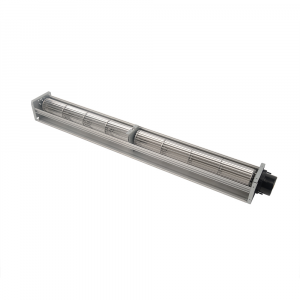
Procurement managers and system integrators use this top-down view to confirm overall component fit within their product chassis.
LWCA-65300SN-10-43 Technical Drawing
Design engineers require this PDF to confirm the baseline electrical characteristics and mechanical dimensions of the core fan assembly.

Here the excerpt from the internal project log shows the rapid evaluation of three engineering options, a key part of Longwell’s fast NPI process.
Why the modification was affordable
For an appliance OEM, four things made this practical.
- A tooling change that costs little. Quoting a housing modification for a low one-time fee is what makes custom fit accessible. It turns a problem that would take a year elsewhere into something resolved inside a 90-day cycle.
- The tooling is ours. Sheet metal tooling, motor winding and final assembly all happen here. Because no external supplier sits in the chain, we could commit to a firm price and a firm lead time immediately.
- We proposed rather than quoted. The customer did not simply get a catalog page back. Instead our team looked at the job and suggested a specific, practical change, which is how these problems really get solved.
- Supply committed for the product life. A custom part number means committing to its supply. The 2,000-unit MOQ set a production baseline, and a frame agreement then secures supply across the product lifecycle.
Browse our cross-flow fan range, or the AC cross-flow fan series for other lengths. Appliance safety requirements come from IEC 60335-1.
Questions about custom housings
What does a housing modification cost, and how long does it take?
On this cross-flow blower the one-time tooling fee was in the low thousands of RMB. First articles then follow design approval inside our standard 90-day NPI cycle, and the tooling work plus sample production typically accounts for three to four weeks of that.
Is the 2,000-unit MOQ the same for every custom project?
No, it is calculated per project against the complexity of the change. Simple modifications such as custom lead wires or connectors can go as low as 500 units. A unique housing modification is a mid-level change. Larger redesigns need different volumes again.
Can this be built for North America, or with variable speed?
Yes to both. The LWCA series is a platform, and we regularly build 110V and 120V 60Hz versions. This particular model is single speed, though we also make a full range of cross-flow fans on SmartEC motors with 0-10V or PWM control built in.
Why does outlet alignment matter so much over a heating element?
Because a heating element only sheds heat where air actually passes over it. A misaligned outlet leaves dead zones. Those zones then run hotter, while the airstream runs cooler than it should. In short, you lose capacity and gain a thermal risk together.
Technical Documentation & Resources
Need the same thing for your own unit?
Give us the numbers and the envelope, and you get a shortlist rather than a catalog. Meanwhile custom spec sheets and samples run to 90 days. Since 1990 Longwell has supplied EC fans and blowers to OEMs in HVAC, cold chain, data center and industrial markets.
Browse Related Products:
🏆 ISO 9001 / ISO 14001 / ISO 45001 | CE (TÜV) | UL/ETL | ATEX Zone 21/22 | AMCA 210/211 / ISO 5801 tested
Choose the right blower
Longwell manufactures 247 blowers in-house. Send airflow, static pressure and voltage — an engineer replies with a matching model, performance curve and price within one working day.