Cooling Requirements for a Dry Type Transformer
A customer needed to cool a large dry-type transformer. The unit sat inside a tight distribution cabinet. They needed a cross flow cooling fan, specifically a
cross flow cooling fan system. The setup had to support an 800 kVA capacity. First, the fans had to sit on both sides of the lower coil. Next, they had to blow air right into the cooling ducts. This airflow stops thermal trips during heavy loads.
However, the cabinet was very small. The whole fan unit had to fit inside a 590 mm length. It also needed a tight 2.5 mm tolerance. Also, the width could not pass 148 mm. The height limit was exactly 160 mm. The mounting hole pitch was strictly 550 mm and 530 mm. This exact spacing matched their existing brackets. Therefore, any size error would stop their assembly line.
The power limits were strict too. The system used an AC 220V, 50Hz supply. So, the fan had to move exactly 1000 m3/h of air. Yet, it could not use more than 50 W. The current limit was just 0.37 A. Next, the noise limit was tight. The cabinet ran in a quiet place. Thus, the noise had to stay under 50 dBA. Finally, the fan had to meet GB/T13933-2008 safety rules. The basic size limits followed the GB/T1804-v standard.
Choosing the Right Cross Flow Cooling Fan
Hitting 1000 m3/h of airflow in a 148 mm deep cabinet was hard. We had to look closely at motor and blade options.
Rejecting Standard Axial Fans
First, we thought about using small axial fans. They could blow air up at the coils. However, axial fans push air in narrow circles. This shape leaves hot spots across the 530 mm long transformer.
As a result, the cooling would be uneven. The customer would have to run the unit below its 800 kVA rating. By contrast, a
cross flow cooling fan makes a wide wall of air. This shape perfectly matches the long transformer ducts. Therefore, we dropped the axial idea right away.
Balancing Noise and Motor Speed
Next, we looked at blade size. A larger fan spinning at 1000 RPM would easily beat the 50 dBA noise limit. Instead, the 148 mm depth limit made a large housing impossible. The cabinet simply lacked the space.
Thus, we chose the LWF-(S)D590-110/120 frame. We needed 1000 m3/h from this small size. So, we had to run the motor at a faster 1400 RPM. This higher speed comes with a real cost.
It causes more wear and shakes more than a slow motor. We fixed this problem by using top-tier ball bearings. These bearings raise the build cost of every unit. Even so, they stop early field failures.
Final Unit Specs
Finally, this design perfectly met all strict rules. The final fan uses just 0.37 A and 50 W. Also, the 5.3 kg unit moves 1000 m3/h across the whole coil. Four fans run on each transformer.
Together, they safely cool the 800 kVA system. They also keep the noise below the 50 dBA limit.
Technical Specifications
| Parameter | Specification |
|---|---|
| Model | LWF-(S)D590-110/120 |
| Airflow | 1000 m3/h |
| Input Power | 50 W |
| Speed | 1400 RPM |
| Voltage | AC 220 V |
| Frequency | 50 Hz |
| Current | 0.37 A |
| Dimensions | 590 x 148 x 160 mm |
| Mounting Hole Pitch | 550 mm / 530 mm |
| Weight | 5.3 kg |
| Noise | <= 50 dBA |
| Bearings | Ball bearing |
First, the 50 W power draw is very low for so much air. This low 0.37 A current stops the fan from draining too much cabinet power. Also, the light 5.3 kg weight makes the setup easy. One person can lift and mount it alone.
Reference: AMCA 210 covers the test method behind these figures.
Technical Documentation
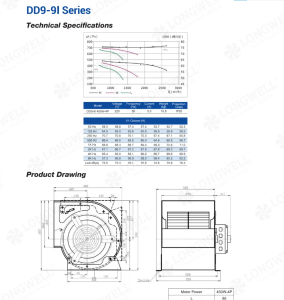
LWF-(S)D590-110/120 Technical Specifications
This spec sheet outlines the operating rules for cabinet engineers.

Next, this drawing provides the exact 550 mm hole pitch dimensions.
Specifying Ventilation for Tight Cabinets
If you need a cross flow cooling fan for a tight cabinet, check your space limits early.
- First, measure the exact mounting hole pitch on your frame. A small 5 mm error will ruin the install and delay the job.
- Next, find the total airflow needed for your kVA rating. For instance, an 800 kVA system often needs four fans to cool the whole coil.
- Also, check the exact depth inside the cabinet door. Fans have different depths. A deep fan will block the cabinet door from closing.
- Finally, test the exact supply voltage at the switch. If you guess 220V but have 400V, field rewiring will waste hours of labor.
We make our own impellers. Thus, we can tune the blade angle to shift airflow without changing the outer box size.
Related: Cross Flow Fans.
Engineering Frequently Asked Questions
Technical Documentation & Resources
Browse our cross-flow fans range, the AC cross-flow fans section, or cross-flow impellers.
Have a Similar Fan Requirement?
Longwell’s engineering team delivers custom spec sheets and samples within 90 days. Since 1990, we have supplied EC fans and blowers to OEMs across HVAC, cold chain, data center, and industrial applications worldwide.
Browse Related Products:
🏆 ISO 9001 / ISO 14001 / ISO 45001 | CE (TÜV) | UL/ETL | ATEX Zone 21/22 | AMCA 210-16 / ISO 5801 tested
Choose the right dc cooling fan
Longwell manufactures 38 dc cooling fans in-house. Send airflow, static pressure and voltage — an engineer replies with a matching model, performance curve and price within one working day.