HVAC Ventilation Requirements in Egypt
A customer in Egypt needed a custom reversible 900mm axial fan. First, they wanted to replace an old Venco VAX-900-14/29-N6 unit. This old fan cooled a large commercial HVAC system. Consequently, the customer needed six new units.
These fans had to blow air in two directions. Meanwhile, the original fan pushed 24,000 m³/h of air. It also faced 50 Pa of static pressure. Therefore, furthermore, the system runs on a strict 3-phase, 400V, 50Hz power supply.
Next, we looked at the old fan data. In practice, the old unit used a 14-blade aluminum impeller. It had a steep 29-degree pitch. Therefore, the fan was very heavy.
It weighed 109.9 kg in total. Meanwhile, space limits were also strict. The casing had a 900mm inside diameter. Therefore, the flanges measured 1000mm across.
Meanwhile, the site had strict noise rules. In practice, the inlet side could not exceed 72 dB(A) at 3 meters. HVAC systems must also save power. As a result, ultimately, our job was clear.
We had to build a custom reversible 900mm axial fan. Meanwhile, it had to change direction without breaking. Instead, it had to keep high airflow efficiency.
Engineering a Reversible 900mm Axial Fan
We looked at different ways to solve this airflow problem. First, we thought about copying the old 14-blade aluminum design. However, a standard 14-blade rotor fails in reverse. Therefore, the old blades had a 29-degree pitch. This steep angle catches air well in one direction. By contrast, it pushes air badly in the other direction. Air falls off the blunt back edges. In practice, this causes massive flow separation. Instead, we changed the basic mechanical design completely. As a result, this reversible 900mm axial fan model became the LWAA6D900S-7MKB-12-00.
Balancing Blade Count Against Noise
We designed a brand new custom 7-blade metal impeller. First, cutting the blade count in half helped us greatly. It let us use a fully symmetrical blade profile. Moreover, this balanced shape works perfectly in both directions.
It pushes air evenly forward. Next, it pulls air evenly backward. Furthermore, the 7-blade design saves a lot of weight. Meanwhile, the total fan weight dropped well below the original 109.9 kg limit.
As a result, the motor lasts much longer. Therefore, it takes less raw power to stop and reverse a lighter fan. The heavy 3.6 kW motor handles these quick changes easily. In practice, the 6-pole motor runs smoothly at 960 rpm.
The 3-phase, 400V power supply requires careful motor tuning. As a result, we matched the new motor to the old 8.316A current limit. Moreover, this ensures the customer keeps their old electrical panels. The factory wiring stays exactly the same.
Furthermore, the 50Hz frequency keeps the motor speed stable. In short, the 6-pole design naturally spins slower than a common 4-pole motor. This slower speed helps protect the internal bearings. The bearings take a lot of shock during directional changes. Therefore, running at 960 rpm extends the life of the whole machine.
The Cost of Our Engineering Choices
Every engineering choice has a real cost. Fewer blades must work much harder. Each single blade moves more of the total 28,176 m³/h airflow volume. The fan still spins at the same 960 rpm speed. However, this higher blade load adds a little extra noise. The customer accepted this small sound penalty. They wanted reliable reverse flow more than total silence.
Finally, we changed the mounting style completely. The old Venco drawings showed a long 570mm tube casing. But the customer had flat metal frames on site. Therefore, we used flat square mounting plates instead. We added built-in bellmouths to guide the moving air. This choice materially lowered the final manufacturing cost. It also cut the production lead time to under 30 days. In short, the final 6 units gave the required 50 Pa static pressure. They also solved the strict reverse-flow problem.
Technical Specifications
| Parameter | Specification |
|---|---|
| Target Airflow | 24,000 m³/h |
| Actual Airflow | 28,176 m³/h |
| Target Static Pressure | 50 Pa |
| Actual Static Pressure | 68.91 Pa |
| Total Pressure | 160 Pa |
| Motor Power | 3.6 kW |
| Current Limit | 8.316 A |
| Speed | 960 rpm (6-pole) |
| Electrical Supply | 3ph 400V, 50Hz |
| Overall Efficiency | 55.53% |
| Original Fan Weight | 109.9 kg |
| Sound (Inlet @ 3m) | 72 dB(A) |
| Impeller Diameter | 900 mm |
| Blade Count | 14 (Original) / 7 (Longwell) |
| Air Density | 1.204 kg/m³ |
| Atmospheric Temp | 20 °C |
| Altitude | 0 m |
The table above shows the exact numbers for this reversible 900mm axial fan. First, the actual airflow is much higher than the target. It reached 28,176 m³/h in real tests. This extra air helps greatly when HVAC filters get dirty. Next, the static pressure reached 68.91 Pa. This beats the required 50 Pa limit easily. Meanwhile, the heavy 3.6 kW motor handles sudden stops well. It draws safe current from the 3-phase 400V supply. Finally, the 6-pole design keeps the speed at a steady 960 rpm. Therefore, the mechanical parts suffer less vibration over time.
Reference: AMCA 210 covers the test method behind these figures.
Technical Documentation
Venco Fan Specification Data
This PDF file shows the old 14-blade fan design limits. It lists the exact 400V motor rules. First, engineers need this sheet to match the old unit footprint.
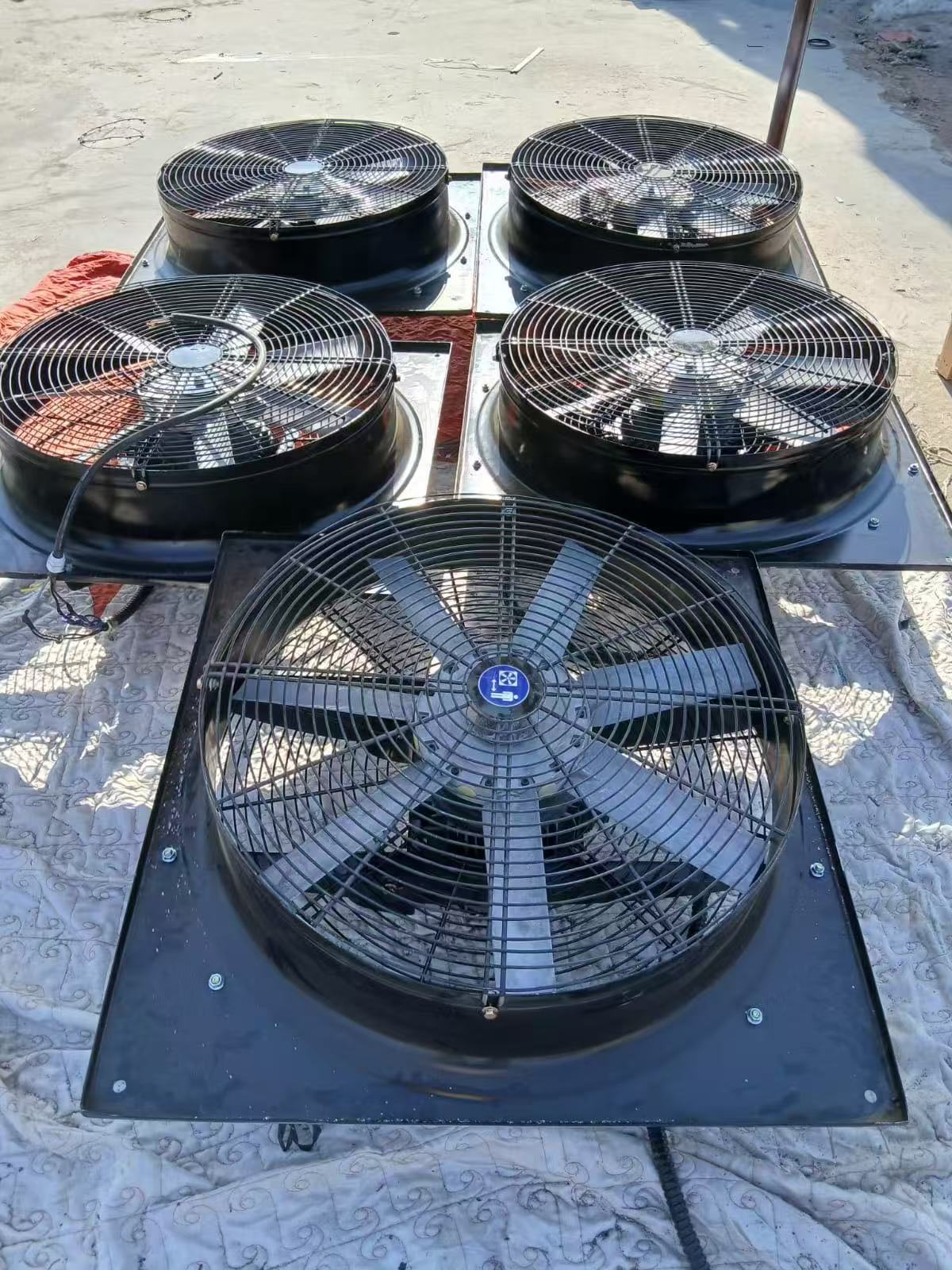
This picture displays the final 7-blade fan design. The fans sit on flat square steel plates. Finally, buyers can check the exact mounting holes here before they install the units.
Specifying Bidirectional Replacements
Specifying a reversible 900mm axial fan is hard work. You must map the exact operating conditions first.
- First, measure your exact mounting space carefully. Long tube fans take up deep spaces inside ducts. By contrast, flat panel fans fit right against walls.
- Next, define the required airflow for both directions clearly. Standard curved blades only work well one way. Instead, symmetrical blades push air both ways equally.
- Even so, you must consider the power supply limits. Always check the available voltage and frequency. A 50Hz supply will run a motor slower than a 60Hz supply.
- Finally, send the exact motor details to your new supplier. Share the old fan performance curve too. This step stops bad motor sizing. It also stops motor failures during fast reversals.
Related: Commercial Fan & Blower.
Common Engineering Questions
Technical Documentation & Resources
Browse our axial fans range, the AC axial fans section, or EC axial fans.
Have a Similar Fan Requirement?
Longwell’s engineering team delivers custom spec sheets and samples within 90 days. Since 1990, we have supplied EC fans and blowers to OEMs across HVAC, cold chain, data center, and industrial applications worldwide.
Browse Related Products:
🏆 ISO 9001 / ISO 14001 / ISO 45001 | CE (TÜV) | UL/ETL | ATEX Zone 21/22 | AMCA 210-16 / ISO 5801 tested
Choose the right axial fan
Longwell manufactures 1,086 axial fans in-house. Send airflow, static pressure and voltage — an engineer replies with a matching model, performance curve and price within one working day.