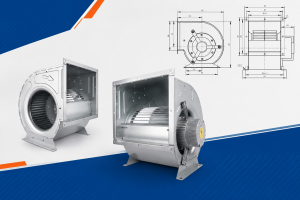
What the OEM needed replaced
A North American HVAC OEM sent us an EC plug fan datasheet and a simple question: can you match this?
The sheet was for a Rosenberg GKHM 355-series fan, and it set both the performance and the size baseline. Their new rooftop unit line had to push air through fine filters and deep coil banks. System impedance was high, so there was no room to negotiate on pressure.
The constraints that could not move
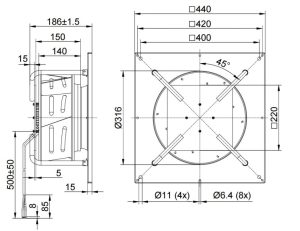
- The fan had to bolt to the existing 500x500mm plate on a 450mm square pattern.
- Electrically it needed 380-480 VAC three-phase, plus the 0-10VDC speed signal their controls already used.
- Additionally the P-Q curve had to hold up in the high-static region, not just at free delivery.
- Finally, ETL or UL certification against UL 507 was mandatory for the US market.
One requirement went unstated, yet it drove the whole exercise. They wanted lower unit cost and shorter lead times than a European-sourced part gave them.
Designing the EC plug fan replacement
We began by reading the competitor unit closely, rather than simply copying it.
What the baseline fan told us
Here the GKHM 355 is a capable fan. However, it draws 4.44 kW and turns at 3650 RPM. Both figures looked like room to improve, rather than targets to hit.
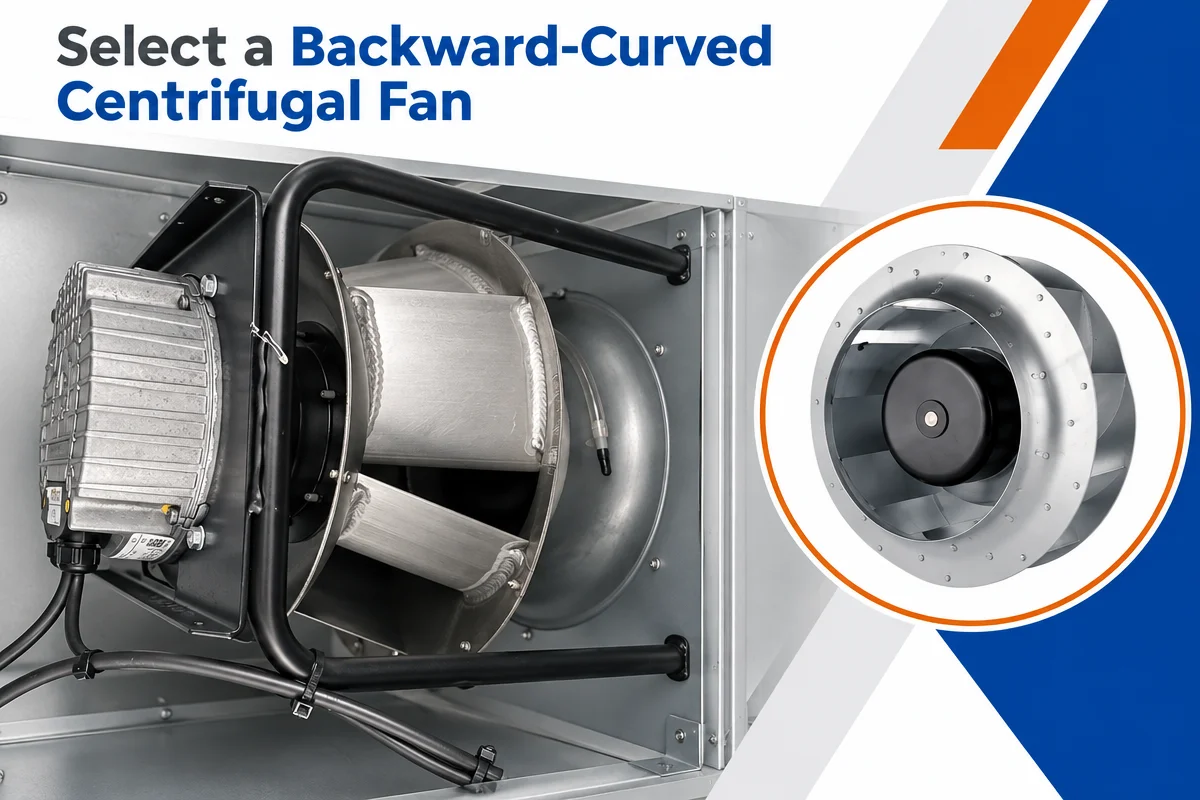
So the job went to our LWBE3G platform, the backward-curved EC plug fan family built for high-pressure HVAC duty.
Why EC, not AC plus a drive
We ruled out an AC motor early. The OEM needed fine speed control to meet ASHRAE 90.1. Meanwhile an AC motor with a separate VFD would have added footprint, parts cost and wiring to every unit.
Our SmartEC integrated drive already speaks 0-10V, PWM and RS485 Modbus. Consequently it met the control requirement with no adapter at all.
Trading speed for power
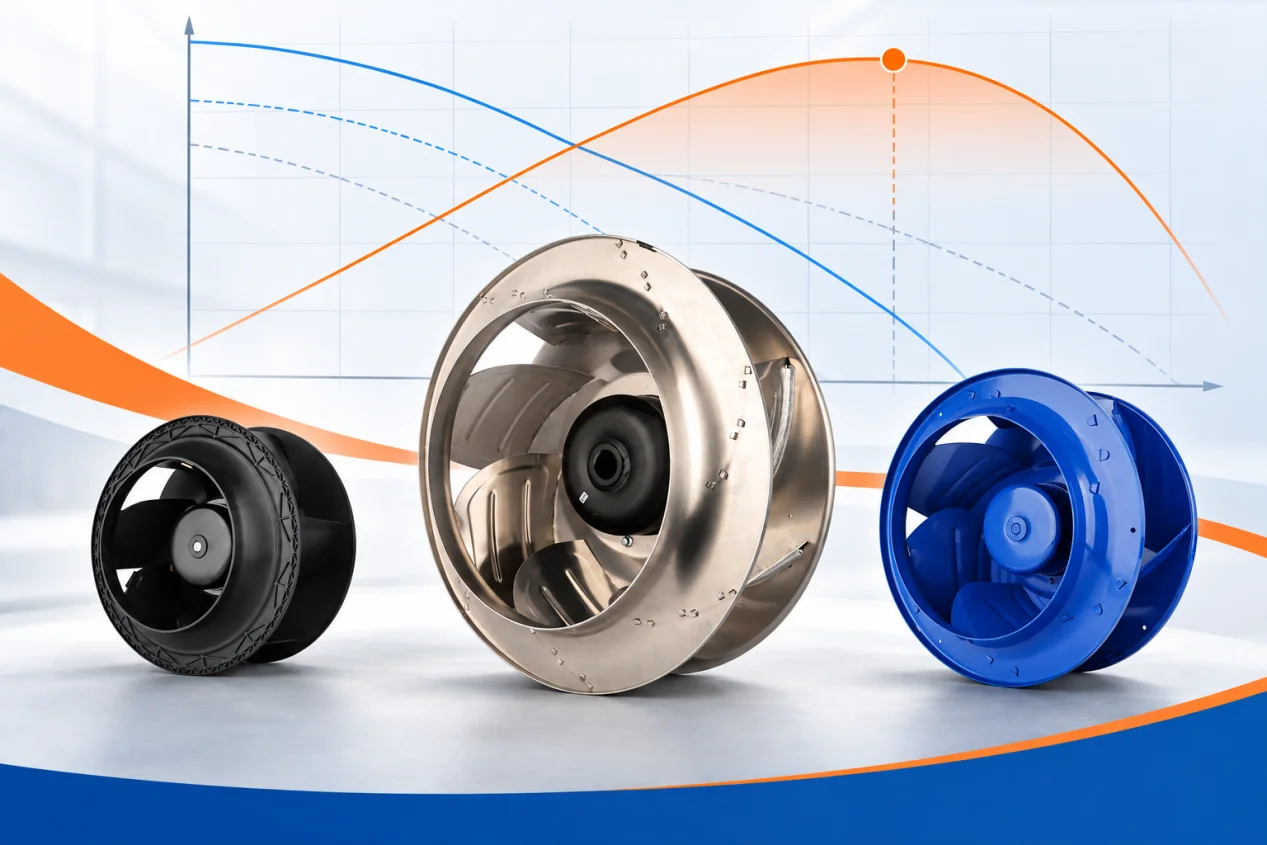
The chosen EC plug fan is the LWBE3G400-188PT-19. It uses a 400mm impeller with a biomimetic blade profile, which builds static pressure with less turbulence.
Here sits the real decision. We could have matched the competitor RPM and finished quickly. Instead the design reaches the same duty at 2900 RPM, roughly 750 RPM slower.
That lower speed cuts power draw and mechanical stress together. As a result the final unit pulls 3050 W against 4440 W, a 32% cut, and still gives 1670 Pa.
A wider temperature envelope
We also used our ThermoFlex build, which takes the range to -30C to +50C rather than -25C to +40C. Rooftop kit sits outdoors across a continent of climates. So that margin is not decoration.
Technical Specifications
Two numbers carried this comparison. Read the pressure row against the speed row: full pressure, lower RPM.
| Parameter | Value |
|---|---|
| Model Number | LWBE3G400-188PT-19 |
| Nominal Voltage [VAC] | 380 |
| Voltage Range [VAC] | 380-480 |
| Frequency [Hz] | 50/60 |
| Speed [RPM] | 2900 ± 100 |
| Current [A] | 5.7 |
| Power Input [W] | 3050 |
| Max Airflow [m³/h] | 11435 |
| Max Airflow [CFM] | 6726 |
| Max Static Pressure [Pa] | 1670 |
| Noise Level [dB(A)] | 90 |
| Max Ambient Temperature [°C] | 50 |
| Min Ambient Temperature [°C] | -30 |
| Insulation Class | Class F |
| Protection Type | IP54 |
| Work System | S1 |
| Life Expectancy (L10 @ 40°C) | 40,000 Hours |
| Impeller Material | Aluminum Alloy |
| Certifications | CE, ETL (UL 507, CSA C22.2#113) |
| Control Interface | 0-10VDC / PWM / RS485 |
Technical Documentation
Meanwhile the following documents were produced during the project to formalize the engineering solution for the customer.
Official Datasheet: This is the final approved technical datasheet for the LWBE3G400-188PT-19, containing performance curves, electrical data, and mechanical drawings for system integration.
LWBE3G400-188PT-19 Official Datasheet (PDF)
Editable Specification File: This document is the editable source file for the technical datasheet, used by engineers for incorporating specifications into their own project documentation.
LWBE3G400-188PT-19 Specification File (DOCX)
Project System Record: This image shows a summary of the fan’s key performance parameters as logged in Longwell’s project management system at the start of the specification development.
Competitor Baseline: This is the datasheet for the competitor’s product that was provided by the customer as the technical baseline for this drop-in replacement project.
Competitor Fan Datasheet (PDF)
Why the OEM qualified us
Qualifying a new EC plug fan supplier is a commercial decision as much as a technical one.
- Bill of materials cost. This was the driver. The EC plug fan came in at a materially lower unit price than the incumbent European fan, which improved margin on the new rooftop line without giving anything up on performance.
- Speed of qualification. Our 90-day NPI process let them customize, test and approve inside one quarter. Meanwhile European suppliers had quoted 12 to 18 months for the same step.
- Certification already in place. The model holds ETL certification to UL 507, so the fan dropped straight into their UL-listed assembly with no test program in between.
- Data they could check. Every performance curve we publish comes from chambers tested to AMCA 210/211 and ISO 5801 methods. Consequently their engineers could verify our claims rather than take them on trust.
See the full EC centrifugal fan range, or read about EC plug fans generally. Efficiency requirements come from ASHRAE 90.1.
Questions about this replacement
How much cheaper is this than the European fan it replaced?
Final pricing depends on volume and specification, so we quote per project. In practice customers see a materially lower acquisition cost against premium European brands at comparable quantities. That gap comes from vertically integrated manufacturing rather than from any compromise in the fan itself.
Is it a true drop-in replacement?
Mechanically, yes. The 500x500mm mounting plate, the 450x450mm bolt pattern and the impeller position are all built for direct interchange. Furthermore the operating range is wider than the fan it replaces, so the same footprint tolerates more extreme sites.
What are the lead times?
A sample of this EC plug fan ships from Ningbo in 1 to 2 weeks. A first production order of 1,000 units runs 30 to 45 days from purchase order and technical sign-off. By comparison, European suppliers commonly quote 12 to 16 weeks.
Why does a slower fan use less power for the same pressure?
Because fan power rises with the cube of speed, whereas pressure rises only with its square. So a better-shaped impeller that hits the same duty at lower RPM saves power out of all proportion. That relationship is the whole reason we redesigned rather than copied.
Technical Documentation & Resources
Got a duty point you need matched?
Tell us the airflow, the pressure and the space you have. Then we mark your duty point on a tested curve and send the drawing back. Meanwhile samples and custom spec sheets take up to 90 days. Since 1990 we have supplied OEMs across HVAC, refrigeration and industry.
Browse Related Products:
🏆 ISO 9001 / ISO 14001 / ISO 45001 | CE (TÜV) | UL/ETL | ATEX Zone 21/22 | AMCA 210/211 / ISO 5801 tested
Choose the right ec plug fan for ahu replacement
Longwell manufactures 83 ec plug fan for ahu replacements in-house. Send airflow, static pressure and voltage — an engineer replies with a matching model, performance curve and price within one working day.