What the OEM was specifying against
An OEM choosing parts for a new commercial cooling system asked for the full spec pack on one EC axial fan. That is a design-in support request, not a development one.
That kind of request means design-in support. The customer has already narrowed the field, and now needs papers solid enough to build a machine around. The airflow figure of 14,935 m3/h points at something large. Namely an air-cooled condenser, a data center dry cooler, or a CRAH unit.
The chosen model carries the constraints with it.
- Firstly, a three-phase supply anywhere between 380 and 480 VAC.
- An 805mm square housing with 215.7mm depth, since the envelope is fixed.
- Up to 237 Pa of pressure, because dense coils and filters resist heavily.
- No more than 69 dB(A), measured at the free-air duty point.
- Guaranteed performance from -20C to +60C, since the equipment ships worldwide.
- Lastly, variable speed through 0-10VDC or PWM, plus CE marking and ISO 5801 data.
None of that is unusual on its own. However, meeting all six in one 630mm frame narrows the field to a handful of fans.
Confirming the EC axial fan choice
Nothing needed inventing here. Instead our job was to check the selection and issue accurate papers fast enough to keep the customer design cycle moving.
Why not AC with a drive
We considered an AC induction motor and dismissed it. Variable speed would need a separate drive, which adds cost, installation work and a failure point.
Worse, an AC motor throttled by a drive loses efficiency at part load. A dry cooler spends most of the year exactly there. An EC axial fan, by contrast, holds efficiency across its range and carries the drive inside the motor. Consequently cost and footprint both fall.
Why the blade profile matters as much as diameter
Certainly a 630mm impeller moves a lot of air efficiently. That is the easy part of the decision.
Here the harder part is the blade shape, developed under our AcousticFlow approach. We tuned it to reach 14,935 m3/h at 1250 RPM while staying inside 69 dB(A). Any blade will make the airflow if you spin it fast enough. Making it at a speed people can live beside is the real work.
What design-in support actually covers
Holding performance up to +60C ambient comes from our ThermoFlex approach, which covers heat stability in the motor windings and in the drive electronics alike.
That second point is often overlooked. In an EC fan the electronics sit inside the motor, so they see the same heat. Consequently they are usually what fails first, unless somebody designed for it.
Finally we issued the approved specification, which set all of this down and let the customer proceed with confidence.
Technical Specifications
Read the noise figure beside the airflow. Moving nearly 15,000 m3/h at 69 dB(A) is the balance this EC axial fan was designed around.
| Model Number | LWAE3G630TS-5MKW-05-00 |
| Nominal Voltage | 380 VAC (3~) |
| Voltage Range | 380-480 VAC |
| Frequency | 50/60 Hz |
| Nominal Speed | 1250 RPM |
| Power Input | 780 W |
| Current | 1.3 A |
| Max. Air Flow | 14,935 m³/h / 8785 CFM |
| Max. Static Pressure | 237 Pa |
| Noise Level | 69 dB(A) |
| Housing Dimensions (W x H) | 805 x 805 mm |
| Overall Depth | 215.7 mm |
| Impeller Diameter | Ø630 mm |
| Max. Ambient Temperature | +60 °C |
| Min. Ambient Temperature | -20 °C |
| Protection Type | IP55 |
| Insulation Class | Class F |
| Work System | S1 (Continuous Duty) |
| Certifications | CE, RoHS, Reach |
Technical Documentation
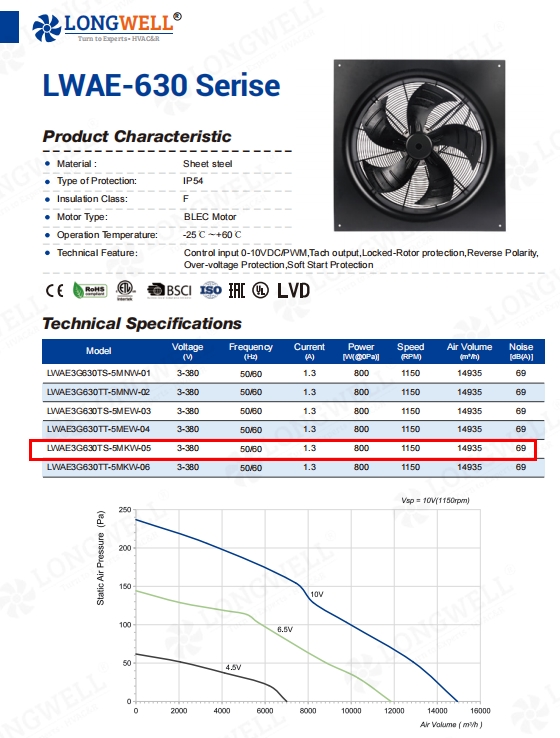
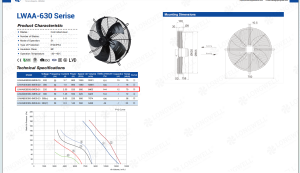
The product summary sheet provides a quick-reference overview of the fan’s key features and performance for procurement managers and initial engineering assessment.
LWAE3G630TS-5MKW-05-00.pdf
Meanwhile the complete technical specification document contains all nominal data, mechanical drawings, wiring diagrams, and performance curves required by design engineers for system integration.
What good design-in support looks like
During a design-in, four things counted.
- Design-in support in days. The request moved from enquiry to a reviewed and approved technical pack quickly. Consequently the OEM design, validation and procurement work all sped up together.
- Curves, independently verifiable. The specification included detailed P-Q performance curves from testing compliant with AMCA 210/211 and ISO 5801. Consequently the engineers could design against real data rather than budget for a redesign.
- Cost, at equal engineering. We have made these in Ningbo since 1990, and the motor, the impeller and the assembly all happen on our own lines. In large-scale cooling equipment, where the same fan is bought by the hundred, that structure is what shows up in the price.
- Certification already held, and extensible. The fan is CE marked with RoHS and REACH documented. For future modifications, our China-local TUV NORD partnership shortens new certification timelines considerably.
Browse our EC axial fan range, or the data center cooling fan section. Test methods are published by AMCA International.
Questions during design-in
What does design-in support include?
The specification sheet, the P-Q curve measured to AMCA 210/211 or ISO 5801, a 2D drawing, a 3D STEP model and the certification evidence. Ask for all five at once. Collecting them one at a time is what turns a two-day design-in into a two-week one.
Can it go into a coastal outdoor condenser?
Here the standard fan holds IP55, which suits general outdoor use against dust and low-pressure water jets from any direction. In genuinely corrosive coastal air with salt spray, we would recommend a custom configuration instead: enhanced anti-corrosion coating and a higher-rated motor assembly, available through our 90-day NPI process.
What are the lead time and MOQ?
Standard production models like this run 15 to 30 days after order confirmation, with an MOQ of 100 units at 630mm. We do accommodate smaller trial orders and prototype requests, with lead times confirmed project by project.
How does it integrate with a BMS?
The SmartEC drive accepts 0-10V analogue and PWM digital signals, which covers most PLC and thermostat control. For deeper integration we offer native Modbus RTU or BACnet MS-TP on the LWAE platform, so a central BMS can set speed and also read RPM, power, running hours and diagnostic alerts.
Why does part-load efficiency matter more than peak efficiency?
Because a dry cooler almost never runs at full load. Ambient temperature falls, and the heat to reject falls with it. Fan power drops with the cube of speed, so hours at reduced speed dominate the yearly bill. Consequently a fan efficient only at full speed saves very little in practice.
Technical Documentation & Resources
Sizing something comparable?
Share the airflow, pressure, voltage and control interface, and we come back with a tested curve and a drawing. Meanwhile custom work runs to 90 days for spec sheets and samples. Since 1990 Longwell has supplied fans to HVAC and industrial OEMs.
Browse Related Products:
🏆 ISO 9001 / ISO 14001 / ISO 45001 | CE (TÜV) | UL/ETL | ATEX Zone 21/22 | AMCA 210/211 / ISO 5801 tested