What the chiller OEM needed
A European OEM was designing a commercial air-cooled chiller for outdoor sites. Consequently they needed a cold weather condenser fan, 630mm, rated to -30C.
They had already picked a candidate model, which is normal for customers who know our range. Any condenser fan pulls ambient air across a coil to reject heat, so airflow rather than pressure governs. A cold weather condenser fan has to keep doing that after a night at -30C.
The constraints
- First, power came from a standard European 220V, 50Hz single-phase supply.
- Next, blade diameter had to be around 630mm, with mounting depth under 160mm.
- The range ran -30C to +60C, since a cold weather condenser fan sits outdoors year round.
- Meanwhile noise could not exceed 70 dB(A) at the duty point, under regional sound rules.
- Finally, CE marking was mandatory, with RoHS and REACH compliance on materials.
They also wanted P-Q curves validated to ISO 5801, since they meant to model the system rather than trust a catalog line.
Specifying a cold weather condenser fan
The customer had already chosen an AC model. In effect that choice told us what they were optimizing for.
Why we did not push EC
An EC version would be more efficient, with 0-10V or Modbus speed control built in. Certainly that suits systems chasing tight ErP targets.
However, their brief pointed at simple on/off control, or an external contactor or drive they already had. In other words the design prioritized upfront cost over lifetime running cost, which is a legitimate call in a competitive market.
So we confirmed the AC condenser fan rather than talking them out of it.
Matching motor to impeller
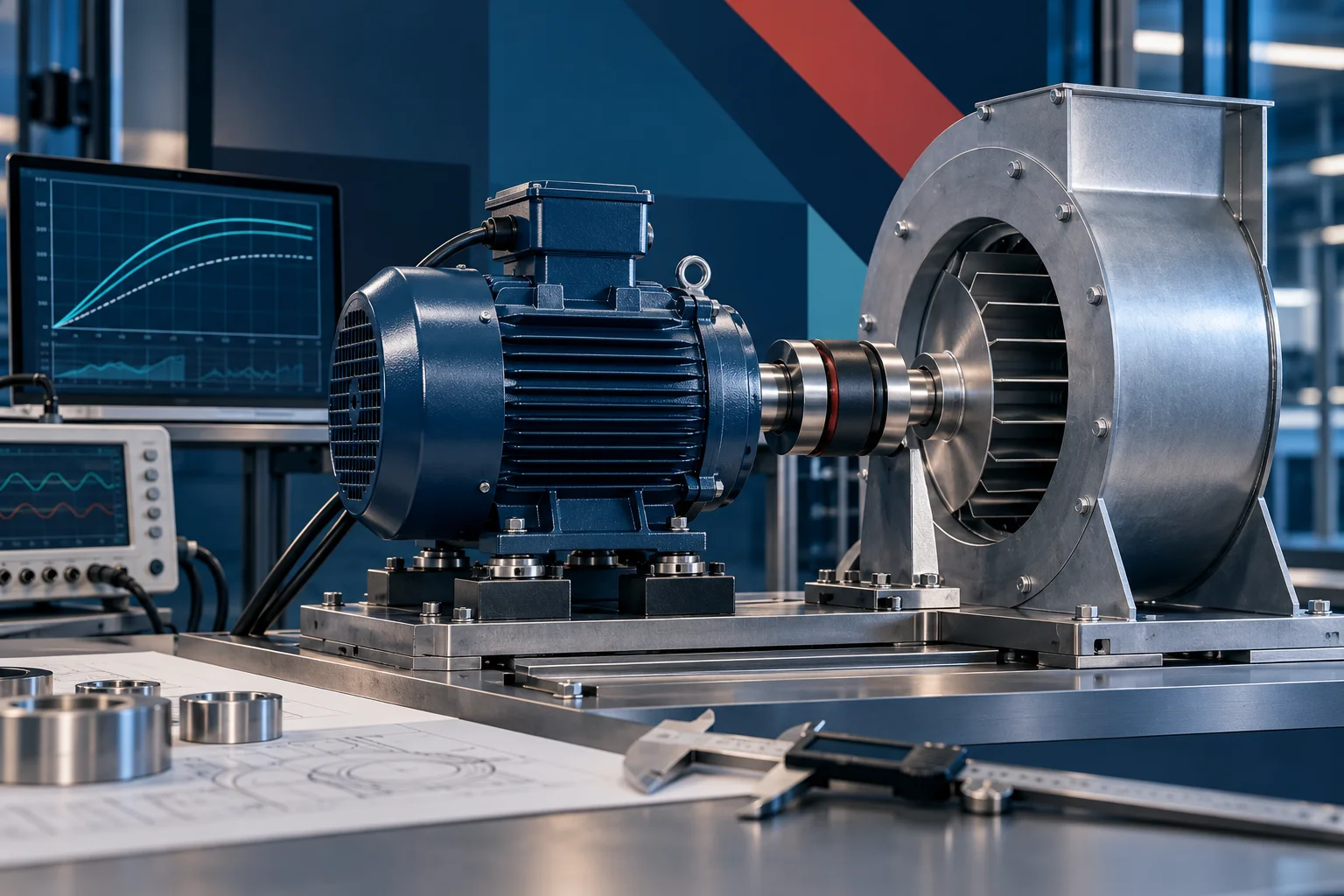
At the core sits a six-pole AC external rotor motor, turning at a nominal 900 RPM on 50Hz. That speed suits the five-blade 630mm steel impeller. Consequently the fan runs near its best efficiency instead of fighting itself.
What a cold weather condenser fan really needs
Class F insulation gives the buffer needed for continuous running at +60C. Admittedly that part is straightforward.
By contrast, the cold end is more interesting. At -30C ordinary bearing grease stiffens, so the motor fights it on every start. In cold climates that is a common cause of early failure in a condenser fan.
So we specified a low pour point grease to keep starting torque sensible. We also chose motor materials that resist cold embrittlement. Both belong to our ThermoFlex approach for wide-temperature builds.
Finally, IP54 protection covers the dust and water spray any outdoor site sees.
Technical Specifications
Look at the temperature row below. In truth, that range is what makes this a cold weather condenser fan rather than an ordinary one.
| Parameter | Value |
|---|---|
| Model Number | LWAA6E630S-5MEB-21 |
| Nominal Voltage | 220 VAC |
| Voltage Range | 198~242 VAC |
| Frequency | 50 Hz |
| Speed | 900 RPM |
| Current | 2.55 A |
| Power Input | 520 W |
| Maximum Airflow | 8403 m³/h / 4943 CFM |
| Maximum Static Pressure | 144 Pa |
| Noise Level (LpA) | 70 dB(A) |
| Operating Temperature | -30°C to +60°C |
| Protection Class | IP54 |
| Insulation Class | Class F |
| Impeller Diameter | 630 mm |
| Overall Depth | 158 mm |
| Life Expectancy (L10) | 30,000 Hours at 40°C |
| Certifications | CE, RoHS, REACH |
Technical Documentation
Here the following documents provide the comprehensive data required by design engineers, system integrators, and maintenance teams for successful project integration.
The complete technical datasheet includes performance curves, dimensional drawings, and wiring diagrams essential for engineering integration and system validation.
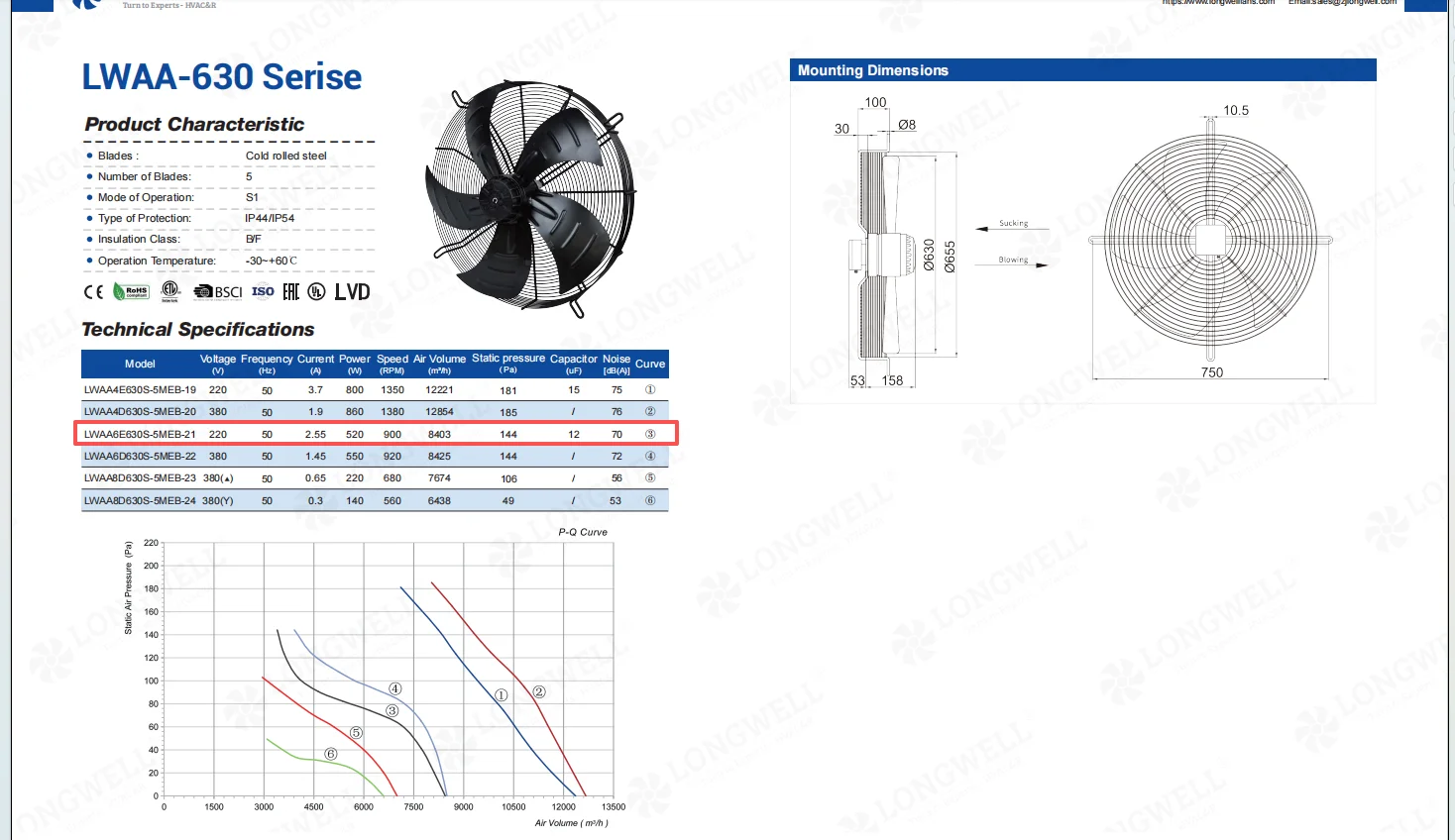
Meanwhile the product summary provides a quick-glance overview of the LWAA-630 series’ key specifications and available models for initial selection.
Why the OEM chose us
Specifications are only part of why an OEM commits to one AC condenser fan supplier.
- Cost against performance. Choosing an AC fan signalled a cost-sensitive project. We met the airflow and the reliability figures without reducing either, which is the part of a cost-driven specification that usually gets quietly relaxed.
- Certification is not the bottleneck. CE marking is a must in Europe. Our Ningbo plant and in-house testing sit alongside a China-local TUV NORD Notified Body, which shortens the CE route a lot.
- Lead times that fit a launch. Standard make-to-order fans take 15 to 25 days. By comparison, many competitors average 8 to 12 weeks. That is the difference between hitting a season and missing it.
- Data engineers can rely on. Airflow and sound tests follow AMCA 210/211 and ISO 5801 methods. Consequently the 8,403 m3/h figure is one they can model with, not just quote.
See our axial fan range, or the condenser fan section. Ingress protection is defined in IEC 60529.
Questions about this fan
What is the L10 life at maximum operating temperature?
The datasheet quotes 30,000 hours L10 at a 40C reference. Running continuously at +60C brings that down to roughly 15,000 to 20,000 hours, following the Arrhenius relationship for grease breakdown. Meanwhile the maintenance-free deep groove ball bearings are chosen for exactly this wide range.
Can this AC condenser fan run on a VFD?
Yes. As a single-phase AC induction motor it works with most correctly sized single-phase drives. However, where the point is precise or frequent speed modulation for energy savings, a SmartEC equivalent is the better answer. Integrated 0-10V, PWM and Modbus control removes the external drive entirely and holds efficiency much better at part load.
What else is this size of fan used for?
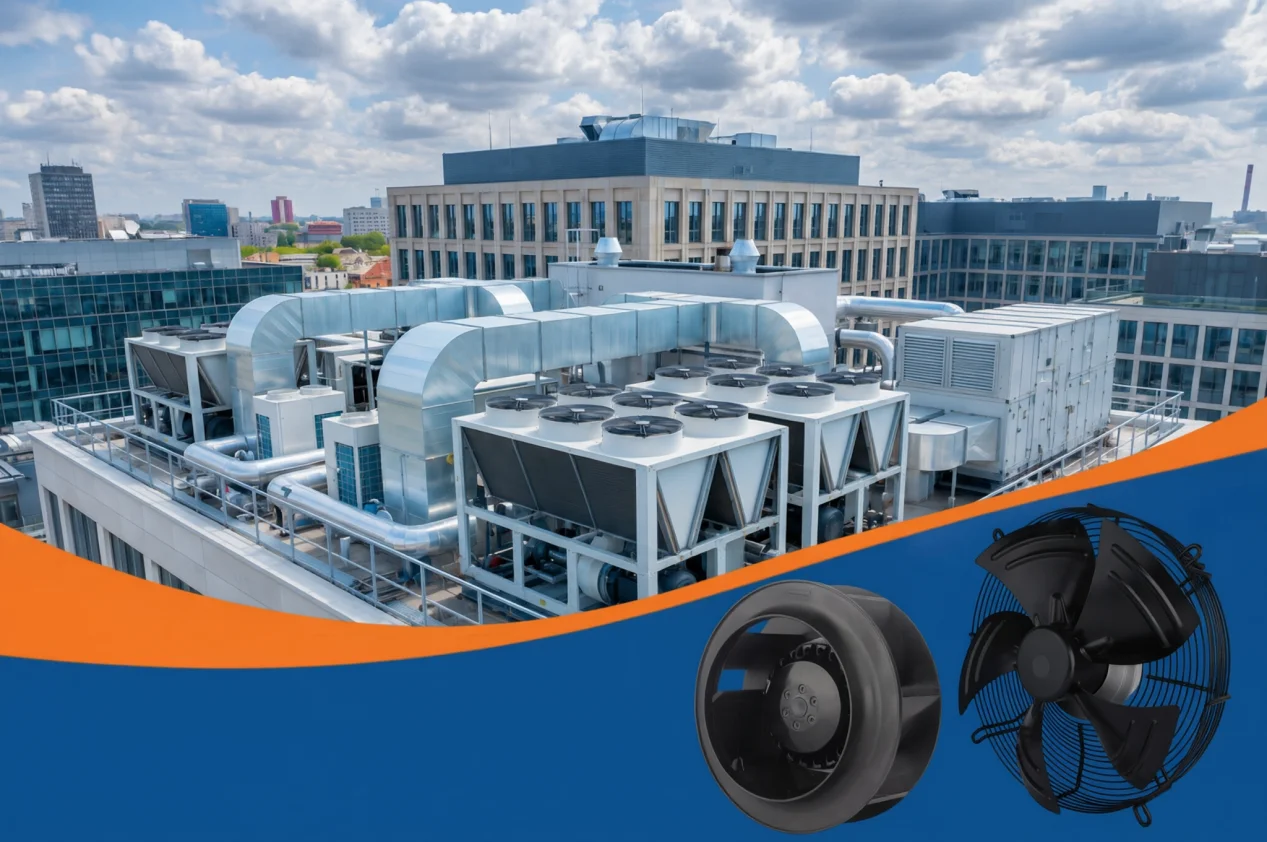
An AC condenser fan of this size, at 8,403 m3/h and 144 Pa, is built for high volume against low resistance. Typical duties include chiller condensers, large rooftop units, dry coolers and process cooling. Furthermore it suits general ventilation in agricultural buildings and warehouses.
Is an ATEX version available?
Not for this model. We do build explosion-proof fans though, including standard ATEX-certified models in our EC blower range for Zone 22 dust environments. An ATEX-rated axial fan for a specific gas or dust zone can be developed through our 90-day NPI process.
Technical Documentation & Resources
Have a fan requirement like this one?
Send the datasheet you are working against, or simply the duty point. Then our engineers tell you what fits and what does not. Meanwhile custom spec sheets and samples take up to 90 days. Since 1990 we have been building fans for OEMs worldwide.
Browse Related Products:
🏆 ISO 9001 / ISO 14001 / ISO 45001 | CE (TÜV) | UL/ETL | ATEX Zone 21/22 | AMCA 210/211 / ISO 5801 tested