CHINA STANDARDS WATCH / FAN SYSTEM EFFICIENCY
China’s 2026 Fan Efficiency Draft: From GB 19761-2020 to FMEG – An OEM Buyer Checklist
China’s 2026 fan-efficiency consultation draft proposes a broader 0.125-500 kW scope and a whole-system FMEG route. Here is the OEM evidence checklist.
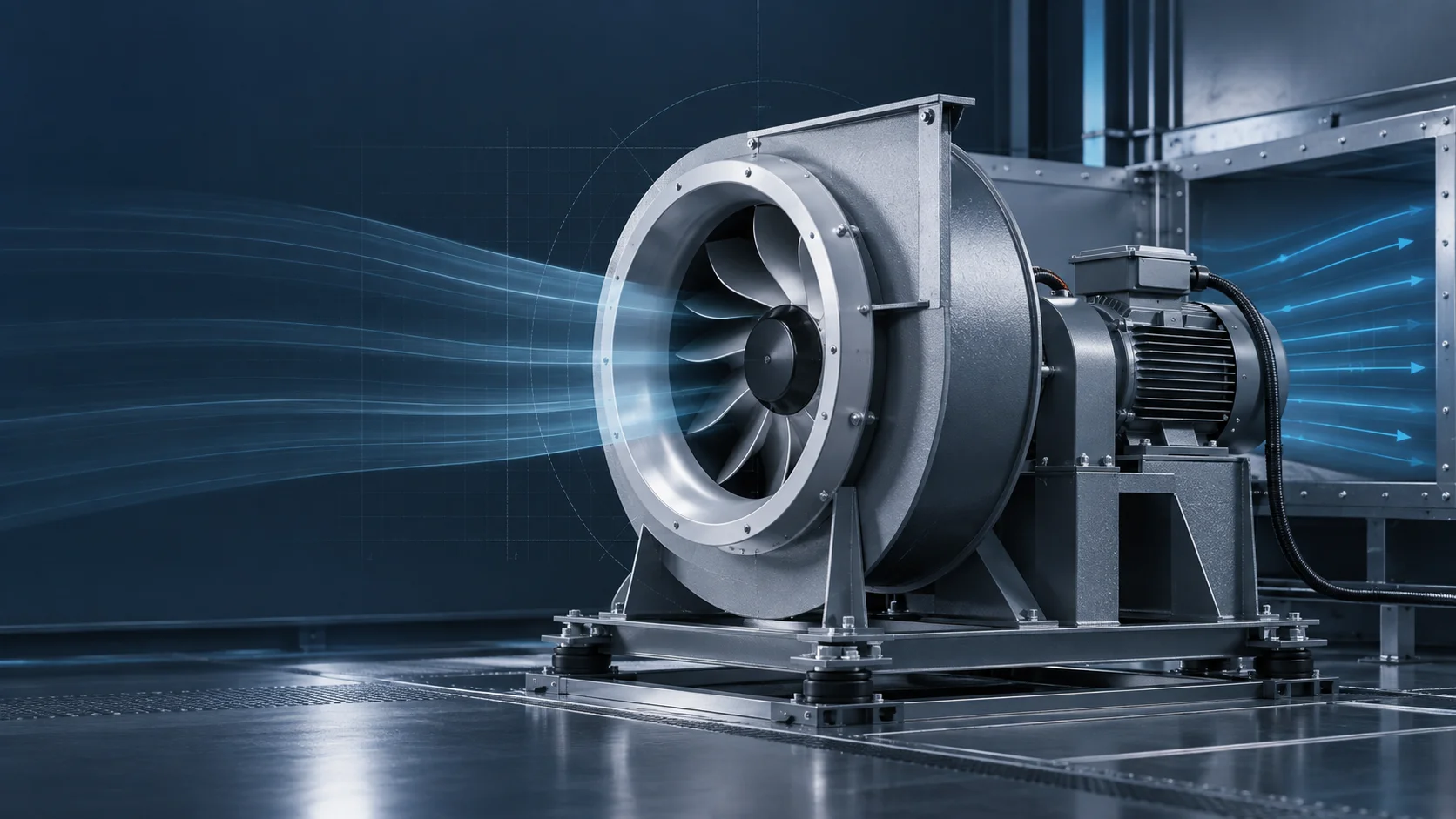
Industrial centrifugal fan and motor on a test bench with airflow and measurement overlays
|
Status boundary – 22 September 2026 This article discusses consultation drafts under plans 20262559-Q-469 and 20262560-Q-469. The comment period closed on 18 September 2026. The drafts are not final or effective replacement standards. GB 19761-2020 and GB 18613-2020 remain the current published standards; the plan pages propose implementation 12 months after a future publication date. |
On 20 July 2026, China’s National Standardization Administration opened consultation on two mandatory national-standard revisions: one for fan efficiency and one for motor efficiency. The fan project, 20262559-Q-469, is intended to replace GB 19761-2020. The motor project, 20262560-Q-469, is intended to replace GB 18613-2020. The public consultation closed on 18 September 2026.
The fan draft matters because it does more than refresh a table. Its explanatory note describes a move from a product-type and fan-body-efficiency route toward an FMEG whole-system route. In practical terms, the proposed boundary starts at electrical input and follows losses through the motor, drive or transmission, bearings and aerodynamics to the air output. The normative draft uses a fan energy-efficiency index, N; the explanatory note calls the route FMEG. Buyers should preserve both labels in their working files until the final text resolves terminology.
The proposed scope is broader
The consultation draft states a 0.125 kW to 500 kW motor-input-power range. It covers general-purpose centrifugal fans, including backward-curved, forward-curved, radial, unhoused and low-specific-speed designs; general-purpose axial and reversible axial fans; mixed-flow fans; smoke-exhaust fans; and non-metallic corrosion-resistant fans. It addresses both fans supplied without a drive and assemblies that include a drive, casing or variable-speed drive.
The draft excludes transport fans used in vehicles, trains and aircraft; explosion-proof fans; box fans, roof fans and air curtains; and jet fans for car parks and tunnels. These boundaries are essential. A similar-looking product can fall on the other side of the rule because of use, construction or supply configuration.
|
Decision point |
GB 19761-2020 route |
2026 consultation draft |
|
Product coverage |
Seven named fan categories; several types expressly outside scope |
Broader list including unhoused centrifugal and mixed-flow fans, with explicit exclusions |
|
Evaluation boundary |
Fan efficiency, with some unit-efficiency treatment |
Overall or overall static efficiency using electrical input power |
|
Classification |
Fan type plus design parameters, coefficients and corrections |
Fan type, A/B/C/D test installation, power range and efficiency index |
|
Drive losses |
Not consistently represented across all product forms |
Motor, controller or transmission losses are intended to enter the system boundary |
|
International alignment |
No direct ISO 12759 route |
Explanatory note maps the method to ISO 12759 / GB/T 43080 |
|
Effective date |
Current published standard |
Draft only; plan proposes 12 months after future publication |
Why installation type changes the evidence
The draft separates total-pressure and static-pressure evaluation by the standardized duct arrangement used for the test. A and C installations use overall static efficiency; B and D installations use overall efficiency based on total pressure. The draft explicitly warns against mixing the two boundaries.
|
Installation |
Connection concept |
Draft efficiency basis |
What the buyer must retain |
|
A |
Free inlet, free outlet |
Overall static efficiency |
Test setup, static pressure, airflow, input power, speed |
|
B |
Free inlet, ducted outlet |
Overall efficiency |
Test setup, total pressure, airflow, input power, speed |
|
C |
Ducted inlet, free outlet |
Overall static efficiency |
Test setup, static pressure, airflow, input power, speed |
|
D |
Ducted inlet, ducted outlet |
Overall efficiency |
Test setup, total pressure, airflow, input power, speed |
Testing is proposed at the best-efficiency point and highest rated design speed, with performance converted to rated speed and standard-air conditions. The cited methods include GB/T 1236-2017 for standardized laboratory testing and GB/T 10178-2006 for field testing. The draft says test uncertainty is not a correction or compliance allowance.
Do not substitute a motor grade for fan-system evidence
A motor certificate and a fan-system result answer different questions. The separate motor-efficiency draft expands coverage to low-voltage variable-speed three-phase induction motors and adds test points for some brushless DC air-conditioner fan motors. That evidence may be necessary, but it does not by itself establish the proposed fan-system index because the fan boundary also includes control, transmission and aerodynamic losses.
|
Procurement rule Request the motor evidence and the complete fan-system evidence as two linked files. Never infer the proposed fan grade from an IE class, a peak motor efficiency value or an EC label alone. |
OEM buyer checklist
|
File to request |
Minimum content |
Why it matters under the draft |
|
1. Scope decision |
Exact fan type, use, power boundary, supplied configuration and exclusion review |
Prevents a wrong standard or exemption from being applied |
|
2. Model identity |
Complete model and suffix, BOM revision, controller and motor revision |
A drive or controller change can alter the electrical-input boundary |
|
3. Declared duty |
Airflow and static or total pressure at one operating point |
Efficiency must be tied to the same duty and pressure definition |
|
4. Installation mapping |
A, B, C or D arrangement plus inlet/outlet description |
Determines whether overall static or overall total efficiency is used |
|
5. Test record |
Method edition, setup, instruments, raw readings, uncertainty and laboratory identity |
Supports reproducibility and prevents brochure-only claims |
|
6. Electrical input |
Voltage, frequency, phases, controller/VSD, input power and speed |
Defines the proposed wire-to-air denominator |
|
7. Calculation sheet |
Efficiency calculation, energy-efficiency index N/FMEG mapping and rounding |
Makes the claimed grade auditable |
|
8. Motor file |
Applicable motor scope, method, efficiency result and certificate or report |
Keeps motor-only evidence separate but traceable |
|
9. Change control |
Triggers for motor, impeller, firmware, controller, material and rating changes |
Stops a tested configuration from drifting after approval |
|
10. Status watch |
Draft version, review date, owner and final-standard recheck gate |
Prevents draft thresholds from being released as final law |
What to do now – without overreacting
- Classify the exact product family against the draft scope and exclusions. Do not classify from a marketing name alone.
- Map existing test reports to A/B/C/D installations, pressure type, method edition and complete drive boundary.
- Find product families for which the fan report contains shaft power but not electrical input power. Mark those as an evidence gap.
- Link the motor report, controller revision and fan curve to one controlled model-and-suffix identity.
- Run a gap test on a representative configuration when the existing report cannot reproduce the proposed calculation.
- Keep the current standard as the release basis until the replacement standard is published and becomes effective; add a mandatory recheck gate for the final text.
How LONGWELL evidence should be used
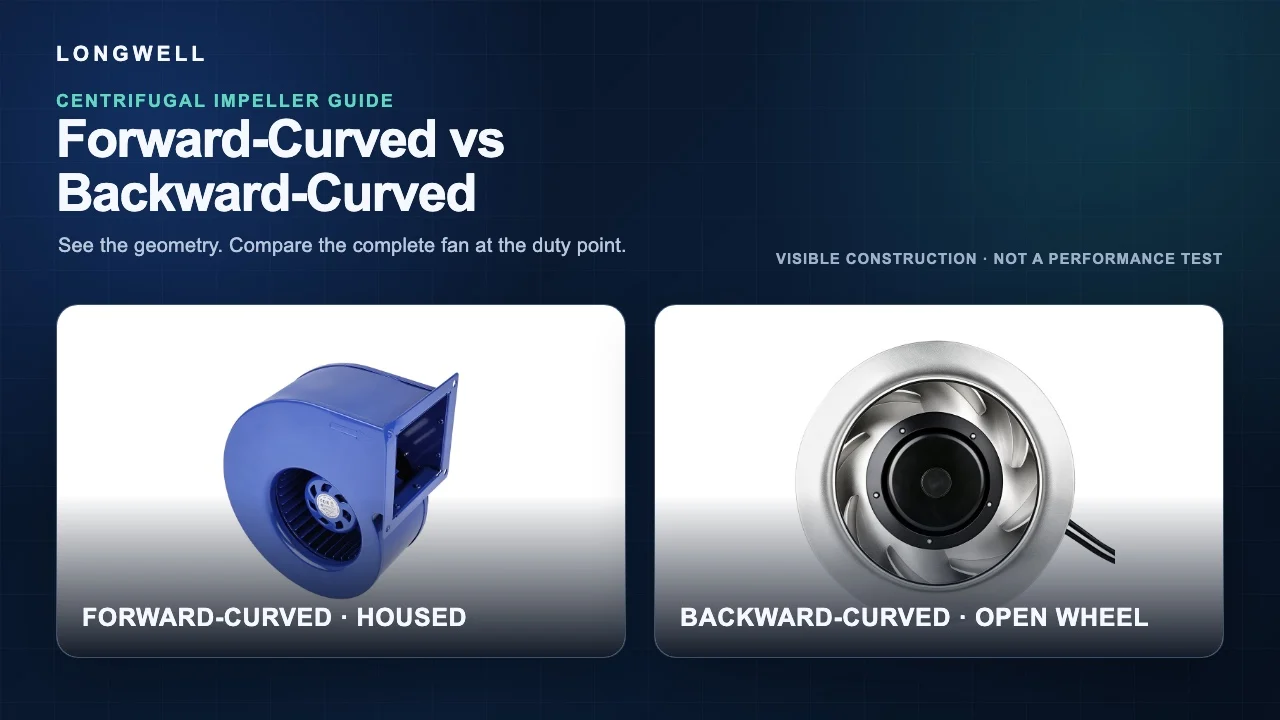
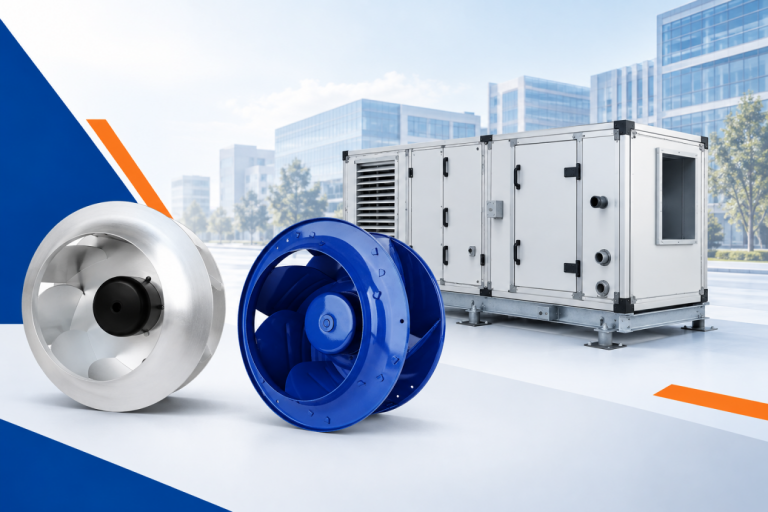
LONGWELL’s current public range includes AC, DC and EC centrifugal families, including backward-curved, forward-curved and RLM unhoused configurations. Its AHU engineering reference page already asks buyers to request the full model and suffix, approved drawing, duty-point curve, control definition and supporting test records. That is the right document architecture for a draft transition.
The boundary is equally important: a series page, catalog maximum or product-family label is not proof that a specific model satisfies a draft or final standard. A model-level conclusion requires the exact configuration, test arrangement, duty point, input-power boundary, method edition and controlled report. No specific LONGWELL SKU is claimed compliant in this article.
Questions OEM teams are asking
Is the 2026 draft already mandatory?
No. It is a consultation draft. The official plan proposes implementation 12 months after a future publication date. Continue to verify the current standard and the final text before release.
Does an IE4 or IE5 motor prove the fan meets the proposed fan grade?
No. Motor efficiency is only one part of the proposed whole-system boundary. Controller, transmission and aerodynamic losses still matter.
Can we reuse a test report produced under GB 19761-2020?
Possibly as supporting data, but only after mapping the setup, pressure type, input-power boundary, method and configuration to the new route. Many legacy reports will have evidence gaps.
Are EC plug fans and unhoused centrifugal fans in scope?
The fan draft expressly includes unhoused centrifugal fans and can cover assemblies with a drive. Exact classification still depends on power, product construction, intended use and exclusions.
What if our fan is integrated into an AHU?
Treat the fan as a controlled component and document the supplied fan configuration. Also keep the AHU’s separate system-level requirements; one does not replace the other.
What should we send for a model review?
Send airflow, static or total pressure, installation type, supply and input power, speed range, ambient temperature, IP and certification targets, destination market and the standard version you need evaluated.
Request a model-level evidence review
For a controlled selection review, send LONGWELL the required airflow and pressure at the same duty point, A/B/C/D installation or inlet/outlet condition, voltage and frequency, controller or VSD, operating-speed range, ambient temperature, IP requirement, target certification, destination market and target standard edition. The engineering response should identify the proposed model, curve, drawing, control revision, test basis and any evidence gap – not just a peak airflow value.
Contact: sales@longwellfans.com
Sources
Official notice – Consultation on the two mandatory national-standard drafts (20 July 2026)
Official plan – Fan efficiency plan 20262559-Q-469
Official plan – Motor efficiency plan 20262560-Q-469
Current standard record – GB 19761-2020
Current standard record – GB 18613-2020
LONGWELL product evidence boundary – AHU and ventilation unit fan engineering reference