What the OEM asked for
An OEM came back to reorder a blower and quoted a superseded fan model we no longer list.
Anyone maintaining equipment knows that moment. The part sits in your drawings and your bill of materials. Meanwhile the supplier catalog has moved on.
They needed 2650 m3/h against roughly 300 Pa, CE certified, in the same physical envelope as before.
Tracing a superseded fan model
The first job was a cross-reference rather than a selection.
What had actually changed
A current production drawing now covers the superseded fan model. Performance and dimensions are unchanged.
Here the new number came from documentation. We updated the CE evidence to current European standards, and that triggered a drawing revision rather than a new fan.
So the customer had run into a paperwork change, not a product change. Their existing installation dimensions still apply.
Why this happens more than people expect
Makers revise part numbers for several reasons. Only some of them mean the part is different.
A certificate update, a sub-supplier change or a document restructure all produce a new number while the fan stays the same. Meanwhile a real design change produces one too. From outside they look identical.
So the only safe move is to ask which kind it was.
Why this blower suits an air handler
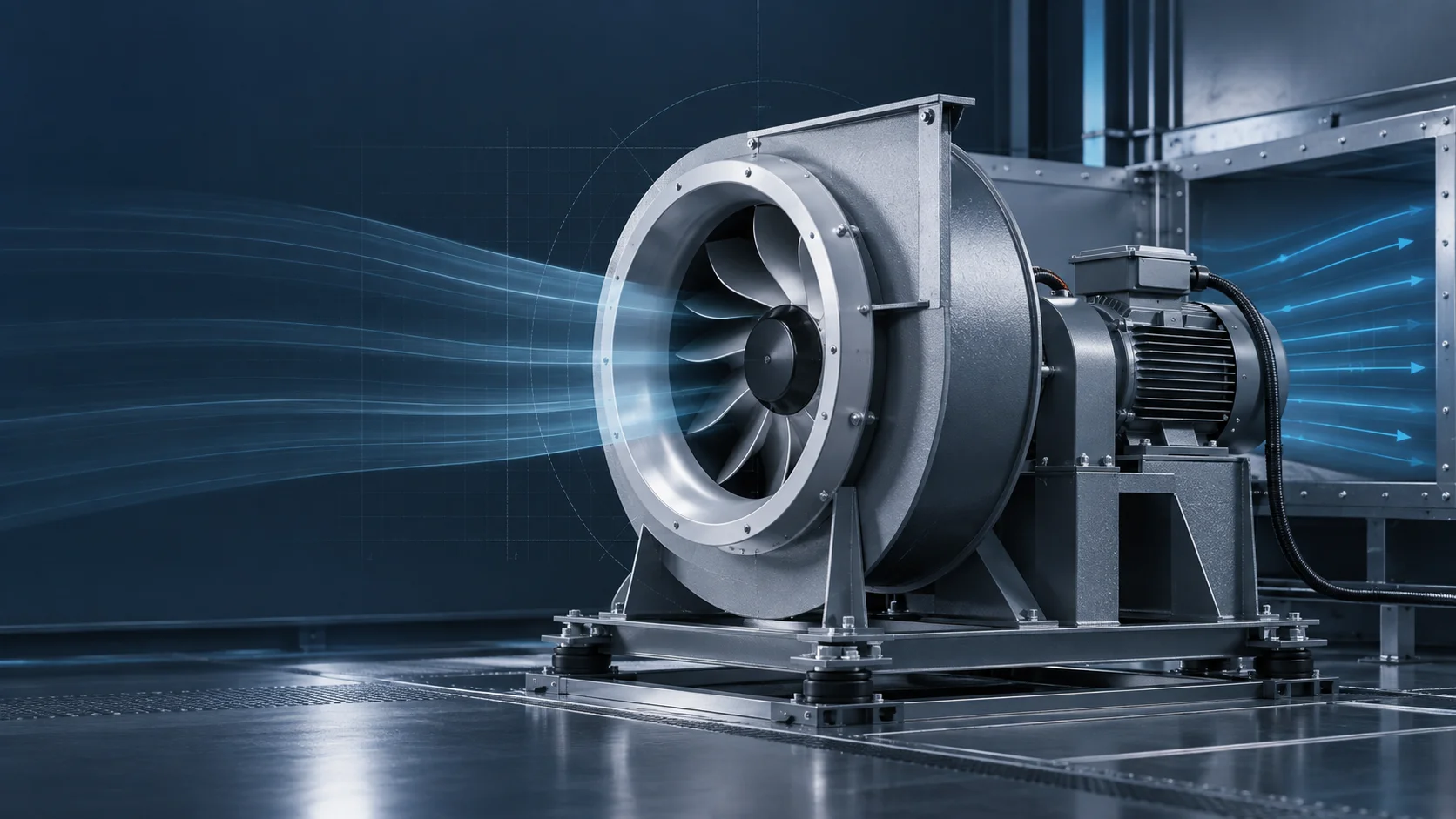
It is a double-inlet, forward-curved blower. Both halves of that matter.
Forward-curved wheels move high volume in a small housing at low to moderate pressure. That is exactly an air handler duty. Meanwhile the double inlet draws from both sides, so capacity rises for a given footprint.
In a space-constrained cabinet that footprint efficiency is usually what decides the selection.
The build
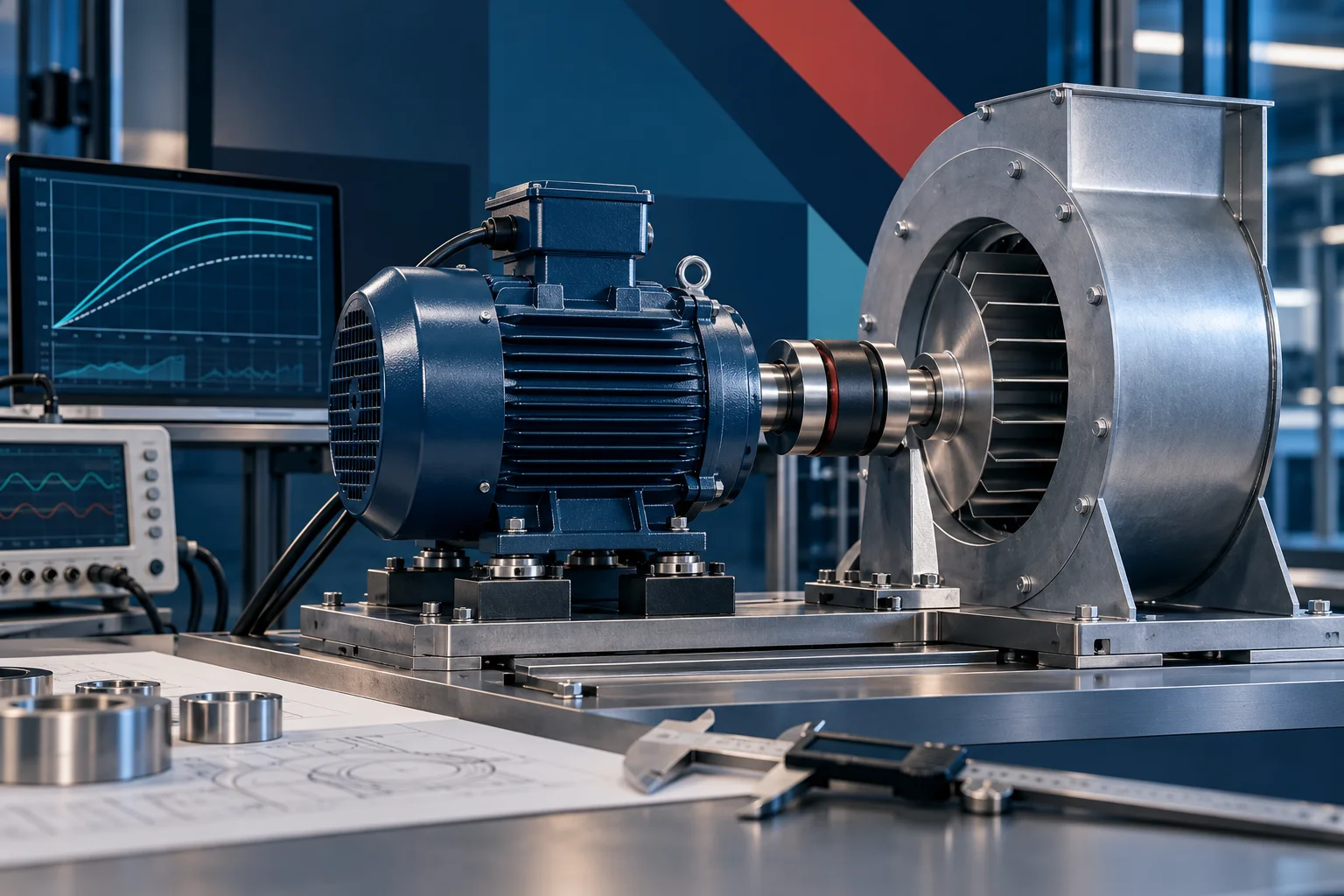
Housing and impeller are galvanized steel, for stiffness and rust resistance. A four-pole AC motor turns at 1250 RPM.
What it cost
Nothing, on this occasion. However, that is luck rather than a rule.
Had the revision moved a dimension, they would have found out during installation rather than ordering. So the lesson sits in the checking, not in this outcome.
Technical Specifications
The drawing number below is current. Meanwhile the figures are the ones the superseded fan model carried.
| Parameter | Value |
|---|---|
| Model / Drawing No. | DD9-9I-003 (DD9-9I 450W-4P) |
| Voltage | 220V AC |
| Frequency | 50 Hz |
| Max. Input Power | 450 W |
| Max. Current | 5.0 A |
| Max. Airflow | 2650 m³/h |
| Static Pressure @ Max Airflow | ~300 Pa (Estimated from curve) |
| Speed | 1250 RPM |
| Motor | 4-Pole AC Asynchronous |
| Protection Class | IP20 |
| Dimensions (W x H x D) | 380 x 390 x 358 mm |
| Weight | 16.8 kg |
| Certifications | CE (TÜV) |
Technical Documentation
Meanwhile the following documents were the final approved deliverables for project DD9-9I-003, providing all necessary data for system integration and procurement.
DD9-9I Series Technical Datasheet (PDF)
The full technical datasheet for the DD9-9I series contains performance curves (P-Q), noise level data, and electrical specifications required by HVAC system design engineers.

Here the mechanical drawing provides all critical dimensions, mounting hole patterns, and assembly tolerances for the DD9-9I-003, essential for OEM procurement managers and mechanical design teams to confirm a drop-in fit.
If your part number no longer exists
A superseded fan model is a routine sourcing problem. So these get you a reliable answer.
- Ask what changed, not just what replaces it. A supplier calling a part superseded should say whether performance, size or only paperwork moved. If they cannot, treat it as a new part and requalify.
- Send the old drawing, not only the number. Numbers get reused and reissued across years and systems. A drawing with dimensions on it is unambiguous, and it resolves the cross-reference in one step.
- Check mounting and inlet sizes yourself. Even when a supplier confirms a swap, comparing the two drawings takes minutes. It catches the case where interchangeable meant electrically, not mechanically.
- Ask for the current certificate with the fan. If the revision was driven by compliance, the new documentation is the thing you actually needed. Get it filed against your product rather than the superseded version.
See our centrifugal fan range, the forward curved fan section, or air handling units. Airflow testing follows AMCA 210.
Questions about this blower
How do I find out if my fan is still available?
Send the model number and, if you have it, the drawing. We cross-reference against current production. Then you learn whether the part continues under a new number, has an equivalent, or has genuinely ended. All three happen, and each needs a different response.
Does a new drawing number mean a different fan?
Not always. Certificate updates, document restructures and sub-supplier changes all generate new numbers without altering the fan. A real design change does too. So ask which it was, rather than reading the number.
Why does double inlet matter in an air handler?
Because it raises airflow capacity for the same housing footprint. Air enters from both sides of the impeller rather than one, so a given cabinet space moves more air. In an air handling unit where the cabinet is already sized, that is usually the deciding factor.
What should I do if the replacement is genuinely different?
Treat it as a new part. Compare mounting sizes, inlet position, electrical connection and the curve at your duty point, not at free delivery. Where anything moves, check your sheet metal and controls still suit before ordering quantity.
Technical Documentation & Resources
Working on something similar?
Send us the duty point, the envelope and the supply, and our engineers come back with a shortlist rather than a catalog. Meanwhile custom spec sheets and samples run to 90 days. Since 1990 we have built fans for HVAC, cold chain, data center and industrial OEMs.
Browse Related Products:
🏆 ISO 9001 / ISO 14001 / ISO 45001 | CE (TÜV) | UL/ETL | ATEX Zone 21/22 | AMCA 210/211 / ISO 5801 tested
Choose the right centrifugal fan
Longwell manufactures 1,130 centrifugal fans in-house. Send airflow, static pressure and voltage — an engineer replies with a matching model, performance curve and price within one working day.