What the integrator was solving
A system integrator designing climate control for a new logistics center needed an HVLS fan moving 7,500 m3 of air per minute.
The building has large open floors and high ceilings, which is exactly the shape that makes comfort difficult. Warm air collects at the roof, cooler air sits at floor level, and neither mixes on its own.
Two problems, not one
Cooling people in summer is the obvious requirement. Destratification in winter is the one that saves money.
When warm air pools at the ceiling, the heating system works to warm a layer nobody occupies. Mixing that layer down cuts heating energy considerably, which is why an HVLS fan earns its place year-round rather than seasonally.
- A 380V three-phase supply.
- Next, integration with the building management system for optimized operation.
- Meanwhile performance verifiable against AMCA 210/211, since the figure feeds their system model.
- Finally, coverage of a large open area from a single mounting point.
Why an HVLS fan and not an array
Here the choice here is between one very large slow fan and many small fast ones. So it is worth being explicit about why the large one wins.
The array of small fans
A grid of high-velocity fans reaches the same total airflow on paper.
However, high velocity is felt as draught rather than comfort, and people under them complain. They also make considerably more noise, use more energy per cubic meter moved, and need multiple power drops and mounting points across the roof structure.
Why slow and large is efficient
Fan power rises steeply with speed while airflow rises only in proportion to it. Consequently moving a given volume slowly through a large area costs far less than moving it quickly through a small one.
That is the whole principle. At 5.5 meters diameter and 75 RPM, this HVLS fan produces 7,500 m3/min while drawing 1.5 kW. A grid of small fans reaching the same figure would draw a multiple of that.
The air also behaves differently. A large slow column reaches the floor and spreads outward in a broad, gentle layer, covering roughly 460 m2 from one point.
Why EC rather than AC
An AC induction motor would turn the fan. However, the customer needed building management integration, and that needs proper speed control.
Meanwhile the EC motor adjusts steplessly from 0 to 100% over a 0-10V signal or RS485 Modbus. In winter the fan runs slowly to mix air without creating any noticeable draught; in summer it runs faster for cooling effect. One fan, two completely different duties.
The blade compromise
Six extruded aluminum blades balance air displacement against weight and drag. Certainly more blades would move more air per revolution, though they add weight to a 125 kg assembly hanging from a roof. Meanwhile fewer would need higher speed, which defeats the point.
What it cost
Structural attachment and installation. This is 125 kg suspended overhead, so the roof structure has to be verified and the mounting engineered rather than improvised.
Furthermore it is a single point of coverage. If the HVLS fan stops, 460 m2 loses air movement at once, whereas an array would degrade gradually.
Technical Specifications
Read the speed row against the airflow row below. That combination is the whole idea.
| Parameter | Value |
|---|---|
| Model Number | LW-ECCF-5.5-07 |
| Diameter | 5500 mm |
| Blade Number | 6 |
| Voltage | 380 V |
| Max Speed | 75 RPM |
| Air Volume | 7,500 m³/min (approx. 264,860 CFM) |
| Input Power | 1.5 kW (1500 W) |
| Weight | 125 kg |
| Effective Coverage Area | 460 m² |
| Motor Type | EC (Electronically Commutated) |
Technical Documentation
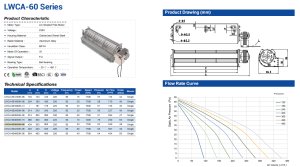
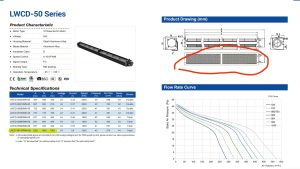
The technical drawing provides essential dimensional and mounting information for structural engineers and installation teams.
Here the product data sheet contains the full performance specifications and operational parameters needed by HVAC design engineers to model the fan’s performance within the building.
Download the document (5-07 TECHNICAL DATA SHEET (PDF))
If you are specifying for a large space
Specifying an HVLS fan is where habits from small fans stop working.
- Specify coverage area, not just airflow. Total volume tells you nothing about whether air reaches the floor or spreads evenly. Coverage at a stated mounting height is the figure that predicts what people will actually feel.
- Check the mounting structure early. A 5.5 meter fan weighs enough that the roof steel needs verifying, and retrofit projects sometimes need additional support. That assessment belongs at the design stage, not at installation.
- Buy for winter as much as summer. The destratification saving often outweighs the cooling benefit in heated buildings. Sizing and control strategy should reflect both duties, since they call for very different speeds.
- Get the performance data tested, not calculated. Large fan airflow figures vary widely in how they are derived. Data verified to AMCA 210/211 methods is what you can safely put into a building energy model.
See our industrial fan range, the ceiling fan section, or EC fans. Airflow testing follows AMCA 210.
Questions about HVLS fans
How does a fan turning at 75 RPM move that much air?
By area rather than speed. A 5.5 meter diameter sweeps a very large disc, so even slow rotation displaces an enormous volume. Notably the blade tips still move quickly in absolute terms. It is the rotational speed that stays low, which is what keeps noise and power down.
What does destratification actually save?
It depends on ceiling height and the temperature gradient, and both should be measured rather than assumed. In a high-bay heated building the difference between roof and floor temperature can be substantial, and every degree held at the ceiling is heating energy nobody benefits from. Mixing that down usually shows up quickly in the heating bill.
Can one fan really cover 460 m2?
At the stated mounting height, yes, though coverage falls off toward the edges. For larger spaces, multiple fans are spaced so their coverage areas overlap slightly. Send us the floor plan and ceiling height rather than the area alone, since obstructions and racking change the layout.
Is variable speed worth it on a fan this size?
More than on almost any other fan. The summer and winter duties are completely different: fast for cooling effect, slow for mixing without draught. A fixed-speed fan does one of those jobs well and the other badly, so the control capability is what makes it a year-round asset.
Technical Documentation & Resources
Got a duty point you need matched?
Tell us the airflow, the pressure and the space you have. Then we mark your duty point on a tested curve and send the drawing back. Meanwhile samples and custom spec sheets take up to 90 days. Since 1990 we have supplied OEMs across HVAC, refrigeration and industry.
Browse Related Products:
🏆 ISO 9001 / ISO 14001 / ISO 45001 | CE (TÜV) | UL/ETL | ATEX Zone 21/22 | AMCA 210/211 / ISO 5801 tested