Matching Physical Constraints to Higher Thermal Loads
Upgrading airflow inside a tight equipment chassis is hard. Physical size limits are absolute. First, the customer needed to replace a failing SUNON EE80251S2-0000-999 unit. They requested a specific 8025 DC cooling fan. It had to deliver exactly 42.02 CFM. Furthermore, it had to fit the original sheet metal housing.
Next, the system required a stable 12.0 VDC power rail. It had to operate safely between 7.0 and 13.8 VDC. The old setup used a 3000 RPM fan. It drew just 1.4W of power. However, that older part failed the new thermal load. Upgraded internal parts ran much hotter. Therefore, we had to push more air through the exact same 80x80x25 mm space.
Ambient conditions ranged from -10°C to +60°C. This temperature band points to indoor electronics. Next, they needed a pre-installed EH2.0 connector. It attached to a 300 mm UL1007 28AWG wire harness. This matched their automated assembly line. Finally, the buyer requested two internal variations. One version used sleeve bearings for base-model economy. By contrast, a premium version used dual ball bearings for longer life. Both models required UL 507 Class A insulation compliance.
Evaluating the 8025 DC cooling fan Upgrade Options
Pushing 42.02 CFM through a tight 80x80x25 mm frame is difficult. A 3000 RPM motor drawing 1.4W is simply too weak. So, we had to boost the overall air output.
First, we tested a steeper blade pitch. This might push more air at the original 3000 RPM speed. However, steep pitch angles cause bad flow separation in compact fans. This separation ruins static pressure. Furthermore, it creates extra turbulence. Consequently, we rejected the steep-pitch idea. It would fail to push air through the tight internal channels.
Instead, we raised the 8025 DC cooling fan speed to 3600 RPM. This choice required a higher input power of 3.12W. It also drew 0.26A of current. Therefore, the acoustic noise rose to 38 dB(A). You cannot push 42 CFM through an 80 mm hole silently. The physics of air velocity make noise unavoidable.
Balancing Bearing Selection and Longevity
Next, we built two identical mechanical versions. This satisfied the buyer’s dual-tier product strategy.
Model LWAD8025LX-29-09 uses an oil bearing system. It hits the exact same air flow targets. However, it limits life expectancy to 30,000 hours at 25°C. This choice offered a materially lower cost. It fit their base-level equipment perfectly.
By contrast, model LWAD8025LX-29-00 uses two ball bearings. It extends continuous life to 50,000 hours. This upgrade carried a higher per-unit cost. Furthermore, it added slight friction noise. Even so, it met the strict needs of their premium line. Finally, both units include a soft starter circuit. This delays full speed for nearly 10 seconds. Consequently, it prevents harmful current spikes on the control board.
Technical Specifications
These parameters define the physical and electrical limits of the final 8025 DC cooling fan output.
| Dimensions | 80 x 80 x 25 mm |
| Rated Voltage | 12.0 VDC |
| Operating Voltage | 7.0 – 13.8 VDC |
| Input Current | 0.26 A |
| Input Power | 3.12 W |
| Speed | 3600 RPM (±10%) |
| Max Air Flow | 42.02 CFM |
| Max Static Pressure | 5.51 mm H2O |
| Acoustical Noise | 38 dBA |
| Insulation Type | UL: CLASS A |
| Dielectric Strength | 5 mA Max at 500VAC~80Hz, 1 Minute |
| Soft Starter | Delay time < 10 seconds to full speed |
| Operating Temperature | -10°C to +60°C |
| Weight | 75 grams |
| Life Expectancy (Model -00) | 50,000 Hours at 25°C (Two Ball Bearings) |
| Life Expectancy (Model -09) | 30,000 Hours at 25°C (Oil Bearings) |
The speed and power rows are the key numbers here. First, we moved from a 1.4W draw to 3.12W. Consequently, we increased the 8025 DC cooling fan speed to 3600 RPM. This higher speed provides the needed 42.02 CFM flow rate.
Reference: AMCA 210 covers the test method behind these figures.
Technical Documentation
These files contain the final approved production data.
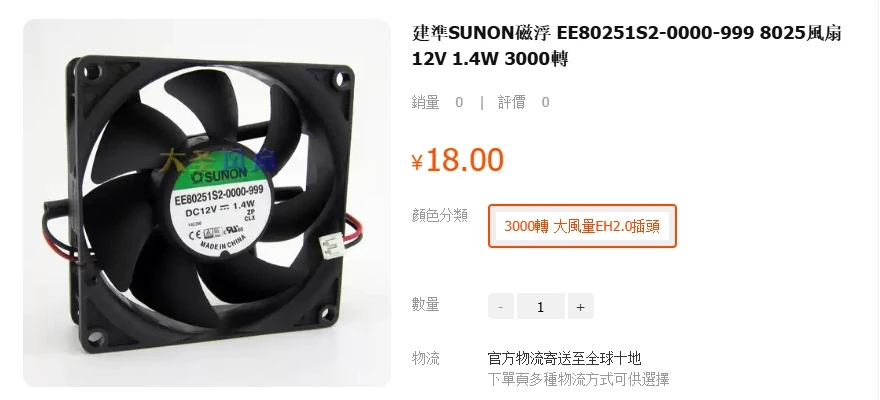
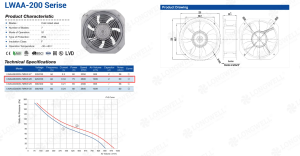
First, the image shows the original 3000 RPM part. It needed a higher-speed replacement for better cooling.
LWAD8025LX-29-00 Technical Specification
Next, system integrators need the technical specification file. It contains the 50,000-hour dual ball bearing parameters.
LWAD8025LX-29-09 Specification Sheet
Finally, procurement teams use the specification sheet. It verifies the 30,000-hour sleeve bearing data.
Guidelines for Upgrading Compact Equipment Airflow
Forcing more air through a small space requires careful planning. This project reveals several practical steps.
- First, measure your actual control board power limits. Upgrading an 80mm fan past 40 CFM requires more wattage. Consequently, your system will fail if the header cannot supply 3.12W.
- Next, check if your equipment runs constantly. Specifying a premium 8025 DC cooling fan with ball bearings everywhere wastes money. Instead, use sleeve bearings for intermittent loads. They perform identically at a materially lower cost.
- Always state your wiring harness constraints upfront. The customer requested an EH2.0 terminal early. Furthermore, they specified 300 mm UL1007 28AWG leads. Therefore, we avoided prototype rework completely.
- Finally, accept the unavoidable noise penalty. Increasing speed to 3600 RPM generates roughly 38 dB(A) of air noise. However, your application might sit in a quiet zone. Instead, you must expand the enclosure to fit a larger, slower fan.
Related: Axial Fans.
Common Questions About High-Speed 80mm Fans
Why did the power consumption increase from 1.4W to 3.12W to achieve 42.02 CFM on this 8025 DC cooling fan?
Fan power needs scale with the cube of the motor speed. First, we increased the speed from 3000 RPM to 3600 RPM. This 20% speed jump needs roughly a 70% increase in mechanical power. Therefore, we specified a 3.12W motor. This maintains stable operation.
What is the primary difference in high-temperature performance between oil and ball bearings?
Oil bearings rely on a fluid lubricant. This fluid degrades or shifts at high temperatures. Consequently, this limits their life to 30,000 hours at 25°C. By contrast, dual ball bearings trap the lubricant inside metal races. Therefore, they extend operational life to 50,000 hours. They survive even near the 60°C limit.
How does the locked rotor protection function on this 12V fan?
This unit uses motor winding impedance protection. First, the internal circuit limits the current automatically if the impeller jams. Consequently, this keeps the internal coil temperature below safety limits. Finally, it ensures the unit will not catch fire. It survives 72 hours of a continuous stall at 12.0 VDC.
Technical Documentation & Resources
Browse our axial fans range, the AC axial fans section, or EC axial fans.
Have a Similar Fan Requirement?
Longwell’s engineering team delivers custom spec sheets and samples within 90 days. Since 1990, we have supplied EC fans and blowers to OEMs across HVAC, cold chain, data center, and industrial applications worldwide.
Browse Related Products:
🏆 ISO 9001 / ISO 14001 / ISO 45001 | CE (TÜV) | UL/ETL | ATEX Zone 21/22 | AMCA 210-16 / ISO 5801 tested