Designing a 60hz ac axial fan for Extreme Cold
An OEM customer asked us for a specific blower. They needed a 60hz ac axial fan for outdoor equipment cabinets. First, the power supply was a strict constraint. The destination market runs on a 220V grid at exactly 60 Hz.
Therefore, standard dual-frequency motors were not ideal. A dedicated design was better. Next, the physical space was extremely tight. The smaller cabinet allowed an envelope of just 225x225x80 mm.
The depth limit of 80 mm was rigid. Meanwhile, the larger cabinet had a 280x280x80 mm boundary. Both fans needed to fit perfectly. These cabinets sit outdoors all year.
Consequently, the 60hz ac axial fan must survive severe weather. The ambient temperature range spans from -30C to +60C. A low limit of -30C tells us the unit faces harsh winters. As a result, standard plastic parts would fail.
We also had to meet strict thermal duties. The motor needed continuous S1 duty classification. Furthermore, the built-in thermal protection required a 140C disconnect threshold. The customer demanded two distinct performance points.
The 200 mm fan needed to move roughly 1000 m3/h. By contrast, the 250 mm unit needed over 1800 m3/h of airflow. Finally, the system required IEC/EN 60335-1 safety compliance. We also tested aerodynamic performance TO AMCA 210-16 methods. In short, this project required standard sizes but custom cold-weather endurance.
Engineering the 60hz ac axial fan Rotor and Motor
Choosing the Impeller Material
We had several options for the rotor design. First, we looked at standard fiberglass-reinforced plastic. Plastic molds quickly and costs less. It also yields a lighter rotor mass. However, we rejected plastic for this project. The -30C environment makes polymers very brittle. Therefore, a plastic blade might shatter during a cold start. A shattered blade destroys the whole cabinet. Instead, we chose cold-rolled steel impellers. Metal withstands freezing temperatures easily. We used steel for both the 200 mm and 250 mm fans. Next, we paired the steel rotors with deep groove ball bearings. These bearings handle the heavier metal loads well. Consequently, the fan achieves 30,000 hours of L10 life at 40C.
Motor Speed and Frequency Trade-offs
Then, we analyzed the stator winding. A 50/60Hz dual-frequency motor is very common. It simplifies the supply chain. Even so, we rejected a dual winding. Dual windings drop peak efficiency at 60 Hz. So, we wound a dedicated 60Hz stator. The exact cost of this choice is higher inventory tracking for the client. However, the performance gain was significant. The 75W motor spins the 200 mm rotor at 2800 RPM. This high speed requires excellent balance. Similarly, the 115W motor drives the 250 mm rotor at 2900 RPM. The input power translates directly into high static pressure.
Balancing Airflow and Acoustic Costs
Furthermore, we balanced blade count against noise. The 200 mm 60hz ac axial fan uses 7 blades. This layout pushes 1009 m3/h at 2800 RPM. The exact cost is a noise level of 60 dB(A). By contrast, the 250 mm unit uses just 5 blades. This larger rotor moves 1854 m3/h at 2900 RPM. Therefore, the acoustic penalty rises to 67 dB(A). We also balanced every rotor dynamically. The grade met G6.3 standards. Balancing takes extra factory time. Yet, it stops heavy steel blades from vibrating in the field.
Technical Specifications
| Parameter | LWAA2E200S-7MKW-28 | LWAA2E250S-5MKW-45 |
|---|---|---|
| Nominal Voltage | 220 VAC | 220 VAC |
| Voltage Range | 198~242 VAC | 198~242 VAC |
| Frequency | 60 Hz | 60 Hz |
| Speed | 2800 RPM | 2900 RPM |
| Current | 0.34 A | 0.55 A |
| Power Input | 75 W | 115 W |
| Air Flow (Max) | 1009 m3/h (593 CFM) | 1854 m3/h (1091 CFM) |
| Noise Level (LpAin) | 60 dB(A) | 67 dB(A) |
| Capacitor | 2 μF | 3 μF |
| Operating Temperature | -30C to +60C | -30C to +60C |
| Insulation Class | Class F | Class F |
| Protection Type | IP44 | IP44 |
| Impeller Material | Cold-rolled steel (7 blades) | Cold-rolled steel (5 blades) |
| Dimensions (Housing) | 225 x 225 x 80 mm | 280 x 280 x 80 mm |
| Operating Altitude | Under 1000 m | Under 1000 m |
First, look at the dedicated 60 Hz frequency row. This spec drives the high 2800 and 2900 RPM speeds. Next, the material row confirms the cold-rolled steel choice. This metal survives the extreme -30C limit easily.
Reference: AMCA 210 covers the test method behind these figures.
Technical Documentation
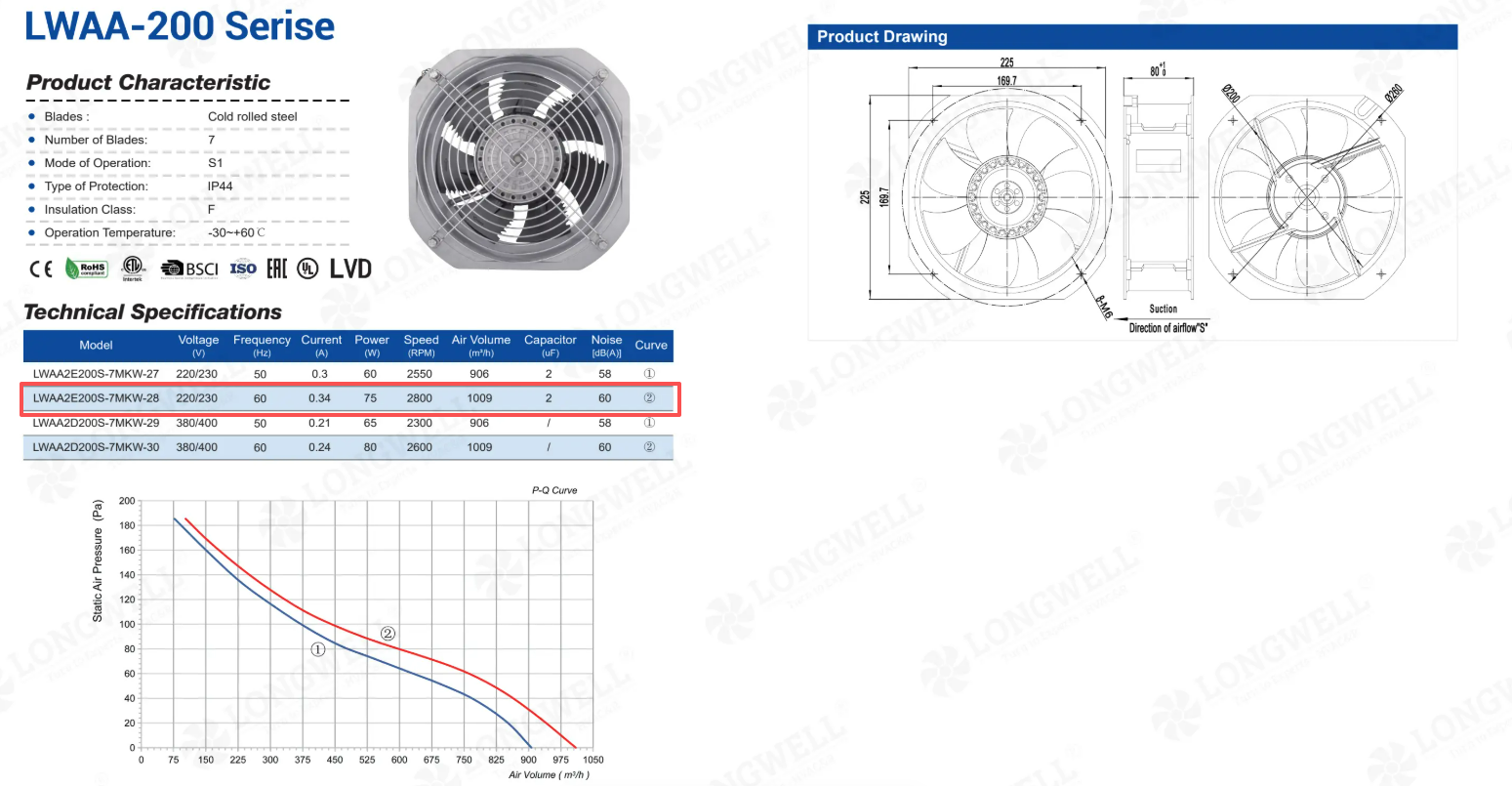
First, this image shows the static pressure curve that engineers need to map system resistance.
Download LWAA2E200S Specification
Next, this document lists electrical limits that procurement managers use to verify voltage ranges.
Download LWAA2E250S Data
Then, this file details the Class F insulation limits that system builders check for thermal safety.
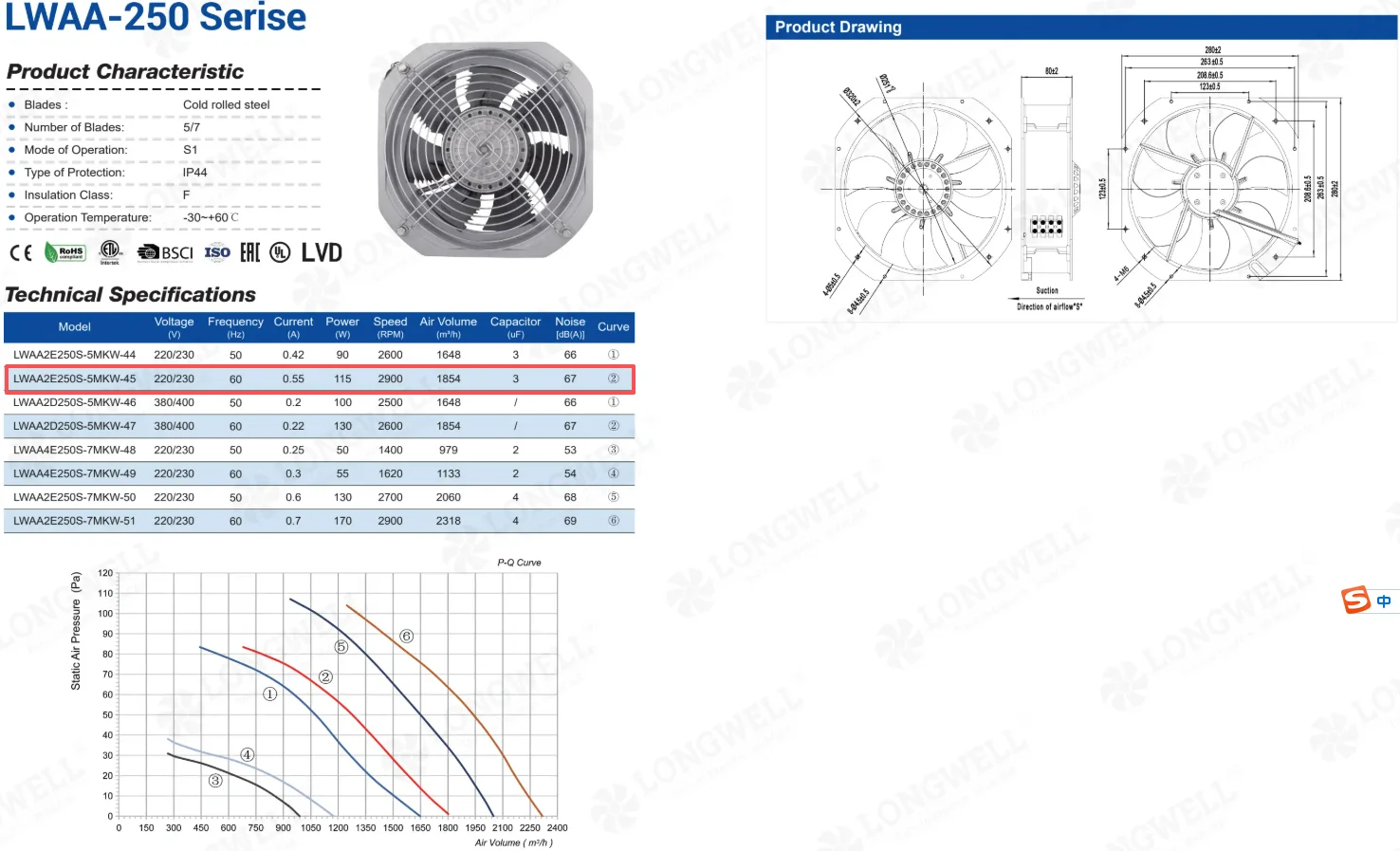
Finally, the drawing provides the exact 225 mm housing dimensions that designers use to cut mounting holes.
Specifying Fans for Freezing Conditions
Do you need a 60hz ac axial fan for cold environments? The wrong choice can ruin an expensive cabinet. You must evaluate your true operating limits first. Follow these practical rules before you finalize your design.
- First, check your lowest ambient temperature. You should drop plastic impellers if the unit sees -30C. Instead, metal blades stop cold-weather shattering.
- Next, verify your exact power grid frequency. A dedicated stator winding performs better. It will spin faster than a generic 50/60Hz motor.
- Finally, confirm the exact mounting box size. Many buyers buy a fan based solely on airflow. Later, they find the 80 mm depth hits internal cables.
Related: Axial Fans.
Engineering Questions and Answers
Technical Documentation & Resources
Browse our axial fans range, the AC axial fans section, or EC axial fans.
Have a Similar Fan Requirement?
Longwell’s engineering team delivers custom spec sheets and samples within 90 days. Since 1990, we have supplied EC fans and blowers to OEMs across HVAC, cold chain, data center, and industrial applications worldwide.
Browse Related Products:
🏆 ISO 9001 / ISO 14001 / ISO 45001 | CE (TÜV) | UL/ETL | ATEX Zone 21/22 | AMCA 210-16 / ISO 5801 tested
Choose the right axial fan
Longwell manufactures 1,086 axial fans in-house. Send airflow, static pressure and voltage — an engineer replies with a matching model, performance curve and price within one working day.