Addressing Mechanical Damage During Blower Installation
An equipment maker uses our EC forward centrifugal fan in a very tight machine chassis. Meanwhile, they reported a mechanical problem during their routine factory assembly. Technicians must bolt the blower housing into a very narrow space. Therefore, the standard LWFE3G146-072DS-14-00 housing uses a galvanized steel frame.
This standard metal frame is about 1.8 mm thick. In practice, when workers tighten the mounting bolts, the frame bends. This distortion causes a major problem for the system. The machine needs to move a high air volume of 1017 m3/h.
It also pushes against a static pressure of 497 Pa. Any frame flex can cause the EC forward centrifugal fan to vibrate during operation. Therefore, strong structural support at the mounting point is vital. The customer asked us to change the fan design completely.
They wanted to increase the metal frame thickness to 2.5 mm. We needed to review this request carefully against the performance limits. The blower runs on a 220V power rail. It uses 115 W of electrical power.
The motor has an IP54 protection rating and Class F insulation. Also, the EC forward centrifugal fan must keep its CE and ETL (UL 507) safety marks after any metal changes. It operates in air temperatures from -10°C to 65°C. A standard indoor HVAC unit might allow some minor frame flex without trouble.
However, this specific factory assembly method applied uneven force. The uneven force caused permanent damage to the standard 1.8 mm flanges.
Evaluating the Frame Modification Options
Engineers must always weigh structural changes against actual factory realities. Do you change the fan design, or do you fix the factory process?
Reviewing the Existing EC Forward Centrifugal Fan Housing
First, we looked closely at the standard flange design. The baseline EC forward centrifugal fan uses a 1.81 mm galvanized steel frame. This frame easily supports the 1400 RPM motor. It holds the heavy impeller firmly under normal running vibration.
However, the customer used a strange clamping method. This bad process put uneven forces on the metal housing. Consequently, we thought about adding external steel brackets to the fan. We rejected this idea quickly.
The customer had very tight space limits in their machine enclosure. Extra steel brackets simply would not fit. Instead, we agreed that a 2.5 mm thick flange was the only viable mechanical fix.
Tooling and Factory Trade-offs
Next, we checked what it takes to build a thicker frame. Stamping 2.5 mm steel needs a much larger factory press. The machine must apply much more force than it does for 1.8 mm steel. Therefore, we could not just change the old metal dies.
We had to design a brand new progressive stamping mold. The new custom mold would handle the thicker steel and stop the metal from springing back. Furthermore, this heavy steel adds real weight to the final assembly. The extra mass changes the vibration profile slightly. Even so, the heavy steel would not hurt the Class F motor cooling.
The Real Cost of Custom Tooling
Every design change has a strict price. In this project, the main hurdle was the new mold cost. Making a custom tool for a 2.5 mm frame requires a materially higher cost. It also adds a long wait time to the production schedule.
We added up the mold fees for the proposed LWFE3G146-072DS-14-13 variant. We also figured out the minimum order quantities needed to pay for the new tool. Finally, we sent the quote to the customer. The customer reviewed the final numbers.
The heavy tooling cost was simply too high for their small order volume. Therefore, they rejected the custom 2.5 mm fan option. They changed their own assembly rules instead. They trained their workers to stop bending the standard 1.8 mm frames.
Technical Specifications
The baseline EC forward centrifugal fan specifications dictate the exact limits the standard housing must support.
| Parameter | Value |
| Airflow (Max) | 1017 m3/h / 598 CFM |
| Static Pressure (Max) | 497 Pa |
| Input Power | 115 W ±10% |
| Speed | 1400 RPM ±10% |
| Nominal Voltage | 220 VAC |
| Voltage Range | 175~265 VAC |
| Frequency | 50/60 Hz |
| Rated Current | 0.83 A |
| Noise Level | 57.8 dB(A) |
| Operating Temperature | -10°C to 65°C |
| Protection Type | IP54 |
| Insulation Class | Class F |
| Certifications | CE, ETL (UL 507), RoHS, Reach |
The 497 Pa static pressure capacity shows exactly how hard this EC forward centrifugal fan pushes air. Meanwhile, the 57.8 dB(A) noise limit demands a very rigid metal frame. Any bend in the metal can close the tight gaps inside the fan. A bent frame increases air noise and lowers the motor efficiency.
Reference: AMCA 210 covers the test method behind these figures.
Technical Documentation
LWFE3G146-072DS-14-00 Specification Sheet
This PDF file lists the exact sizes, electrical power curves, and speed control inputs for the fan.
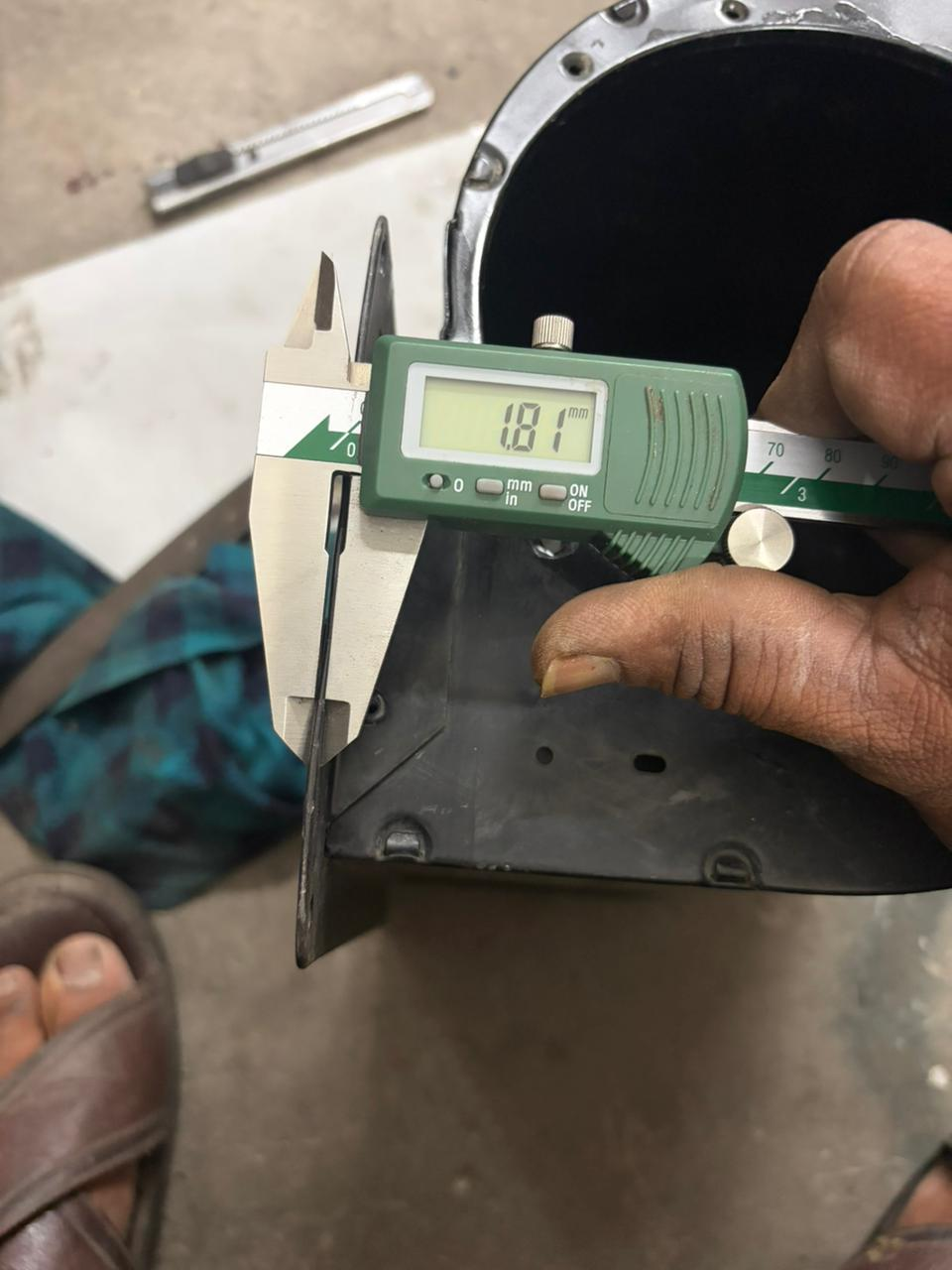
This photo shows a caliper measuring the normal 1.81 mm flange thickness before any changes were requested.
How to Handle Bending Fan Housings
When factory workers bend standard EC forward centrifugal fan housings, you must make a clear choice. You must decide whether to buy a custom fan or change your tools. If you face a bent metal frame, follow these practical steps:
* First, measure the exact twisting force applied to your mounting bolts. Uneven bolt tightening often causes thin sheet metal to warp.
Fixing your torque settings can solve the problem for free. * Next, check the empty space around the fan inside your machine. Bolting a simple steel plate to your own unit is usually cheaper than changing the fan housing. * Also, remember that upgrading from 1.8 mm to 2.5 mm steel always means buying a new stamping mold.
Custom tooling takes around 90 days to finish. You must add this time and money to your project plan. * Finally, tell your fan supplier about your exact order volume early on. A supplier needs to know how many units you will buy to quote the mold cost fairly.
Therefore, always review your own assembly process before asking for heavy custom metal parts. Related:
Centrifugal Fans.
Technical Documentation & Resources
Browse our blowers range, the exhaust blowers section, or centrifugal blowers.
Have a Similar Fan Requirement?
Longwell’s engineering team delivers custom spec sheets and samples within 90 days. Since 1990, we have supplied EC fans and blowers to OEMs across HVAC, cold chain, data center, and industrial applications worldwide.
Browse Related Products:
🏆 ISO 9001 / ISO 14001 / ISO 45001 | CE (TÜV) | UL/ETL | ATEX Zone 21/22 | AMCA 210-16 / ISO 5801 tested
Choose the right blower
Longwell manufactures 247 blowers in-house. Send airflow, static pressure and voltage — an engineer replies with a matching model, performance curve and price within one working day.