Three fans and one easily missed line
An HVAC integrator asked for specifications on three AC axial fans across parallel product lines. Their brief held a line most orders omit: the fans must hold up in both vertical and horizontal planes. In other words, fan mounting orientation was an explicit condition.
Specifically, the trio covered a 200mm 380 V unit and two 300mm units, one on 380 V 50 Hz and one on 220 V 60 Hz. They serve different grids and markets.
The shared envelope
- First, up to 2112 m3/h, across -30C to +60C ambient.
- Next, 80mm frame depth on the 300mm models and 65mm on the 200mm, inside heat exchanger cabinets.
- Meanwhile 61 dB(A) maximum, tightening to 53 dB(A) for the small unit.
- Finally, IP44, Class F insulation, S1 continuous duty and 30,000 hours L10 at 40C.
Why that one line matters
The same fan model lands in different cabinets across the customer product lines. For instance, some blow sideways and some blow up.
So nobody at the integrator can promise which way any given fan will point. The spec has to cover both, or the approval only covers half the fleet.
Fan mounting orientation and the bearings
Fan mounting orientation decides which way gravity pulls the rotor. Meanwhile the bearings feel every degree of it.
Two directions, two kinds of load
Firstly, with the shaft sideways, the rotor weight presses across the bearings as a radial load, which ball bearings carry easily.
Turn the shaft upright and that same weight becomes thrust, pushing along the shaft onto surfaces that were doing lighter duty before. Neither load is severe on a fan this size. However, they are different loads, and the grease moves differently too.
Why the bearing choice settles it
Deep groove ball bearings carry both radial and modest axial load, which is why they qualify in either plane. Consequently, the 30,000-hour L10 figure stands for both directions.
Here the alternative matters more than it seems. Sleeve bearings, common in cheaper fans, ride on an oil film, and gravity drains that film differently shaft-up than shaft-sideways. Many sleeve-bearing fans carry a fan mounting orientation limit in the fine print, and an installer who never reads it mounts them wrong.
The rest of the selection
Next, we looked at DC and EC variants and set them aside. The customer thermostat loop has no control signal to offer, and their product tier could not carry the hardware cost.
Meanwhile, the blade pitch analysis balanced pressure against noise for each frame, since steeper pitch buys pressure and spends decibels. All three fans hold their sound caps at the rated duty.
Qualification that matches reality
Because the condition was explicit, we verified in both planes rather than the easy one. Airflow figures follow ISO 5801 methods either way.
In short, that is the quiet value of the clause: it forces the test lab to mirror the field.
Technical Specifications
The L10 figure below holds in both mounting planes. That claim is only true because someone required it to be.
| Parameter | LWAA2E300S-5MEB-09-00 | LWAA2D300S-5MEB-33-00 | LWAA2D200S-5MEB-38-00 |
|---|---|---|---|
| Voltage | 220 VAC (198~242V) | 380 VAC (342~412V) | 380 VAC (342~412V) |
| Frequency | 60 Hz | 50 Hz | 50 Hz |
| Max Airflow | 2112 m³/h (1242 CFM) | 1957 m³/h (1151 CFM) | 906 m³/h (533 CFM) |
| Input Power | 155 W | 115 W | 65 W |
| Speed | 2600 RPM | 2500 RPM | 2300 RPM |
| Current | 0.7 A | 0.25 A | 0.21 A |
| Noise Level (LpA) | 60 dB(A) | 58 dB(A) | 53 dB(A) |
| Capacitor | 4 μF | N/A | N/A |
| Operating Temp | -30°C to +60°C | -30°C to +60°C | -30°C to +60°C |
| Insulation Class | Class F | Class F | Class F |
| Protection Type | IP44 | IP44 | IP44 |
| Duty Cycle | S1 | S1 | S1 |
Technical Documentation
- longwell-ac-technical-doc-01.pdf: Final technical specification sheet detailing the 380V 300mm fan parameters, required by the OEM quality control department.
- longwell-ac-technical-doc-06.pdf: Approved engineering document for the 220V 60Hz 300mm variant, used by application engineers for electrical panel sizing.
- longwell-ac-technical-doc-07.pdf: Performance and dimensional data for the compact 200mm 380V model, necessary for internal structural routing.
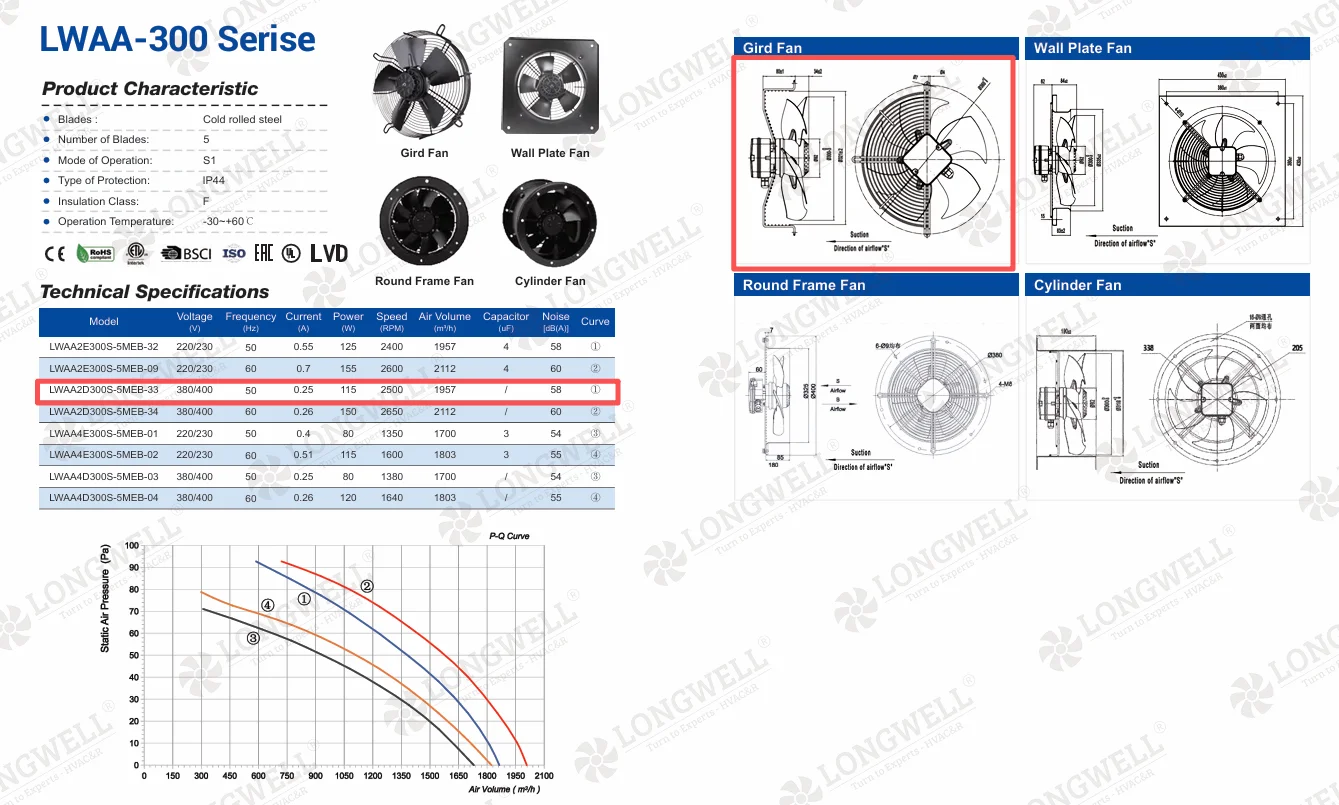 Visual engineering drawing detailing the 80mm frame depth and mounting hole patterns for the 300mm series.
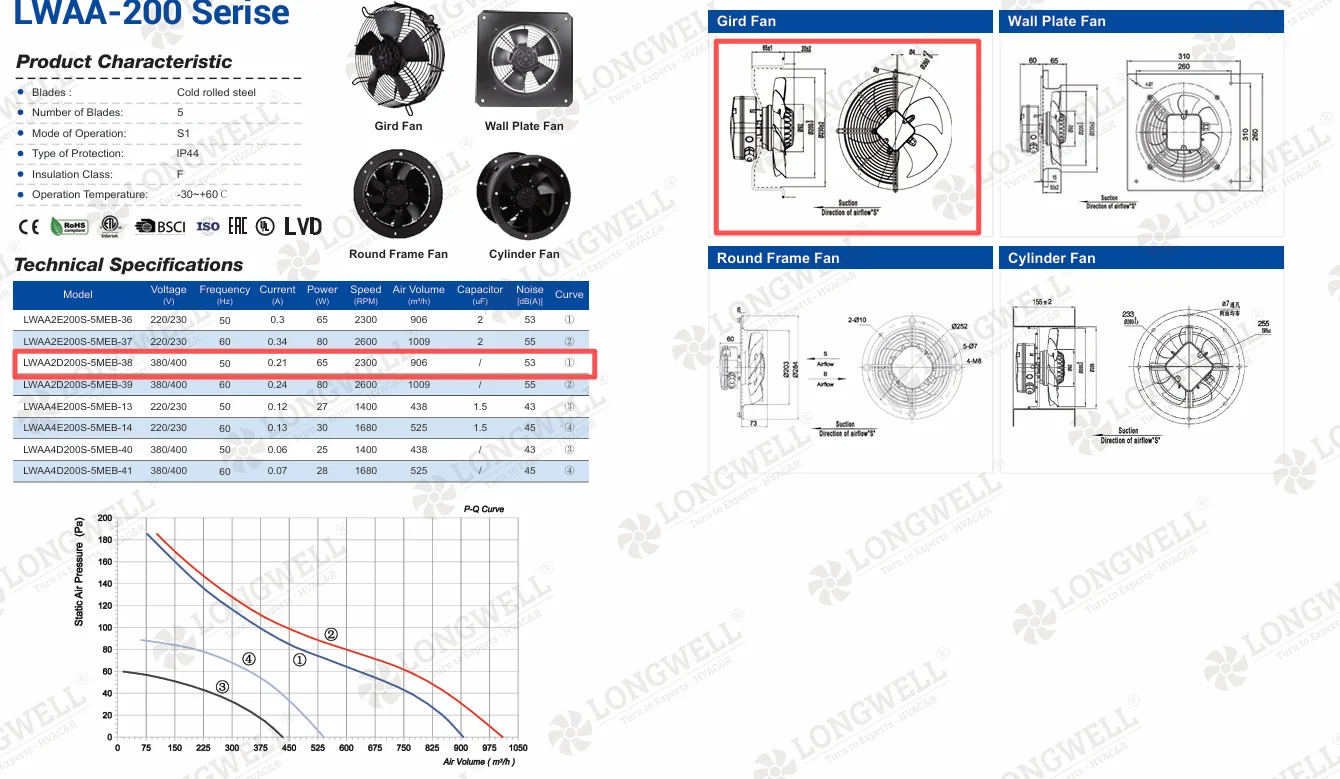 Schematic outlining the 65mm profile and grille integration for the compact 200mm axial fan.
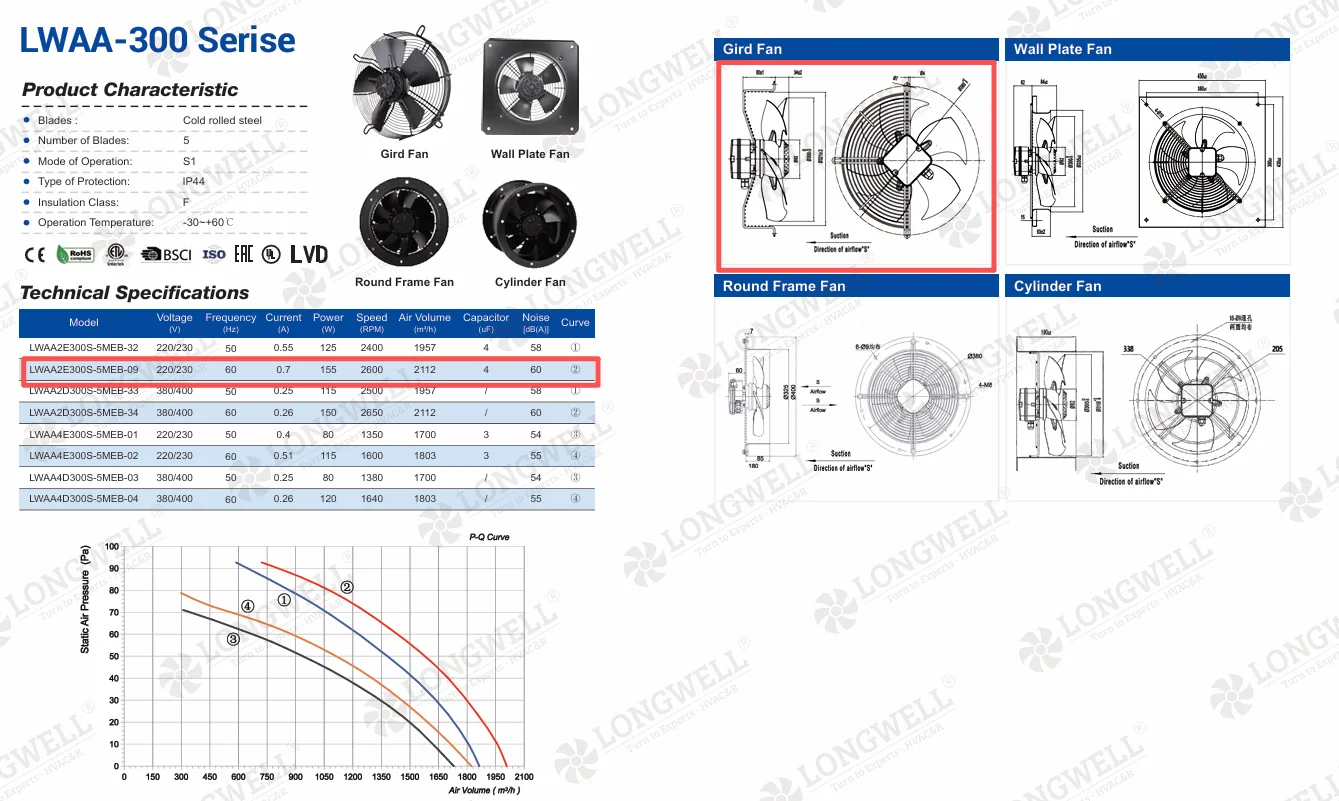 Secondary performance documentation mapping PQ curves for system static pressure calculations.
- longwell-ac-spec-sheet-04.docx: Original source data document outlining raw electrical characteristics during the prototyping phase.
- longwell-ac-project-image-03.docx: Supplementary application note reviewing material compliance standards.
- longwell-ac-project-image-09.docx: Archival project requirement checklist used by the technical PM to verify input limits.
Specifying orientation properly
Fan mounting orientation is free to specify and costly to discover. Four habits cover it.
- State every orientation the product family uses. For example, if the same fan ships shaft-up in one cabinet and shaft-sideways in another, the order must say so. A fan mounting orientation clause costs one sentence and makes the life figure true for the whole fleet.
- Ask whether the L10 figure covers your plane. After all, a life figure computed for level shafts does not automatically carry over to upright duty. Ask the supplier which orientation the number assumes, and whether both were tested.
- Treat sleeve bearings as orientation-restricted until proven otherwise. Indeed, many are rated for level shafts only, and the limit hides in datasheet footnotes. Ball bearings cost more precisely because they forgive the installer.
- Check condensate drainage per orientation too. Likewise, an IP44 fan sheds water by design, and the drain paths assume a mounting direction. A fan tipped ninety degrees from its assumed plane can pool water where the designer expected it to run off.
See our axial fans range, the AC axial fans section, or compact axial fans.
Questions about mounting orientation
Can I mount any fan in any orientation?
No. Ball-bearing fans generally allow both planes. However, sleeve-bearing fans often demand a level shaft, and the limit sits in the datasheet fine print. Check before you design the sheet metal, because the constraint is awkward to discover after.
Why does orientation change bearing life?
Because gravity loads the bearing differently: across it when the shaft is level, along it as thrust when upright. Also, grease settles and moves differently in each plane. The effects are small per hour and meaningful across 30,000 of them.
Does orientation affect airflow or noise?
Barely, for the fan itself. What changes is the setup around it. Hot air rises, water drains, and vibration travels differently depending on which way the assembly points. That is why system-level testing in the real fan mounting orientation still matters.
What does an orientation clause cost the buyer?
One sentence in the enquiry. The supplier then picks bearings rated for both planes and verifies twice where it matters. Both are cheap at design time. Neither is available at all once a level-only fan is bolted in upright.
Technical Documentation & Resources
Got a duty point you need matched?
Tell us the airflow, the pressure and the space you have. Then we mark your duty point on a tested curve and send the drawing back. Meanwhile samples and custom spec sheets take up to 90 days. Since 1990 we have supplied OEMs across HVAC, refrigeration and industry.
Browse Related Products:
🏆 ISO 9001 / ISO 14001 / ISO 45001 | CE (TÜV) | UL/ETL | ATEX Zone 21/22 | AMCA 210/211 / ISO 5801 tested
Choose the right axial fan
Longwell manufactures 1,086 axial fans in-house. Send airflow, static pressure and voltage — an engineer replies with a matching model, performance curve and price within one working day.