What the electronics OEM needed
An electronics OEM needed a native 48V DC fan for a new power conversion cabinet.
Their whole system runs on a 48V rail, which is standard across telecom and data center kit. So they wanted a fan running on it directly, with no conversion stage between.
The constraints
- First, an envelope of 250mm length, 72mm height and 80mm depth.
- Next, at least 105 m3/h, delivered as a consistent air curtain across a bank of components.
- Meanwhile 0-10V speed control, so their main controller manages thermals dynamically.
- Finally, ball bearings for service life, with 20 prototypes and an initial order above 200 units.
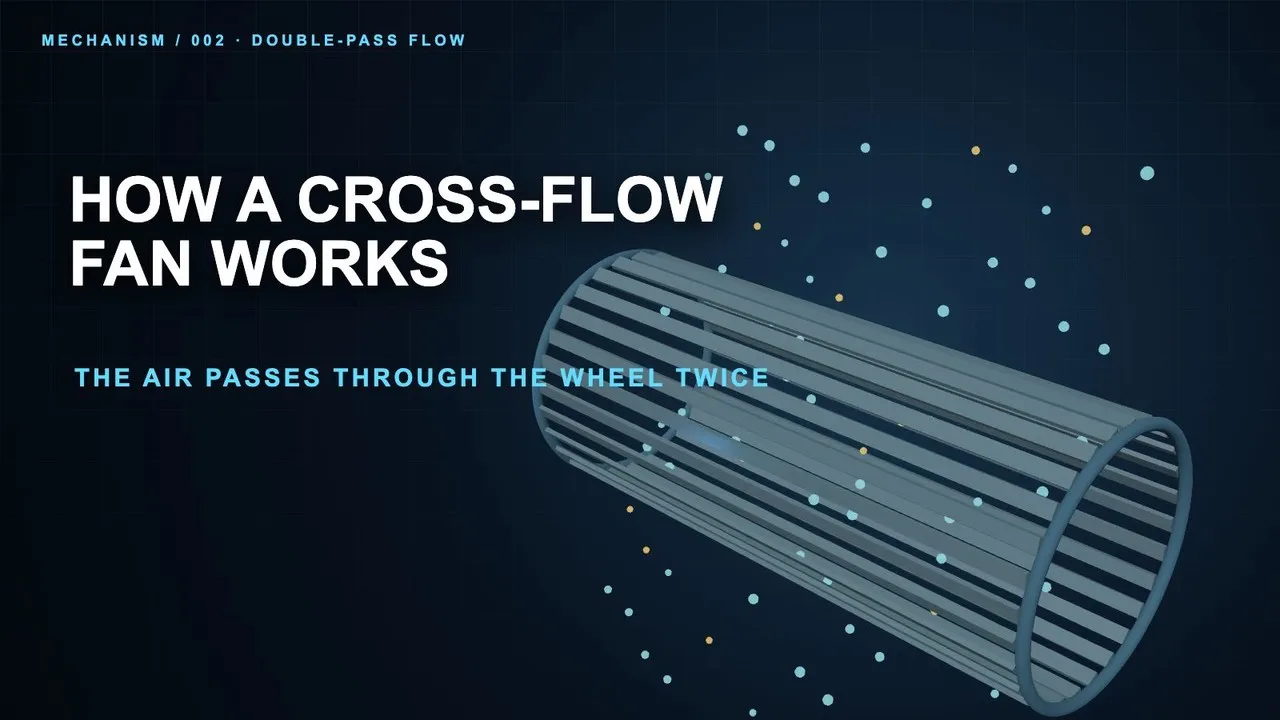
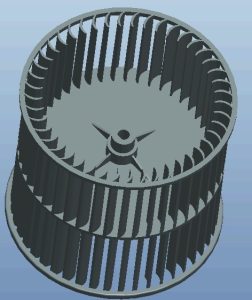
Notably the phrase that mattered was air curtain. They are not cooling one hot part. Instead they sweep a row of components evenly, which is why a cross-flow fan suits and an axial one does not.
Building a native 48V DC fan
Our LWCD-45 series matched the dimensions and airflow already. However, one thing did not. The standard model runs on 24V.
The converter option
Certainly the obvious answer is to supply the 24V fan and let the customer add a DC-DC converter.
We rejected it. That converter is a part they have to source, mount and wire, and it is a component that can fail inside a sealed cabinet. Furthermore every conversion stage loses energy, so the system runs slightly less efficiently for the life of the product.
On 20 prototypes it would be fine. By contrast, across 200 units a year it becomes a permanent tax on every build.
What actually changes at 48V
Two things, and both are real engineering rather than a relabel.
First, the motor windings were recalculated for the higher voltage. Consequently the native 48V DC fan reaches 2000 RPM while winding temperature stays where it should. Simply feeding 48V to a 24V winding would over-speed and overheat the motor.
Meanwhile the controller board was revised. Input capacitors and power stage FETs were re-specified with higher voltage ratings, with margin above 48V rather than at it. That margin is what keeps the electronics alive through supply transients.
What was deliberately left alone
Meanwhile the 0-10V control input carried over unchanged, so their controller integration needed no rework.
We also re-verified the -25C to +60C operating range rather than assuming it survived the change. It did.
What it cost
Time and a minimum quantity. A rewind plus a board revision is real development work, so it runs through our NPI process rather than shipping next week.
Furthermore this variant carries its own part number and minimum order. For a customer buying 200 units a year that is easily worth it. By contrast, for someone needing five fans the converter is genuinely better, and we would say so.
Technical Specifications
Everything below except the voltage row matches the 24V model this native 48V DC fan came from.
| Parameter | Value |
|---|---|
| Model Number | LWCD-45190MN-06 (48V Custom) |
| Voltage (VDC) | 48 |
| Speed (RPM) | 2000 ±10% |
| Air Volume (m³/h) | 105 |
| Control Signal | 0-10V |
| Bearing Type | Ball Bearing |
| Overall Length (A) | 250 mm |
| Impeller Length (C) | 190 mm |
| Housing Height | 72 mm |
| Housing Depth | 80 mm |
| Impeller Diameter | 45 mm |
Technical Documentation

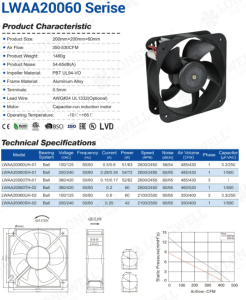
The mechanical drawing provides precise dimensional and mounting data for mechanical engineers to ensure correct fit and integration into the final assembly.
Open Technical Specification (PDF)
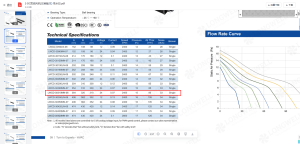
The technical specification sheet contains all electrical and performance data required by electrical and systems engineers for power budget calculations and control system integration.
If your rail is 48V
A 48V rail is common now, although fan catalogs have not fully caught up. So these help when you need a native 48V DC fan.
- Work out whether you need native or converted. Below roughly a hundred units a year, an off-the-shelf converter usually wins on total cost. Above that, a native 48V DC fan removes a part from every unit you build.
- Ask what is being changed inside. A genuine voltage variant means a rewind and a board revision. A supplier offering the same fan with a different label is either using a wide-range controller, which is fine and should be stated, or hoping.
- Give the rail tolerance, not just the nominal. A 48V telecom rail can sit anywhere from 42V to 58V depending on battery state. The controller has to handle the whole window, and that shapes the component selection.
- Keep the control interface identical if you can. Changing voltage and control scheme at the same time doubles what has to be revalidated. Holding the 0-10V input constant kept the customer software untouched.
See our cross flow fan range, the DC cross flow fan section, or DC cooling fans. Appliance safety follows IEC 60335-1.
Questions about voltage variants
Can I run a 24V fan on 48V?
No. It would over-speed badly, draw far more current than rated, and overheat quickly. This is not a marginal overload like running a 24V fan on 26V. Rather, it is double the design voltage. So either use a converter or ask for a native 48V DC fan.
When is a DC-DC converter the better choice?
At low volume, or when you need fans quickly. A converter is an off-the-shelf part you can buy today, and on twenty units the extra component cost is trivial next to a development program. The calculation changes once you are building hundreds a year.
What voltage window does the 48V version accept?
Tell us your rail behavior and we will confirm. A telecom 48V bus commonly ranges from around 42V to 58V with battery state, and the controller components are chosen with margin above the top of that window. Sending the real minimum and maximum is more useful than the nominal figure.
Why does doubling the voltage need a rewind rather than just a controller change?
Because the winding sets the relationship between voltage and speed. More turns of thinner wire produce the same torque and speed at higher voltage and lower current. Leaving the winding alone and limiting voltage in the controller would work, but it wastes the difference as heat inside the fan.
Technical Documentation & Resources
Need the same thing for your own unit?
Give us the numbers and the envelope, and you get a shortlist rather than a catalog. Meanwhile custom spec sheets and samples run to 90 days. Since 1990 Longwell has supplied EC fans and blowers to OEMs in HVAC, cold chain, data center and industrial markets.
Browse Related Products:
🏆 ISO 9001 / ISO 14001 / ISO 45001 | CE (TÜV) | UL/ETL | ATEX Zone 21/22 | AMCA 210/211 / ISO 5801 tested