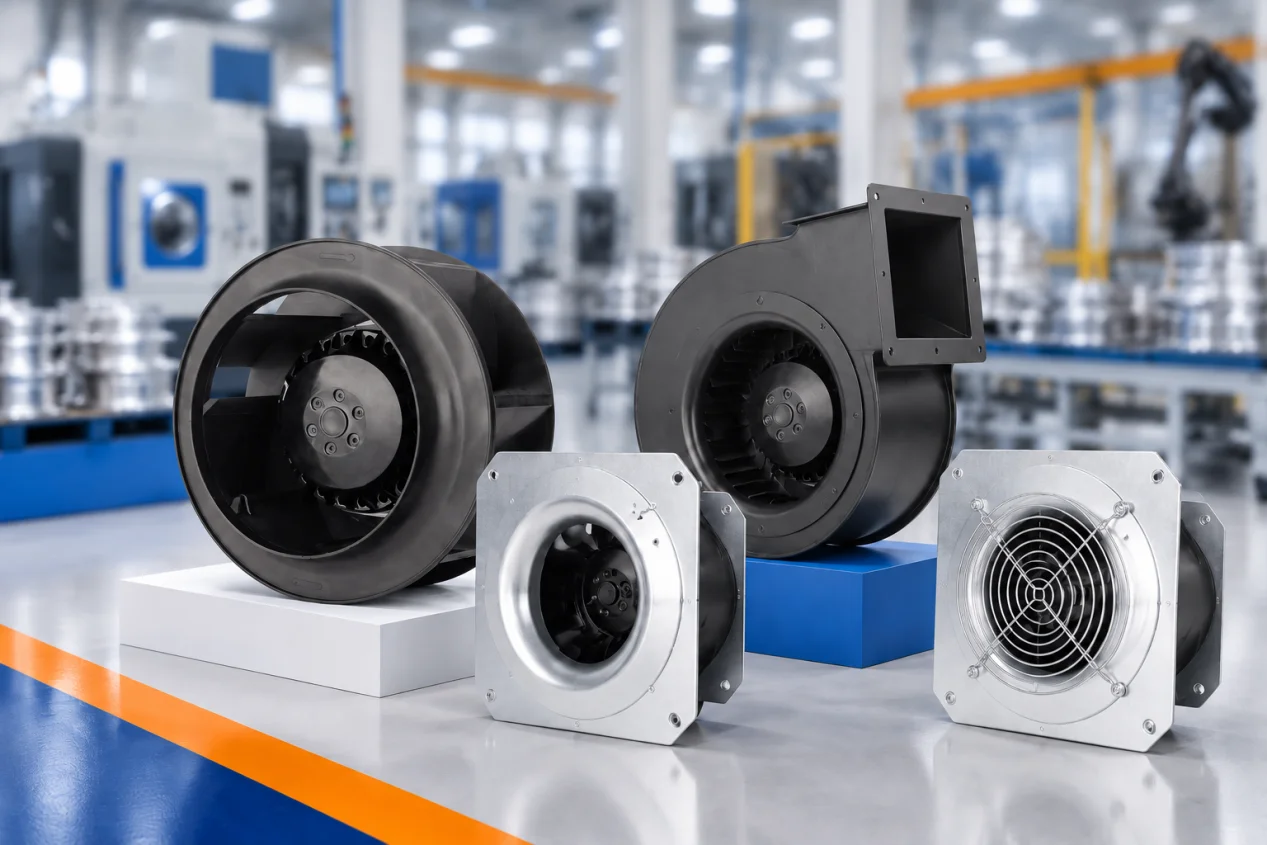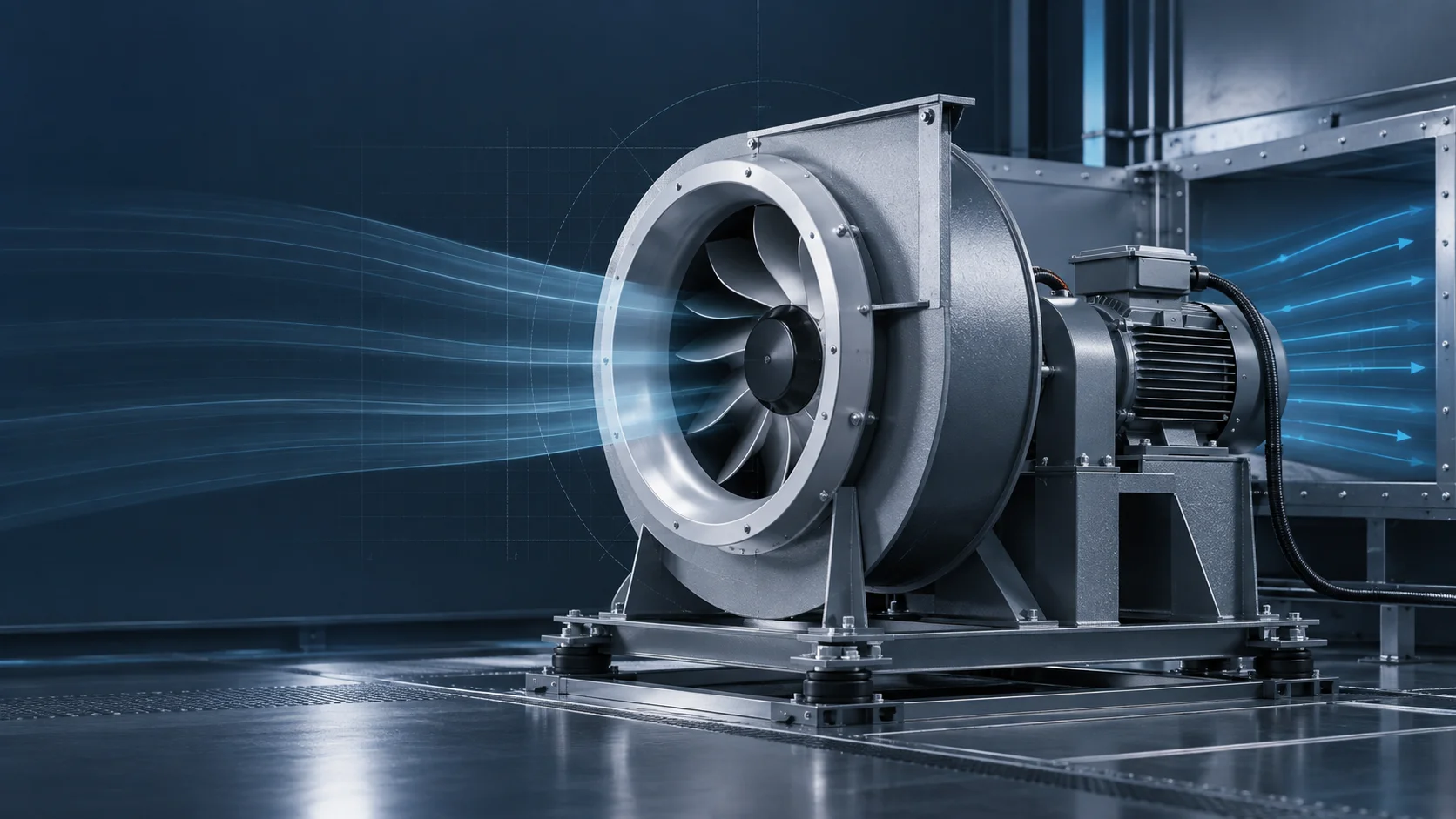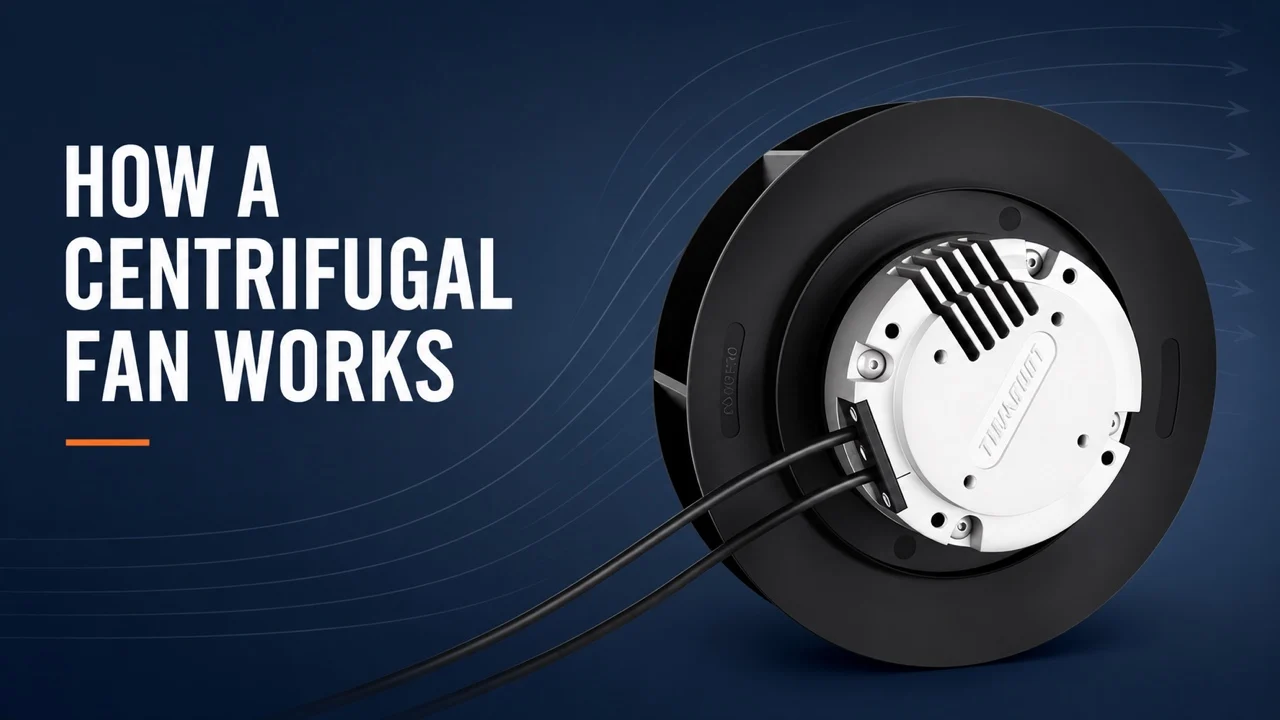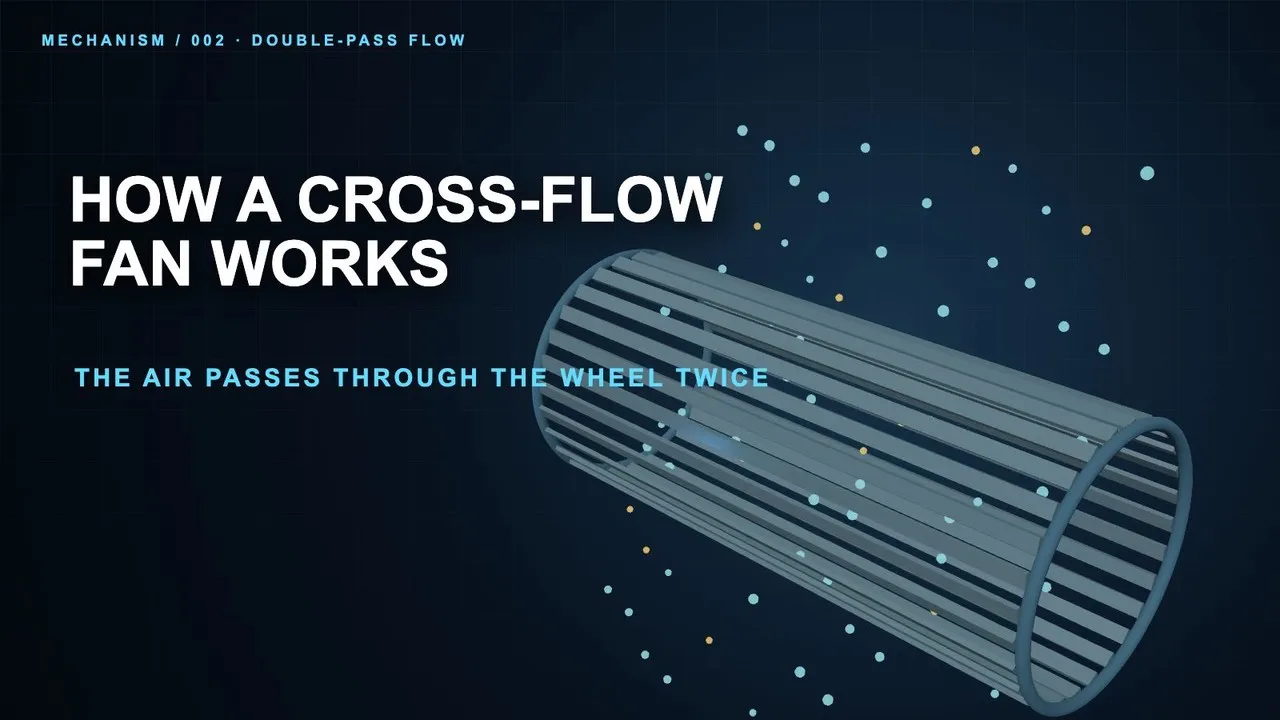
What the HRV maker needed
An OEM building heat recovery and energy recovery ventilation units needed a 24V DC HRV duct fan capable of 365 Pa.
That pressure figure makes the job demanding. Heat recovery cores are dense by design, since that is how they exchange heat. Consequently an HRV duct fan pushes through the core, the filters and the whole duct run.
The constraints
- First, a 24 VDC bus, which their system already runs on.
- Next, 365 Pa maximum static pressure.
- Meanwhile circular duct interfaces at 100mm and 125mm.
- Finally, speed regulation, so the unit can balance supply and extract airflow.
Usefully they had named two specific models, so this was validation rather than selection.
How one platform gives two HRV duct fan sizes
An AC motor was never a candidate. Their system is 24V DC, so an AC fan would need an inverter that adds cost, a failure point and volume inside a unit that has none to spare.
What the two models share
Notably this is the part worth knowing if you design around them.
The 3000 RPM EC motor, the metal housing and the integrated controller are identical across both sizes. That is deliberate rather than incidental.
Consequently the two HRV duct fan sizes are mechanically interchangeable in the ways that matter to an OEM. One control strategy, one wiring approach, one set of electrical qualification work covers both.
What differs
In fact only the backward-curved impeller and the duct collar diameter.
Here the 100mm model gives 241 m3/h. The 125mm gives 270 m3/h, an extra 29 m3/h, for two additional watts.
Both reach the same 365 Pa maximum, which is set by the motor and the impeller design rather than by the duct size.
The impeller material
Glass-filled PA6 rather than metal. It holds shape at 3000 RPM, weighs far less than aluminum, and moulds repeatably at volume.
A metal impeller would cost more and weigh more without buying anything at this diameter and speed.
What it cost
Noise, at the pressure end. Reaching 365 Pa from an HRV duct fan this size means 3000 RPM, and that is audible.
The speed control is the mitigation. A heat recovery unit rarely needs full pressure, since that figure exists to cope with a loaded filter and a long duct run. Most of the year it runs well below, and quietly.
Technical Specifications
Two models sit side by side below. Compare the airflow and power columns, since that gap is the whole decision.

| Parameter | LWDD-100M-MBN-12 | LWDD-125M-MBN-08 |
|---|---|---|
| Model No. | LWDD-100M-MBN-12 | LWDD-125M-MBN-08 |
| Nominal Voltage (VDC) | 24 | 24 |
| Input Power (W) | 30 | 32 |
| Current (A) | 1.32 | 1.35 |
| Max Airflow (m³/h) | 241 | 270 |
| Max Airflow (CFM) | 143 | 161 |
| Max Static Pressure (Pa) | 365 | 365 |
| Speed (RPM) | 3000 | 3000 |
| Noise [dB(A)] | 62 | 62 |
| Operating Temp (°C) | -25 to +60 | -25 to +60 |
| Duct Diameter (mm) | 100 | 125 |
| Overall Dimensions (mm) | Ø244 x 192 | Ø244 x 192 |
| Protection Class | IP44 | IP44 |
| Insulation Class | B | B |
| Life Expectancy (L10 @ 40°C) | 25,000 Hours | 25,000 Hours |
| Control Signal | 0-10V / PWM | 0-10V / PWM |
| Motor Protections | Over-temp, Over-current, Stop-turn | Over-temp, Over-current, Stop-turn |
| Certifications | CE, LVD, ISO | CE, LVD, ISO |
Technical Documentation
Datasheet: LWDD-100M-MBN-12-00.pdf
The document provides the complete specifications, PQ curve, and mechanical drawings for the 100mm model, essential for mechanical and electrical design integration.
Datasheet: LWDD-125M-MBN-08-00.pdf
Here the file contains the full technical data for the 125mm model, allowing procurement managers and engineers to directly compare it against the 100mm version.
If you are sizing a heat recovery fan
Choosing an HRV duct fan punishes optimistic pressure estimates more than most applications.
- Add the core, the filters and the ducts together. The heat exchanger alone can consume most of your pressure budget, and it is the part people forget when sizing from a fan catalog. Measure or obtain the core pressure drop at your design flow.
- Size against a dirty filter, not a clean one. Filter resistance roughly doubles over a service interval. A fan with no headroom delivers steadily less air as months pass, and the occupants notice before the maintenance schedule does.
- Use the shared platform to your advantage. Where 100mm and 125mm variants share a motor and controller, you can offer two product sizes from one electrical design and one set of qualification testing.
- Balance supply and extract with speed, not dampers. Dampers waste the pressure you just paid for. Two speed-controlled fans let you trim the balance electrically, which is both quieter and more efficient.
See our duct fan range, the EC inline fan section, or HVAC systems. Ventilation rates follow ASHRAE 62.1.
Questions about these fans
Why does the larger fan only give 29 m3/h more?
Because both share the same motor and speed. The larger impeller moves somewhat more air per revolution, though it is working against the same pressure capability. If you need substantially more airflow, the answer is a different platform rather than the next duct size up.
Is 365 Pa enough for a heat recovery unit?
It depends on your core and duct run, which is why we ask for both. A compact residential unit with short ducts sits comfortably inside it. By contrast a large core with long runs and fine filtration may not. So add up the core, the filters and the ductwork before deciding.
Can I mix a 100mm and a 125mm fan in one unit?
Yes, and it is sometimes the right answer. Supply and extract paths often have different resistance, so matching each side separately gives better balance than using two identical fans and correcting with dampers. The shared controller makes running both straightforward.
Why backward-curved rather than forward-curved?
Because of the pressure. Forward-curved wheels lose capability quickly as resistance rises, and a heat recovery core is nothing but resistance. Backward-curved geometry holds its pressure and stays efficient there, which is why it is standard in this application.
Technical Documentation & Resources
Working on something similar?
Send us the duty point, the envelope and the supply, and our engineers come back with a shortlist rather than a catalog. Meanwhile custom spec sheets and samples run to 90 days. Since 1990 we have built fans for HVAC, cold chain, data center and industrial OEMs.
Browse Related Products:
🏆 ISO 9001 / ISO 14001 / ISO 45001 | CE (TÜV) | UL/ETL | ATEX Zone 21/22 | AMCA 210/211 / ISO 5801 tested
Choose the right duct fan
Longwell manufactures 254 duct fans in-house. Send airflow, static pressure and voltage — an engineer replies with a matching model, performance curve and price within one working day.