What the OEM asked for
An OEM needed a compact axial fan for industrial power conversion modules, in a fixed 80 by 80 by 25 mm location on 12 VDC. The sleeve versus ball bearing question decided it.
Performance targets were modest: roughly 35 CFM against low pressure, under 35 dBA, with UL-94V-0 materials for their own certification.
One request needed a second look
Notably their procurement team asked for a lubricated sleeve bearing by name.
Usually that comes from a unit cost target rather than an engineering preference. There is nothing wrong with it in itself. However, the rest of the brief pointed the other way.
These modules go into high-reliability applications where cooling cannot fail. Consequently the context differs from a consumer product, and that changes the sleeve versus ball bearing answer.
Weighing sleeve versus ball bearing
We took the sleeve bearing request seriously before pushing back, since sometimes it is the right call.
What sleeve bearings actually give you
Certainly they are cheaper, and quiet when new. Both are real advantages.
However, they typically last 20,000 to 30,000 hours. Furthermore their life falls off with mounting orientation and with ambient temperature, both of which are uncontrolled inside a customer product.
A sleeve bearing with its shaft vertical wears faster than a horizontal one. That is not a defect. Rather, it is how the lubricant film behaves under gravity.
Why we proposed the change
By contrast a dual ball bearing fan reaches 50,000 hours, roughly doubling service life. Furthermore it is far less sensitive to orientation and temperature.
The trade is a marginal increase in unit cost. Meanwhile, against a module running for years in the field, that buys back more in avoided failures than it costs.
So we put the numbers in front of their engineering team rather than quietly substituting the part. They agreed.
The fan that resulted
Ultimately the chosen 80mm model runs at 3250 RPM for 37.43 CFM. Notably that clears the 35 CFM target with margin, rather than exactly meeting it.
Furthermore it draws 2.40W and measures 34 dBA against their 35 dBA limit. Its PBT frame and impeller already carried the UL-94V-0 rating.
What it cost
Unit price, honestly. Ball bearings cost more than sleeve, every time.
Here the argument only works because of where this fan goes. By contrast, on a consumer product with a short life and easy access, the same reasoning reverses and sleeve wins. We would say so in that case too.
Technical Specifications
The bearing and life rows below are where sleeve versus ball bearing shows up in numbers.
| Parameter | Value |
|---|---|
| Model Number | LWAD8025LX-28-00 |
| Dimensions | 80 x 80 x 25 mm |
| Rated Voltage | 12.0 VDC |
| Operating Voltage | 7.0 – 13.8 VDC |
| Input Current | 0.20 A |
| Input Power | 2.40 W |
| Rated Speed | 3250 RPM (±10%) |
| Maximum Air Flow | 37.43 CFM / 63.59 m³/h |
| Maximum Static Pressure | 4.59 mmH₂O / 45.02 Pa |
| Acoustical Noise (AVG) | 34 dBA |
| Bearing Type | Two Ball Bearings |
| Life Expectancy | 50,000 Hours (at 25°C, 15-65%RH) |
| Operating Temperature | -10°C to +60°C |
| Frame & Impeller Material | PBT Plastic (UL-94V-0) |
| Insulation Type | UL CLASS A |
| Weight | 75 g |
| Lead Wire | UL1007 28AWG#, 300mm |
| Protection | Impedance Protected (Locked Rotor) |
Technical Documentation
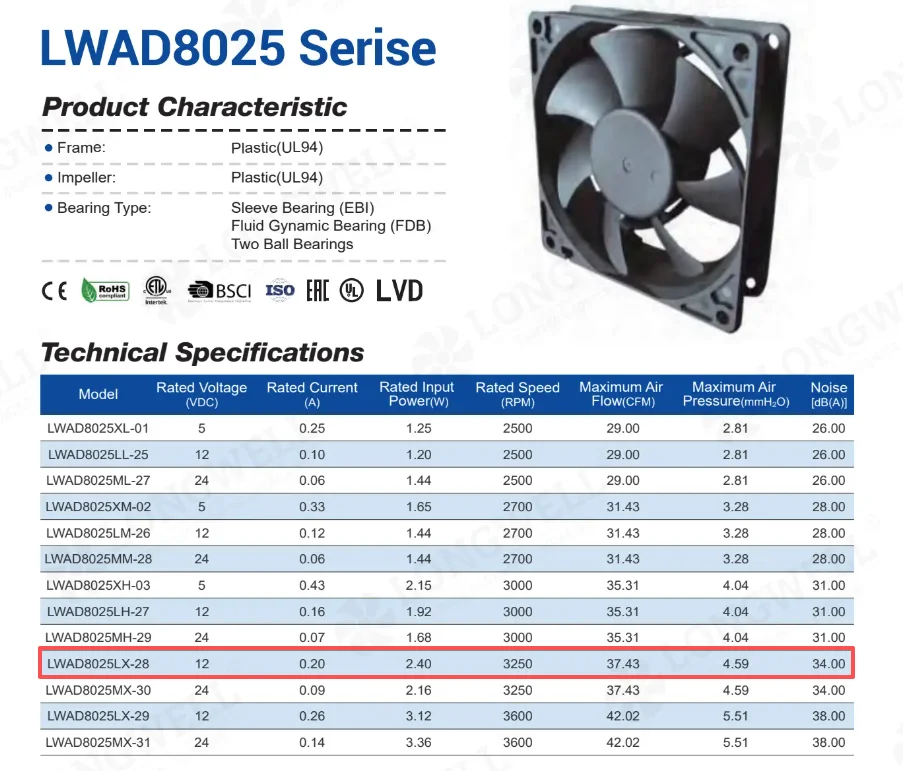
Meanwhile the product family specifications table shows performance variations across the LWAD8025 DC axial fan series, enabling quick comparison for procurement managers.
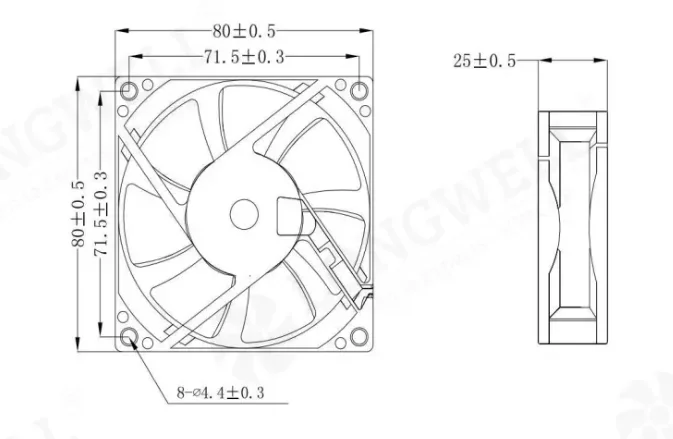
Here the mechanical drawing defines the 80x80x25mm external dimensions and 71.5×71.5mm mounting hole pattern required by design engineers for CAD integration.
Open Full Technical Datasheet (PDF)
The complete technical datasheet for the LWAD8025LX-28-00 contains performance curves, electrical characteristics, and environmental ratings for final engineering review and approval.
How to make this call yourself
Here the sleeve versus ball bearing call gets made on price when it should be made on context.
- Ask how the fan will be mounted. Sleeve bearing life depends heavily on shaft orientation, since the lubricant film behaves differently under gravity. So a vertical shaft is where sleeve versus ball bearing matters most.
- Work out the expected running hours, not the warranty period. A fan running continuously reaches 20,000 hours in under three years. If your product is expected to outlast that, the bearing choice is already made for you.
- Count the cost of access, not just the part. A fan buried in a sealed module costs a site visit to replace. That figure dwarfs the price difference between bearing types, and it is the number that should decide.
- Check the ambient at the fan, not in the room. Bearing life ratings assume 25C. Inside a power conversion module the air around the fan is warmer, and sleeve bearings lose life faster than ball as that rises.
See our compact fan range, the DC axial fan section, or fan accessories. Safety testing follows UL 507.
Questions about bearings
When is a sleeve bearing the right choice?
Where the fan is horizontal, runs intermittently, sits at moderate temperature and is reachable if it fails. Consumer appliances and office equipment fit that description well. They are quieter when new and cost less, and neither advantage is imaginary.
Why does mounting orientation matter for sleeve bearings?
Because the lubricant film between shaft and bush is maintained partly by gravity and by rotation. With the shaft vertical the film distributes less evenly, so wear concentrates and life shortens. Ball bearings do not depend on that film in the same way, which is why they tolerate any orientation.
Is 50,000 hours a guaranteed figure?
No, it is an L10 rating at 25C ambient and controlled humidity. It means 90% of a large batch are expected to still be running at that point. Real service life depends on your actual temperature, orientation and duty cycle, so treat it as a comparison basis rather than a promise.
Do ball bearings make more noise?
Slightly, when both are new. A sleeve bearing typically starts quieter. However, sleeve noise rises as it wears while ball bearing noise stays more stable, so over a long service life the comparison often reverses. Compare them at end of life, not out of the box.
Technical Documentation & Resources
Have a fan requirement like this one?
Send the datasheet you are working against, or simply the duty point. Then our engineers tell you what fits and what does not. Meanwhile custom spec sheets and samples take up to 90 days. Since 1990 we have been building fans for OEMs worldwide.
Browse Related Products:
🏆 ISO 9001 / ISO 14001 / ISO 45001 | CE (TÜV) | UL/ETL | ATEX Zone 21/22 | AMCA 210/211 / ISO 5801 tested