What the OEM asked for
An HVAC OEM needed an urgent quotation on four cross-flow impeller models, 120 units of each. Impeller tooling decided how fast we could answer.
The largest ran 109mm in diameter by 830mm long. Meanwhile the set covered three diameters and four lengths between them.
What the spread implied
Four sizes in one enquiry usually means a product family rather than a single machine. Given the long, linear geometry, that points at commercial air curtains or trench heaters.
Their spreadsheet gave exact dimensions for each variant. So the requirement was clear. Consequently the only question was how fast we could quote.
Why impeller tooling decided the timeline
In the end the whole answer turned on one check. It is worth explaining why.
How impeller tooling is actually built
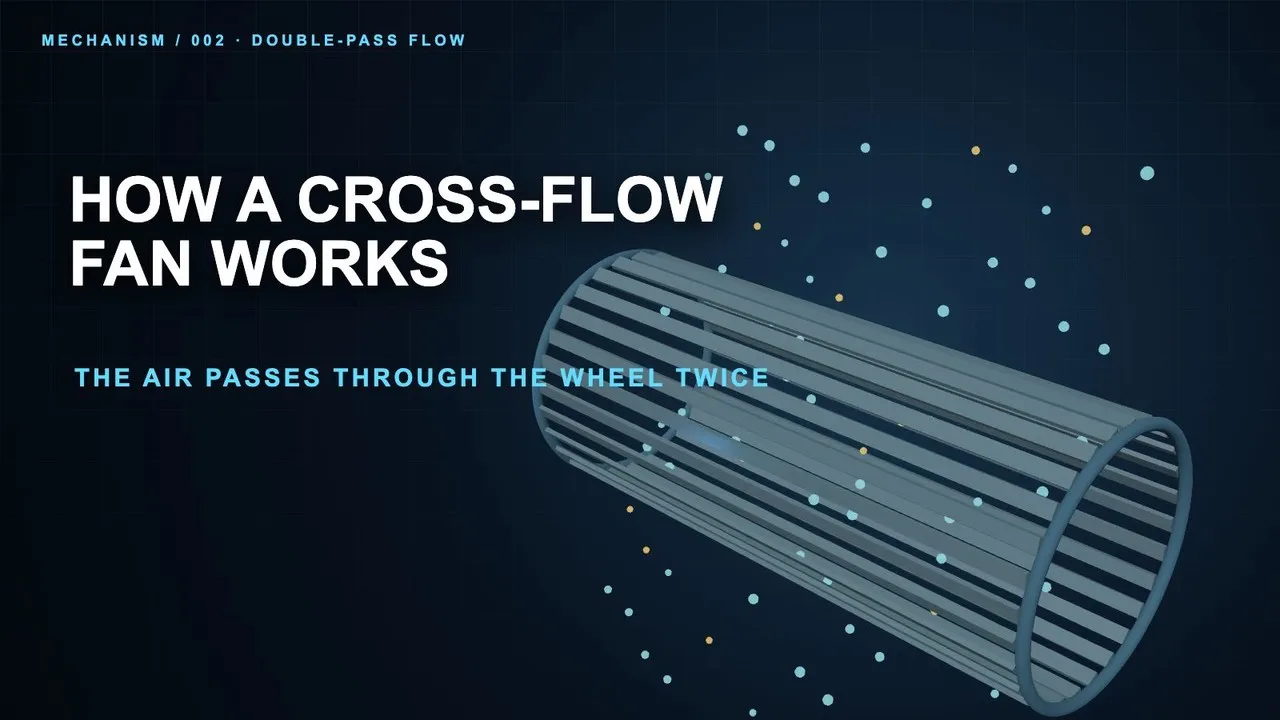
Essentially a cross-flow impeller is molded as blade segments joined to end rings. The mold defines the blade profile, and therefore the diameter.
Length behaves differently. A longer impeller simply uses more segments of the same molded part, joined along a shaft. Consequently changing length does not need new impeller tooling, whereas changing diameter does.
That distinction is the single largest cost lever on a custom impeller, and customers rarely know it going in.
Checking the four against inventory
Usefully the requested diameters were 97mm, 101.5mm and 109mm. All three already exist in our tooling inventory.
So a full NPI cycle, which runs 90 days when new tooling is genuinely needed, was unnecessary. The remaining work was drawings for the specific lengths and shaft configurations.
Aluminum considered for the long ones
Here the 848mm spans raised the usual question about material.
Aluminum is stiffer, and over that length stiffness matters for runout. However, glass-filled AS held the required runout tolerance anyway. Meanwhile it weighs less and costs considerably less.
It also handles humidity well, which suits an air curtain sitting above a doorway.
What it cost
Flexibility on diameter. The customer got a fast quotation precisely because they happened to want diameters we already tool.
Had they asked for 105mm instead of 101.5mm, none of this applies. That is worth knowing before a housing is designed around a diameter nobody has a mold for.
Technical Specifications
Three diameters and four lengths sit below. Read them as a grid, since that is how the tooling works.
| Parameter | LWPI-Φ97X621-01 | LWPI-Φ101.5X848-01 | LWPI-Φ101.5×848-02 | LWPI-Φ109X830-01 |
|---|---|---|---|---|
| Diameter | 97 mm | 101.5 mm | 101.5 mm | 109 mm |
| Length | 621 mm | 848 mm | 848 mm | 830 mm |
| Material | AS+GF30% (Acrylonitrile Styrene w/ 30% Glass Fiber) | |||
| Shaft Diameter | 6 mm | |||
| Shaft Length (Exposed) | 25 mm | |||
| Rotation Direction | CCW (Counter-Clockwise) | |||
| Bushing Type | External | Built-In | Built-In | External |
| Bushing ID | 8 mm | 10 mm | 8 mm | 8 mm |
| Balancing Specification | ≤0.3g @ 1200 RPM | |||
| Radial Runout | <0.7 mm | |||
| Axial Runout | <0.6 mm | |||
Technical Documentation
The following documents were generated to define the solution and enable manufacturing. These are the final, approved deliverables for this project.
LWPI-φ97X621-01.pdf: This drawing provides detailed dimensional and tolerance data for the 97mm diameter, 621mm length impeller, critical for housing design and motor shaft integration.
LWPI-Φ101.5X848-01.pdf: This drawing specifies the 101.5mm diameter x 848mm length impeller with a 10mm ID bushing, ensuring correct assembly for this specific variant.
LWPI-Φ101.5×848-02.pdf: This document details the second 101.5mm diameter x 848mm length impeller, identical except for its 8mm ID bushing.
LWPI-φ109X830-01.pdf: This engineering drawing outlines the largest diameter impeller at 109mm with a length of 830mm and an external bushing.

How to keep a custom impeller cheap
Custom impellers are cheap or expensive depending on one decision. These keep you on the cheap side.
- Ask which diameters are already tooled before fixing your housing. Impeller tooling is the dominant cost, and it is priced per diameter. Designing around an existing one costs nothing; designing around a new one costs a mold and 90 days.
- Treat length as free and diameter as expensive. Within limits, length is a matter of how many molded segments go on the shaft. If your design can flex on one dimension, flex on length.
- Send diameters with tolerances, not nominal sizes. A 101.5mm requirement and a 100mm requirement look similar and are not. Stating the tolerance tells the supplier whether an existing tool actually covers you.
- Check runout before choosing material. Long spans need stiffness, and that is where plastic sometimes loses to aluminum. Give the runout figure you need and let the material follow, rather than specifying metal defensively.
See our cross flow impeller range, the cross flow fan section, or fan impellers. Balance grades follow ISO 21940.
Questions about custom impellers
Why does diameter need new tooling but length does not?
Because the mold forms the blade profile in cross-section, and that cross-section is what diameter changes. Length is built by joining more of the same molded segments along a shaft. So a new length is a drawing change, while a new diameter is a new mold.
What does new impeller tooling cost in time?
Our full NPI cycle runs 90 days from spec lock to first samples, and the mold is the long pole in that. Compare it with an existing diameter, where drawings come back in days and samples follow within a couple of weeks.
Is there a length limit before plastic stops working?
It depends on diameter, speed and the runout you need, rather than on length alone. A slender rotor sags and resonates as it gets longer, so the practical limit falls as diameter drops. Send us the length, diameter, speed and runout tolerance together and we will say whether plastic holds.
Can you machine an existing impeller to a different diameter?
No. Unlike a bore, the blade profile is formed by the mold and cannot be reduced afterwards without destroying the aerodynamics. Where an existing diameter is close but not exact, it is usually better to adapt the housing than to modify the impeller.
Technical Documentation & Resources




Sizing something comparable?
Share the airflow, pressure, voltage and control interface, and we come back with a tested curve and a drawing. Meanwhile custom work runs to 90 days for spec sheets and samples. Since 1990 Longwell has supplied fans to HVAC and industrial OEMs.
Browse Related Products:
🏆 ISO 9001 / ISO 14001 / ISO 45001 | CE (TÜV) | UL/ETL | ATEX Zone 21/22 | AMCA 210/211 / ISO 5801 tested