What the condenser OEM needed
A commercial HVAC OEM asked for a specification sheet on a 900mm dual-speed condenser fan for a new range of large air-cooled condensers.
They had already referenced an existing fan profile, so the shape of the answer was clear. In practice they needed documents and confirmation.
The constraints
- First, a 380/400V, 50Hz three-phase supply.
- Next, roughly 900mm blade diameter with mounting depth under 205mm.
- Meanwhile the ambient range ran from -30C to +60C, covering both target markets.
- Noise had to stay at or below 80 dB(A) at full speed.
- Finally, both CE and ETL certification, satisfying EN 60335-1 and UL 507.
Baseline airflow was 27,089 m3/h. However, the requirement that shaped the design was dual-speed operation. Consequently the unit could run quieter and cheaper overnight, or in mild weather.
Two speeds from one dual-speed condenser fan
The request pointed at an established AC axial design. Even so, we weighed the alternative before agreeing.
EC was considered and set aside
An EC motor gives better efficiency and infinitely variable speed. However, the customer had signalled a preference for the simplicity and lower purchase cost of an AC motor, and the requirement was two speeds rather than a continuous range.
Consequently a VFD or an EC controller would add expense and complexity for capability the system never uses.
Two speeds with no electronics at all
Here the answer is a Dahlander winding, sometimes called a consequent-pole motor. Switching between a Delta and a Star connection changes the effective pole count, and therefore the speed.
That switch happens with ordinary contactors. Consequently the dual-speed condenser fan needs no drive, no controller and nothing that can fail electronically in an outdoor cabinet.
How the two points compare
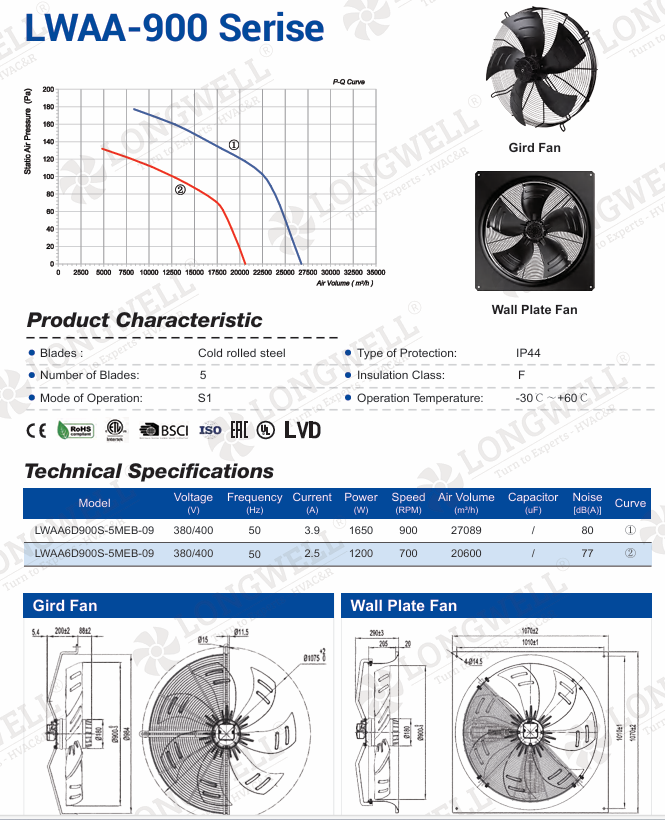
At 900 RPM this dual-speed condenser fan gives 27,089 m3/h, drawing 1650W at 80 dB(A). Meanwhile at 700 RPM it gives 20,600 m3/h, drawing 1200W at 77 dB(A).
Note the shape of that trade. Airflow falls by about a quarter, yet power falls further and noise drops 3 dB(A). In short, running slow at night is worth the extra contactor.
Impeller and build
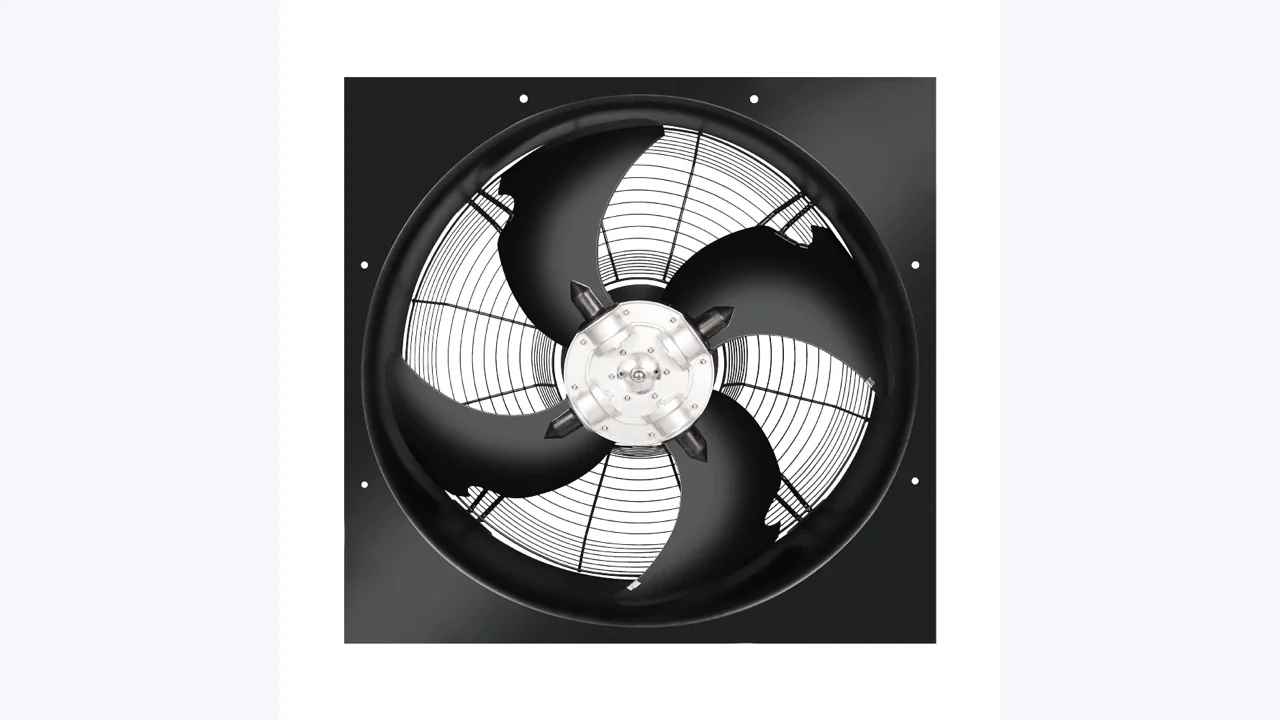
The impeller has five blades, balancing airflow against noise and structural stability at 900 RPM. Furthermore they are cold-rolled steel, which gives a 900mm diameter the rigidity it needs outdoors.
Class F insulation and IP54 protection cover the thermal and environmental side. Together they let this dual-speed condenser fan sit outdoors for years.
Technical Specifications
Two operating points appear below. Compare the power figures, since that gap is exactly why the second speed exists.
| Parameter | Value (High Speed) | Value (Low Speed) |
|---|---|---|
| Model | LWAA6D900S-5MEB-09 | |
| Voltage | 380/400 V (Range: 342-418V) | |
| Frequency | 50 Hz | |
| Speed (RPM) | 900 | 700 |
| Input Power (W) | 1650 | 1200 |
| Current (A) | 3.9 | 2.5 |
| Air Volume (m³/h) | 27,089 | 20,600 |
| Air Volume (CFM) | 15,935 | 12,118 |
| Noise Level [dB(A)] | 80 | 77 |
| Blade Diameter | 900 mm | |
| Protection Class | IP54 | |
| Insulation Class | F | |
| Operating Temperature | -30°C to +60°C | |
| Duty Cycle | S1 (Continuous) | |
| Certifications | CE, ETL (UL 507, CSA C22.2#113) |
Technical Documentation

Meanwhile the primary product data sheet provides procurement managers and engineers with a quick-reference summary of performance, electrical data, and key features.
Open Full Technical Specification (PDF)
The complete technical file contains detailed performance curves, dimensional drawings, wiring diagrams, and a full list of compliance standards for system integrators and compliance engineers.
Why the OEM specified it
Beyond the airflow figure, four practical points carried this dual-speed condenser fan.
- One SKU for two continents. The fan already held CE and ETL certification, so the OEM could specify a single part number for condensers sold in Europe and North America. That simplifies their bill of materials and their inventory at once.
- AC cost with the performance intact. Fan cost matters at condenser volumes, where the same part ships thousands of times. Established AC motor technology delivers the airflow and the reliability without electronics that a fixed-speed duty would never use.
- Documentation without chasing. The request was for a formal spec sheet, and an approved, technically accurate document came back promptly. Design work stalls waiting on paperwork, so that speed lands on their schedule.
- Outdoor duty proven in the field. The S1 continuous rating, IP54 protection and 30,000-hour L10 life rest on deployment history, including over 120,000 units a year for data center cooling and more than 30,000 for cold chain.
See our axial fan range, or the condenser fan section. Ingress ratings come from IEC 60529.
Questions about this fan
What changes between the 900 RPM and 700 RPM modes?
Here the winding configuration, switched from Delta for high speed to Star for low. At 900 RPM you get 27,089 m3/h, 1650W and 80 dB(A). Meanwhile at 700 RPM that becomes 20,600 m3/h, 1200W and 77 dB(A). The low setting suits night running and partial load, where the energy saving and the noise limit both matter.
Can it run on a VFD?
Not sensibly. This is a pole-changing motor built for two fixed speeds at mains frequency. Certainly some standard AC motors tolerate drive control, although this one would need careful review to avoid overheating or vibration. For genuinely variable speed, take a SmartEC fan with 0-10V or PWM control instead.
What does the 30,000-hour L10 figure actually mean?
It means that after 30,000 hours of continuous running under test conditions, at 40C ambient and 15 to 65% humidity, 90% of a large batch are expected to still be working. The figure is set mainly by the maintenance-free deep groove ball bearings rather than by the motor itself.
Is two speeds enough, or should we hold out for variable?
It depends on your control strategy. If the condenser needs only a day and a night setting, two speeds capture nearly all the saving for a fraction of the cost. By contrast, if you plan to modulate head pressure continuously against ambient, an EC fan repays itself. So decide the control logic first, then pick the fan.
Technical Documentation & Resources
Have a fan requirement like this one?
Send the datasheet you are working against, or simply the duty point. Then our engineers tell you what fits and what does not. Meanwhile custom spec sheets and samples take up to 90 days. Since 1990 we have been building fans for OEMs worldwide.
🏆 ISO 9001 / ISO 14001 / ISO 45001 | CE (TÜV) | UL/ETL | ATEX Zone 21/22 | AMCA 210/211 / ISO 5801 tested
Choose the right condenser cooling fan
Longwell manufactures 17 condenser cooling fans in-house. Send airflow, static pressure and voltage — an engineer replies with a matching model, performance curve and price within one working day.