What the FCU builder specified
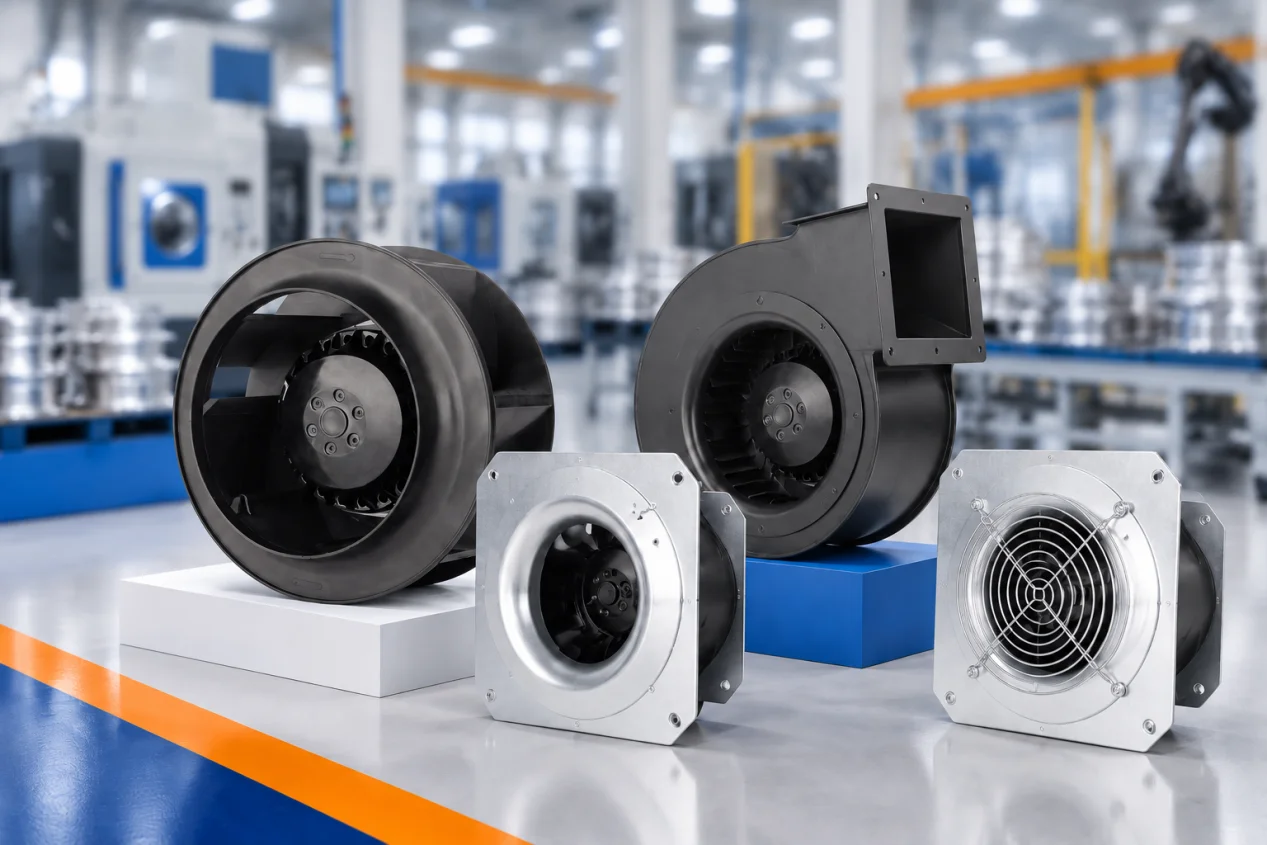
An OEM needed a double-inlet DC centrifugal blower for a high-performance fan coil unit. It had to run on 24 VDC and deliver 1,237 m3/h. The opening order was 200 units.
The drawings and the product type made the application obvious. Namely modern commercial HVAC, where efficiency and precise control both matter.
Here the constraints were demanding in several directions at once.
- A wide DC window from 16 to 32V, since a battery or shared supply sits behind it.
- Maximum static pressure of 300 Pa, to overcome resistance in ducted runs.
- PWM speed control from 50 Hz to 500 Hz, because a building management system drives it.
- An operating range from -40C to +85C, at both extremes.
- No more than 70 dB(A), with L10 life of at least 40,000 hours.
- CE marking against EN 60335-1 for the European market.
That temperature span is worth pausing on. Basically it tells you the finished FCU goes into unconditioned space, where the kit sees whatever the season provides.
Validating the DC centrifugal blower
The came in as light development, meaning documents and a quotation against a standard model. Even so, our task was to check the LWFC-DC103M-01 really meets a demanding brief rather than merely resembling it.
Why not AC
We considered an AC motor briefly, and it fails at the first hurdle. It cannot run from 24 VDC. Furthermore, it cannot take PWM without an external inverter that adds cost and bulk.
Forward-curved, not backward-curved
Here the one is a genuine trade-off. A backward-curved wheel is more efficient at peak pressure, and in a larger machine it would win.
Inside an FCU, however, the envelope decides it. At 351.6 by 167.4 by 139.4mm, a forward-curved wheel gives considerably more airflow from that space. In short, efficiency you cannot fit in the cabinet is not efficiency.
What the standard model already had
This DC centrifugal blower runs an integrated brushless motor on our SmartEC platform. Consequently it takes the customer PWM signal directly.
Its -40C to +85C range is standard rather than special. That comes from our ThermoFlex approach, which uses automotive-grade electronics alongside Class F insulation rated to 155C. Consequently there is real thermal headroom above the 85C ambient maximum rather than a rating quoted right at the limit.
The IP66 rating nobody asked for
IP66 is standard on this motor platform. Admittedly it far exceeds what an indoor HVAC fan normally needs.
That is not padding, though. It costs the customer nothing, while giving a wide margin against condensation, dust and whatever cleaning regime the building operator later introduces. In the end the standard model met every requirement without modification.
Technical Specifications
Two rows below stand out. Firstly the temperature range, then the IP rating. Both exceed what an indoor FCU normally needs, yet neither costs extra on this DC centrifugal blower platform.
| Parameter | Value |
|---|---|
| Model Number | LWFC-DC103M-01 |
| Nominal Voltage | 24 VDC |
| Voltage Range | 16 – 32 VDC |
| Max Speed | 4500 RPM |
| Max Current | 13.9 A |
| Max Power Input | 330 W |
| Max Airflow | 1237 m³/h / 727 CFM |
| Max Static Pressure | 300 Pa |
| Noise Level (LpA) | 70 dB(A) |
| Dimensions (W x H x D) | 351.6 x 167.4 x 139.4 mm |
| Min. Ambient Temperature | -40°C |
| Max. Ambient Temperature | +85°C |
| Insulation Class | Class F |
| Protection Class | IP66 |
| Life Expectancy (L10) | 40,000 Hours at 25°C |
| Work System | S1 (Continuous Duty) |
| Speed Control | PWM (50-500Hz, 0-100% duty cycle) |
| Certifications | CE, RoHS, Reach |
Technical Documentation
Meanwhile the LWFC-DC103M-01 technical specification sheet contains all performance data, P-Q curves, mechanical drawings, and wiring diagrams required by design engineers for system integration.
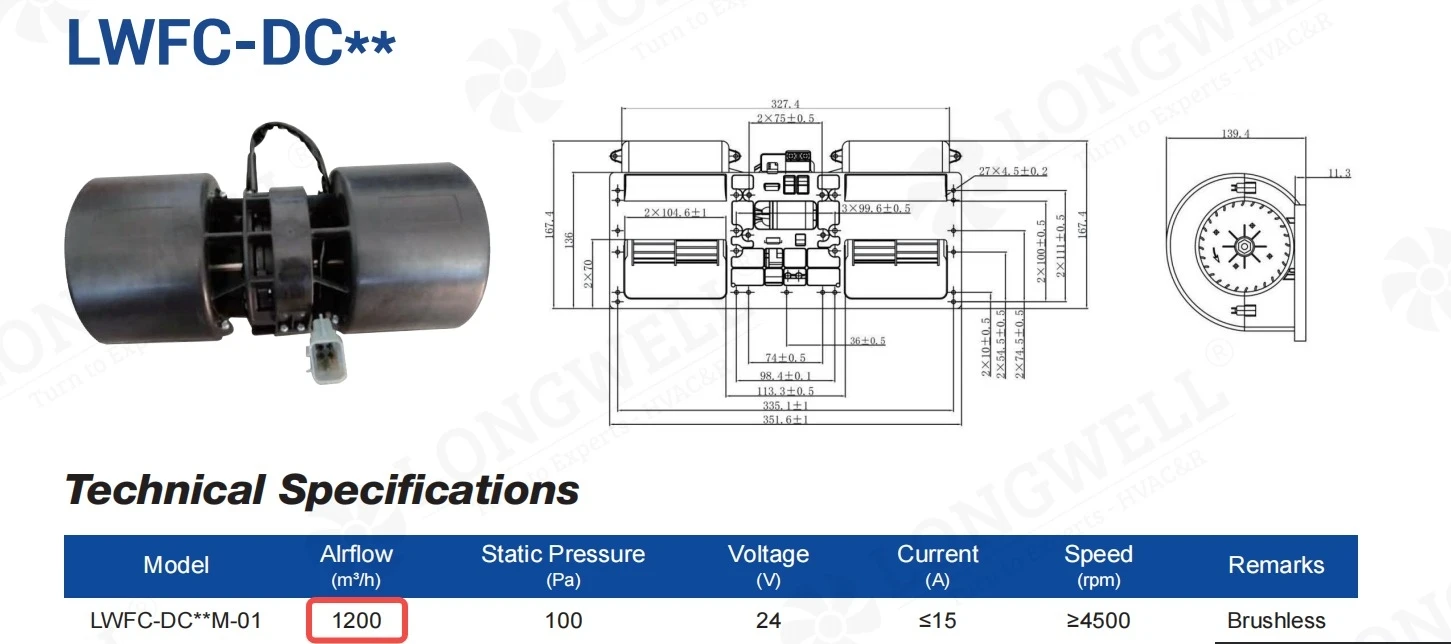
Above, the product image and dimensional drawing provides procurement managers with a quick visual reference for the LWFC-DC**M-01 series double-inlet centrifugal blower.
Why the OEM sourced from us
For an OEM moving into volume production, four things counted.
- Supply that can be planned around. Two hundred units, with more likely, needs a supplier with real scale. Our make-to-order lead time of 15 to 25 days for HVAC products is predictable, against the far longer cycles imported European brands quote.
- A tough specification without a tough price. IP66 and a -40C to +85C range come from sealing and component selection, both of which we do ourselves. So the OEM gets a harder-wearing product without the cost of that toughness landing somewhere else in the design.
- Data and certification both ready. Every DC centrifugal blower is tested to ISO 5801, so the P-Q curve is usable. CE is already in hand too, backed by our China-local TUV NORD link, which cuts the customer own approval work.
- One platform across the range. SmartEC and ThermoFlex run through all our EC products. Consequently a customer needing a different fan type later gets the same control interface and the same reliability behavior, which simplifies design and procurement alike.
Browse our centrifugal blower range, or the fan coil unit blower series. Protection ratings are defined in IEC 60529.
Questions about duty points and ratings
What does it do at a realistic duty point rather than the maximum?
The headline figures are 1237 m3/h at 0 Pa and 300 Pa peak pressure, which never occur together. On the curve, a high-static FCU typically sits near 1100 m3/h at 200 Pa. PWM control between 50 and 500 Hz then lets you set any point the system design needs, trading airflow against noise and watts.
Is IP66 standard, and is the motor really sealed?
Yes on both counts. The motor and its integrated electronics form a fully sealed assembly. IP66 certifies protection against total dust ingress and powerful water jets, which is a large margin over the IP44 typical of indoor fans, and it matters wherever condensation or wash-down cleaning occurs.
How is the -40C to +85C range achieved, and what happens to L10 life?
Through Class F windings rated to 155C, automotive-grade electronics and specialized bearing lubrication. The published 40,000-hour L10 is rated at 25C ambient. Continuous running at 85C shortens it, and cooler operation extends it. Send us your thermal profile and we will produce a specific life calculation.
Why does a wide voltage window matter on a 24V fan?
Because a nominal 24V rail rarely stays at 24V. Battery-backed and shared supplies sag under load, then rise on charge. A DC centrifugal blower working from 16 to 32V keeps going through all of it, whereas a narrower part either shuts down or overheats at the extremes.
Technical Documentation & Resources
Need the same thing for your own unit?
Give us the numbers and the envelope, and you get a shortlist rather than a catalog. Meanwhile custom spec sheets and samples run to 90 days. Since 1990 Longwell has supplied EC fans and blowers to OEMs in HVAC, cold chain, data center and industrial markets.
Browse Related Products:
🏆 ISO 9001 / ISO 14001 / ISO 45001 | CE (TÜV) | UL/ETL | ATEX Zone 21/22 | AMCA 210/211 / ISO 5801 tested
Choose the right fan coil unit
Longwell manufactures 14 fan coil units in-house. Send airflow, static pressure and voltage — an engineer replies with a matching model, performance curve and price within one working day.