What the appliance OEM asked for
A major home appliance OEM came to us with a projected 10,000 units a year. They wanted a family of AC axial exhaust fan models, both square and round cased.
Their brief named four variants and gave reference figures. Importantly, they also offered to adapt to our existing range, to speed development and control cost. That flexibility shaped everything afterwards.
- One square AC axial exhaust fan for a 31cm duct at a target 2600 RPM.
- Then a square unit for a 41cm duct at 1400 RPM.
- Next a square unit for a 53cm duct, also at 1400 RPM.
- Finally a round-cased unit for a 43cm duct at 1400 RPM.
- Meanwhile 220V at 50Hz applies across all four.
These go into consumer appliances. Consequently scalability, unit cost and steady quality matter as much as airflow. Furthermore, any part in a domestic appliance must support the end product meeting standards such as IEC 60335.
Standardizing the AC axial exhaust fan family
The ran as light development. In other words we matched the AC axial exhaust fan requirement onto existing models, rather than opening a 90-day NPI cycle.
The speed request did not add up
Our engineers looked at the mixed speeds first. 2600 RPM needs a 2-pole motor, whereas 1400 RPM comes from a 4-pole one.
Using two motor types across one product family complicates the customer supply chain and raises the cost of every unit. On 10,000 fans a year, that is not a small consequence.
So we asked what the number was for
Here the team suspected the RPM figures stood in for airflow, rather than being requirements themselves. If so, the whole family could run on one 4-pole motor platform.
Analysis confirmed it was feasible. For the 31cm fan at a nominal 2600 RPM, we proposed a model turning at 1350 RPM that still gives 1680 m3/h. Afterwards the customer confirmed airflow, not motor speed, was what mattered.
Consequently one conversation standardized the motor across all four sizes, simplifying both manufacturing and buying.
The four models
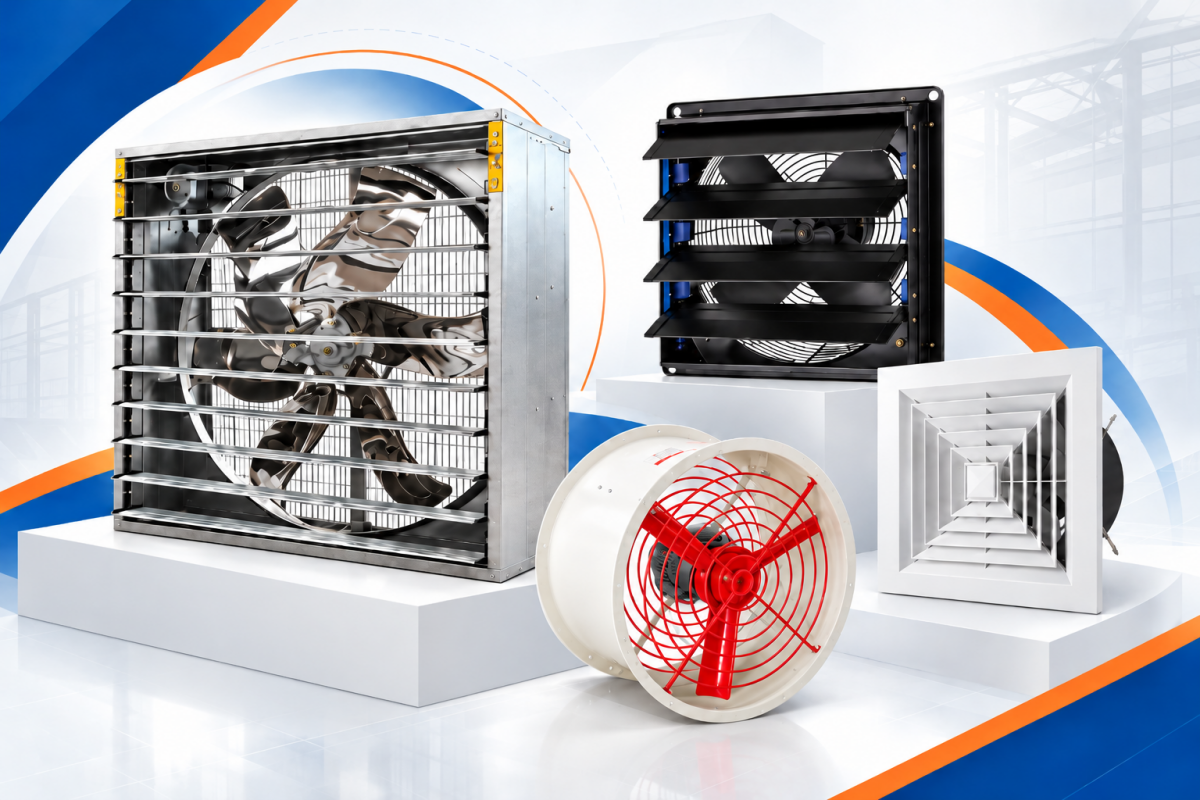
The remaining three matched directly within our LWEA series: one for the 41cm request, one for the 53cm, and one round 43cm model. Each AC axial exhaust fan runs from 220V, 50Hz at a nominal 1350 to 1433 RPM.
Why AC rather than EC
We chose AC over EC deliberately. Home appliance budgets are unforgiving, and an AC axial exhaust fan delivers the ventilation needed at a materially lower cost than an EC equivalent.
Nothing in the application asks for variable speed. Consequently the EC capability would have been paid for and never used.
Technical Specifications
Four AC axial exhaust fan models are listed below. Look at the speed column, since every one runs at roughly the same RPM. That was the point of the exercise.
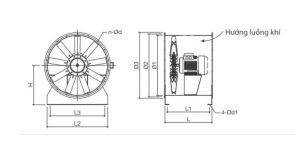
| Parameter | LWEA300(12)SM-120 | LWEA350(14)SM-123 | LWEA400(16)SM-121 | LWEA500(20)SM-122 |
|---|---|---|---|---|
| Voltage (VAC) | 220 | 220 | 220 | 220 |
| Frequency (Hz) | 50 | 50 | 50 | 50 |
| Airflow (m³/h) | 1680 | 2450 | 2880 | 9000 |
| Speed (RPM) | 1350 | 1433 | 1350 | 1350 |
| Input Power (W) | 80 | 166 | 150 | 500 |
| Static Pressure (Pa) | Not Specified | 120 | Not Specified | Not Specified |
| Frame Dimensions (mm) | 340 x 340 | Ø380 | 480 x 480 | 590 x 590 |
| Depth (mm) | 180 | 130 | 210 | 230 |
| Protection Type | IP54 | IP54 | IP54 | IP54 |
Technical Documentation
Meanwhile the following documents were approved and delivered to the customer, providing all necessary data for integration and qualification.
LWEA300(12)SM-120 Datasheet: This document provides the mechanical drawing, dimensions, and performance specifications for the 300mm square frame model, essential for the design engineer.
LWEA350(14)SM-123 Datasheet: This file contains the engineering data for the 350mm round frame model, including its unique 120 Pa static pressure capability, for the HVAC systems integrator.
LWEA400(16)SM-121 Datasheet: The procurement manager and engineering team use this specification sheet to confirm the performance and fit of the 400mm square fan.
LWEA500(20)SM-122 Datasheet: This datasheet outlines the capabilities of the highest-airflow model, delivering 9,000 m³/h, crucial for validating the top-tier appliance’s ventilation capacity.


Why one supplier covered four sizes
For an OEM building 10,000 appliances a year, the supplier choice runs well past the fan itself.
- Four datasheets and a quotation, quickly. Because the customer was flexible, our engineers matched each AC axial exhaust fan requirement straight onto an existing LWEA model. Consequently they had actionable data in days rather than weeks, with no NPI process in between.
- Scale that supports the volume. Ten thousand units a year needs a partner with proven capacity. Manufacturing here since 1990, with over 120,000 data center fan units built annually, gives both the capacity and the cost structure a consumer appliance needs.
- Four sizes, one supplier. Four fan sizes could have meant four suppliers. Consolidating them removes duplicated procurement, logistics, quality audits and payment terms from the OEM side.
- Certified foundations. All four carry IP54, our manufacturing is ISO 9001 certified, and performance is verified against AMCA 210/211 and ISO 5801. That is what an OEM needs underneath a component when their own product faces CE or UL.
Browse our exhaust fan range, or the AC axial fan section. Appliance safety comes from IEC 60335-1.
Questions about the fan family
What is the lead time on 10,000 units a year?
A volume like that runs on a rolling schedule rather than as one order. Initial batches of 500 to 1,000 units are made to order in 15 to 25 days. Once a frame agreement is in place we set up a dedicated inventory program, which brings standard quantities down to 1 to 5 working days.
Why supply a 1350 RPM fan when 2600 RPM was requested?
Because our review concluded the 2600 RPM figure stood in for an airflow target, rather than being a hard requirement. The proposed AC axial exhaust fan reaches the 1680 m3/h the application needs on a 4-pole motor at 1350 RPM. Consequently one motor platform serves all four sizes, which lowers cost and simplifies the supply chain.
Are these suitable for Europe or North America?
Yes. These units were built for 220V/50Hz, and we make variants for all global markets including 115V/60Hz and 230V/60Hz. They can be supplied CE marked, certified by TUV, and with UL component recognition under UL 507. Our China-local TUV NORD relationship shortens certification for OEM-specific requirements considerably.
Why does a slower motor sometimes move as much air?
Because airflow depends on blade diameter and shape as well as speed. A larger, better-shaped impeller at 1350 RPM matches a smaller one at 2600 RPM. Moreover it runs quieter and draws less power doing it. In short, an airflow figure is a far more useful requirement than an RPM figure.
Technical Documentation & Resources

Need the same thing for your own unit?
Give us the numbers and the envelope, and you get a shortlist rather than a catalog. Meanwhile custom spec sheets and samples run to 90 days. Since 1990 Longwell has supplied EC fans and blowers to OEMs in HVAC, cold chain, data center and industrial markets.
Browse Related Products:
🏆 ISO 9001 / ISO 14001 / ISO 45001 | CE (TÜV) | UL/ETL | ATEX Zone 21/22 | AMCA 210/211 / ISO 5801 tested
Choose the right exhaust fan
Longwell manufactures 241 exhaust fans in-house. Send airflow, static pressure and voltage — an engineer replies with a matching model, performance curve and price within one working day.