What the OEM needed documented
An HVAC OEM needed formal drawings for one long fan, 1286mm, going into low-profile trench heaters and perimeter convectors for Europe and Eurasia.
They had already qualified the fan in their design. Now they were moving from prototype to production and needed controlled documentation for their bill of materials and technical file.
What the housing dictates
The channel is 60mm wide and 63.3mm high. That is a slot in a floor, and it constrains the answer far more than the airflow figure does.
- First, a 24 VDC supply drawing about 0.5A.
- Next, 0-10V analog speed control.
- Meanwhile CE and EAC marking on the label, for both target markets.
- Finally, aluminum impeller construction across the full 1286mm housing.
Why one long fan beat the alternatives
Here the original selection had already proven out, so our work was validating it. Even so, the alternatives are worth recording, because this decision comes up constantly.
An array of small axial fans
Putting three or four small axial fans in a row looks flexible and is usually cheaper per fan.
However, each one produces a cone of air. Consequently you get fast patches under each fan and slow gaps between them, and those gaps become thermal hotspots on the heat exchanger.
The wiring gets worse too. Four fans means four sets of connections, four potential failure points, and a harness that has to run the length of the channel.
A ducted centrifugal blower
A blower certainly moves the air. It also needs a housing with real volume, plus ductwork to distribute the output along the trench.
Neither fits in 63mm of depth. This is a case where the fan type was decided by the floor void rather than by the aerodynamics.
Why one long fan wins here
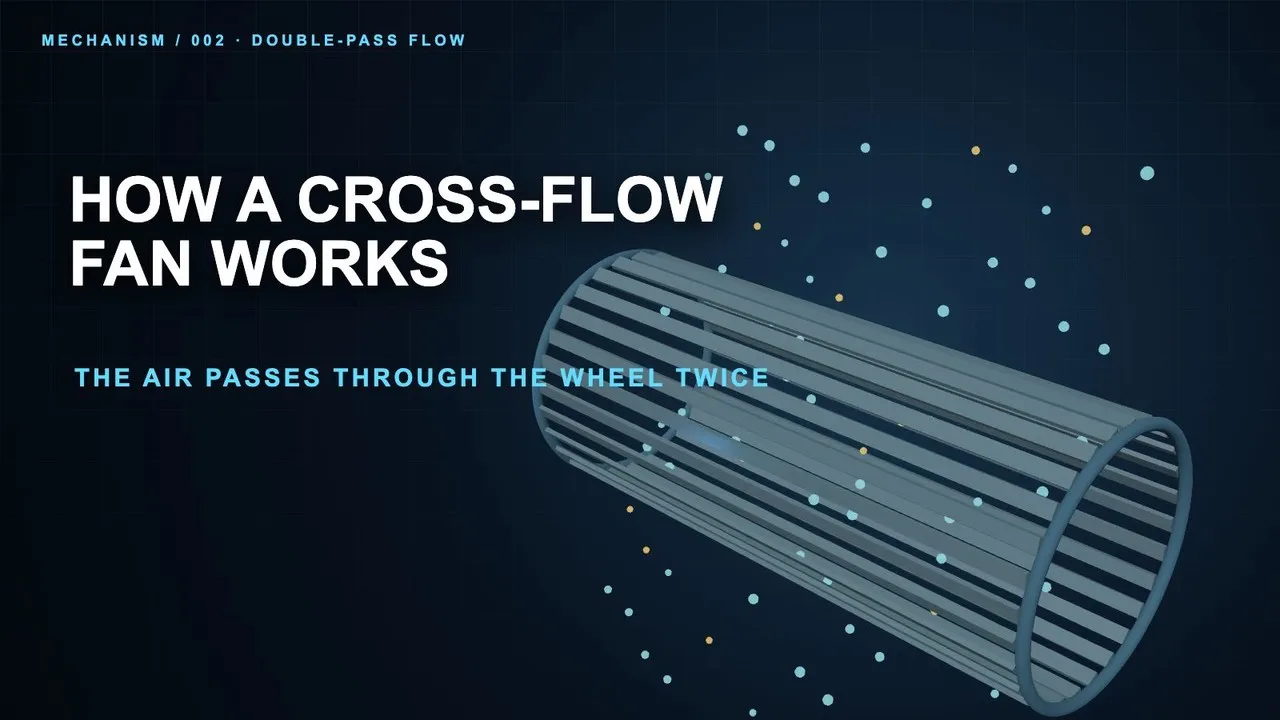
One long fan of the cross-flow type draws and discharges along its entire length. Consequently airflow is uniform end to end, with no gaps to engineer around.
It also fits the slot. A cross-flow fan is inherently long and shallow, which is exactly the shape of the space available.
The design details that make 1.3 meters work
A single brushless DC motor drives the whole span, which is the most economical arrangement at this length.
Meanwhile the 22-blade impeller is aluminum, chosen to keep rotational inertia and sag low over 1.3 meters. Meanwhile the integrated driver takes the 24V supply and the 0-10V signal directly, modulating speed from near zero up to 2200 RPM.
What it cost
A single point of failure. With one fan across the whole heater, a motor failure stops all the airflow rather than degrading it.
An array would keep working at reduced output with one fan down. That is a genuine advantage, and it is outweighed here by uniformity and by the fact that four fans have four times the chance of one failing in the first place.
Technical Specifications
Note the housing width and height below. Those two numbers are what rule out most other fan types.
| Parameter | Value |
|---|---|
| Model Number | LWCD-401286MN-06-16 |
| Voltage (VDC) | 24 V |
| Current (A) | 0.5 A ±10% |
| Speed (RPM) | 2200 ±10% |
| Speed Control | 0-10V Analog |
| Bearings | Ball Bearing |
| Overall Length (L) | 1344 ±2 mm |
| Housing Length | 1286 ±1 mm |
| Housing Width | 60 mm |
| Housing Height | 63.3 mm |
| Impeller Material | Aluminum |
| Certifications (on label) | CE, EAC |
Technical Documentation
The following documents were the final deliverables for project LWCD-401286M-30.
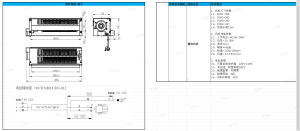
LWCD-401286MN-06-16 Drawing & Specifications (PDF)
Here the official engineering drawing provides all dimensional tolerances, material specifications, and electrical parameters needed by design engineers for mechanical integration and by quality teams for incoming inspection.
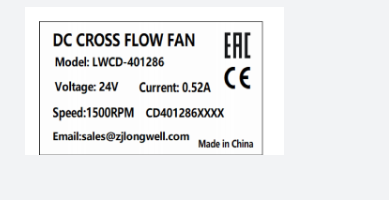
Here the product rating label specifies the base electrical parameters and regulatory compliance marks, used by compliance engineers for assembly certification and by field service technicians for component identification.
If you are covering a wide opening
Choosing one long fan over an array is a recurring decision. These are the parts worth settling early.
- Decide uniformity tolerance before fan count. If your heat exchanger or outlet can tolerate variation across its width, an array is viable and often cheaper. If it cannot, one long fan is the only clean answer.
- Measure the available depth honestly. Depth is what eliminates centrifugal options, and it is usually the constraint people discover last. Include the mounting, the cable exit and the service clearance, not just the fan body.
- Count the connections, not just the fans. An array multiplies the harness, the connectors and the failure points. On a floor-buried unit where access means lifting a grille, that matters more than the component price.
- Ask about sag and inertia over long spans. Above roughly a meter, impeller material and construction stop being a detail. Aluminum, segmentation and bearing support all become the difference between quiet and not.
See our cross flow fan range, the DC cross flow fan section, or cross flow impellers. Ventilation guidance follows ASHRAE 62.1.
Questions about long fans
Would several small fans really cause hotspots?
Yes, and predictably so. An axial fan discharges in a cone, so airflow peaks under each unit and falls between them. Across a heat exchanger that produces alternating well-cooled and poorly-cooled bands, and the poorly-cooled ones set the limit for the whole unit.
What happens if the single motor fails?
The heater stops delivering air, which is the honest downside of using one long fan. However, the tachometer or status output feeds your controller, so the failure becomes an alarm rather than a cold room someone reports days later.
How long can a single cross-flow fan span?
Well over a meter with the right construction. Past that, impeller material, segmentation and bearing support all become critical, since a slender rotor sags and resonates. Tell us the span and the speed and we will confirm what the construction needs to be.
Why does a trench heater need variable speed?
For two reasons. It matches output to heating demand instead of cycling on and off, which keeps the room temperature steadier. It also lets the fan run slowly and quietly most of the time, which matters when the unit is set into the floor of an occupied room.
Technical Documentation & Resources
Need the same thing for your own unit?
Give us the numbers and the envelope, and you get a shortlist rather than a catalog. Meanwhile custom spec sheets and samples run to 90 days. Since 1990 Longwell has supplied EC fans and blowers to OEMs in HVAC, cold chain, data center and industrial markets.
Browse Related Products:
🏆 ISO 9001 / ISO 14001 / ISO 45001 | CE (TÜV) | UL/ETL | ATEX Zone 21/22 | AMCA 210/211 / ISO 5801 tested