A rail that was not 24V
An existing customer came back with a non-standard DC voltage problem. Their new system supply puts out a stable 26 to 26.5 volts, while every fan they had been buying was rated 24V.
They needed a drop-in replacement for a 480mm cross-flow fan we had already supplied. Same chassis, same performance, different rail.
What could not change
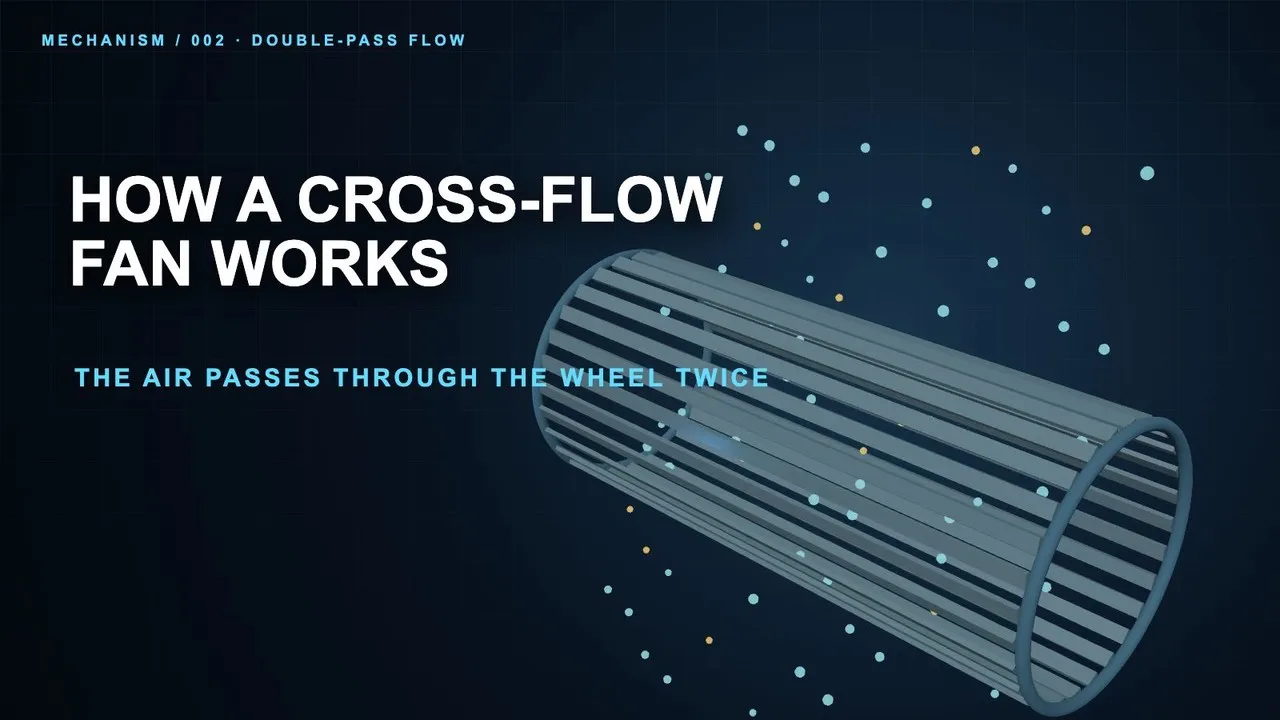
- The envelope stayed at 480mm long by 90 by 90mm, since the chassis was already built.
- Airflow had to hold at 355 m3/h with a nominal 1900 RPM.
- Meanwhile the 0-10V analog speed input had to survive, because their climate controller uses it.
- Finally, general appliance safety under IEC 60335 applied for their market.
A non-standard DC voltage rail is commoner than fan catalogs suggest. Battery systems, telecom supplies and vehicle rails all sit at odd numbers. Meanwhile the fan is usually the last part anyone thinks about.
Three ways to handle a non-standard DC voltage
Three routes existed for closing a 2.5 volt gap. However, two of them look reasonable and are not.
Option one: drop the voltage with a converter
Add a DC-DC converter ahead of the fan and feed it the 24V it expects.
We rejected this. It adds a part to the assembly, adds cost, and creates a failure point between supply and fan. Furthermore, on a sealed HVAC unit that converter is the part nobody can reach when it fails.
Option two: run the 24V fan at 26.5V and hope
This is the option customers most often propose, and it is worth being blunt about why it fails.
A 24V motor on 26.5V over-speeds. It draws more current than rated and runs hotter. Consequently bearing grease degrades faster and winding insulation ages faster, so the fan does not fail immediately. It fails early, in the field, after the equipment has shipped.
It also breaks repeatability. The speed now depends on the exact rail voltage, so two identical units behave differently.
Option three: change what the controller expects
This is the route we took. The fan uses our own EC motor and drive electronics, so the controller firmware is ours to adjust.
So we recalibrated the SmartEC controller to treat that non-standard DC voltage as its nominal input, driving the motor to exactly 1900 RPM. Meanwhile the motor winding and the 60 by 420mm impeller were left alone.
Consequently the mechanical fit is guaranteed, the airflow figure is unchanged, and the motor runs at the current and temperature it was designed for. A new part number was issued so the variant stays traceable in both our records and theirs.
What it cost
Honestly, very little here. Even so, the fan is now specific to this rail. Run the variant on 24V and it turns slower than the label says. That is a documentation problem rather than an engineering one, though it is real on a shop floor holding two similar-looking parts.
Technical Specifications
Everything below except the voltage row is identical to the 24V model it replaces. That was the requirement.
| Parameter | Value |
|---|---|
| Model Number | LWCD-60420MN-10-41 |
| Voltage (VDC) | 26-26.5V |
| Current (A) | 0.7 A ±10% |
| Speed (RPM) | 1900 ±10% |
| Air Volume (m³/h) | 355 |
| Input Power (W) | 18.2 W ±10% |
| Speed Control | 0-10V DC |
| Bearing Type | Ball Bearing |
| Overall Length (mm) | 480 ± 2 |
| Housing Profile (mm) | 90 x 90 |
| Impeller Diameter (mm) | 60 |
| Impeller Length (mm) | 420 |
Technical Documentation
The final approved drawing confirms all mechanical and electrical specifications for the custom part, essential for mechanical engineers and quality assurance teams. Download Final Specification LWCD-60420MN-10-41.
Here the customer’s initial signed document outlines the original request, providing context for the voltage modification and serving as the project’s starting point. View Original Customer Request Document.
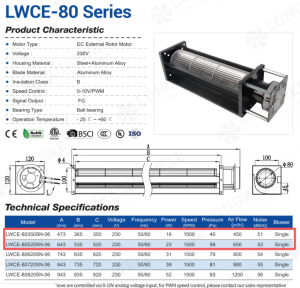
The engineering drawing provides the critical dimensions, mounting points, and bill of materials for the cross-flow fan assembly. 
If your supply rail is not a standard voltage
Specifying a fan for a non-standard DC voltage is worth thinking through before the chassis is built.
- Say the rail voltage in your first message. Most quotations assume a standard rail and quietly select a standard part. Giving the actual range up front, including tolerance, avoids a second round.
- Do not size by voltage alone. What matters is airflow at your system resistance. Send the duty point and the envelope, and let the supplier work backwards. A voltage figure by itself tells them almost nothing.
- Ask whether the change is firmware or hardware. A supplier who makes their own drive electronics can often retune the controller, which keeps the mechanical part identical. A supplier who buys motors in usually has to change the motor, and that changes the fit.
- Get a distinct part number. A voltage variant that shares a part number with the standard model will eventually be mixed up in stores. Insist on a separate designation even when nothing visible has changed.
See our cross flow fan range, or the DC cross flow fan section. Appliance safety follows IEC 60335-1.
Questions about voltage variants
Can I just run a 24V fan on a 26.5V supply?
You can, and it works on the bench. However, it over-speeds, draws more current and runs hotter than rated, which shortens bearing and winding life. Consequently the failure shows up in the field rather than in testing. For a one-off repair that may be acceptable. For an OEM product it is not.
What voltage range can be accommodated?
Most EC fans tolerate a fairly wide window, and beyond that we retune the controller. Send the nominal figure plus the real minimum and maximum your supply reaches under load. In practice the tolerance matters as much as the nominal value, since a non-standard DC voltage that sags to 22V under inrush is a different problem.
Does a firmware change affect certification?
Not the mechanical or aerodynamic side, which is where most certification effort sits. The electrical variant does need its own documentation, and we issue a distinct part number precisely so that paperwork stays clean. Tell us your target market and we will confirm what carries over.
Why does the same fan spin faster on a higher voltage?
Because in a DC motor the speed follows the applied voltage, once losses are accounted for. Raise the voltage and the motor spins faster until load torque balances it. In an EC fan, though, a controller sits in between, so the relationship is whatever the firmware says it is. That is exactly what made this fix possible.
Technical Documentation & Resources
Sizing something comparable?
Share the airflow, pressure, voltage and control interface, and we come back with a tested curve and a drawing. Meanwhile custom work runs to 90 days for spec sheets and samples. Since 1990 Longwell has supplied fans to HVAC and industrial OEMs.
Browse Related Products:
🏆 ISO 9001 / ISO 14001 / ISO 45001 | CE (TÜV) | UL/ETL | ATEX Zone 21/22 | AMCA 210/211 / ISO 5801 tested
Choose the right cross flow fan
Longwell manufactures 495 cross flow fans in-house. Send airflow, static pressure and voltage — an engineer replies with a matching model, performance curve and price within one working day.