What the customer was buying
The enquiry for a quiet inline duct fan was short: reconfirm the model, issue the drawing and quotation. A product photo came with it.
Brevity like that means the customer already knows what they want. So they had picked a 100mm plastic-cased EC model, and our job was to confirm it and issue documents.
What the choice implied
Nobody selects a plastic EC inline fan by accident. The combination points at controlled environment agriculture or high-end residential ventilation, where noise and running cost both matter and the duct is short.
- A 100mm duct sets the physical integration.
- Meanwhile the environment runs -20C to +50C, often humid.
- Airflow reaches 375 m3/h against a maximum 165 Pa.
- Noise is the headline: 28 dB(A).
- Finally, CE, FCC and RoHS for European and North American sale.
That 28 dB(A) figure is what sells this fan. It is also the number most likely to be misread, which is worth unpacking.
Where a quiet inline duct fan gets its quiet
This was a standard product, so nothing needed designing. Even so, the reasons a quiet inline duct fan works are worth setting out, since they generalise.
Why EC rather than AC
An AC version exists and costs less. However, the customer chose EC deliberately.
EC gives stepless speed control, managed here by a pulse knob controller. In an indoor growing room that matters practically: ventilation gets tuned to growth stage and ambient conditions rather than being on or off.
Efficiency follows from the same choice. Consequently this fan draws 40W, whereas an AC equivalent moving the same air draws more.
Plastic over metal, on purpose
A metal case resists impact better, and for some installations that decides it.
Here it did not. The IP44 plastic housing shrugs off humidity that would eventually mark steel. Furthermore it weighs 1.0 kg, so one person fits it overhead, and it costs less. In a damp room with short duct runs, plastic is simply better.
Where the quiet actually comes from
Two places, and only one of them is the fan.
Here the fan itself contributes a backward-curved impeller in a compact housing, plus maintenance-free ball bearings good for 50,000 hours. Together those give the 28 dB(A) figure at full speed.
The larger contribution is the speed control. Sound power falls steeply with speed, so a fan running at 60% is far quieter than its rated figure suggests. Consequently the practical noise in a room depends more on how the fan is controlled than on the number in the catalog.
What it cost
Pressure capability. At 165 Pa maximum, this quiet inline duct fan is built for short, clean duct runs. Add a carbon filter, long flexible duct and a couple of bends, and the operating point moves somewhere far less comfortable. In short, it is quiet because it is not fighting hard, and it should be specified that way.
Technical Specifications
Note the noise figure for this quiet inline duct fan is measured at full speed. In practice these rarely run there.
| Parameter | Value |
|---|---|
| Model Number | LWDE-100(4″)S-PWN-20-00 |
| Voltage Range | 220 VAC |
| Frequency | 50/60 Hz |
| Speed | 2800 RPM |
| Rated Input Power | 40 W |
| Airflow (Max) | 375 m³/h / 220 CFM |
| Static Pressure (Max) | 165 Pa |
| Noise Level (LpA) | 28 dB(A) |
| Operating Temperature | -20°C to +50°C |
| Protection Type | IP44 |
| Bearing Type | Maintenance-free deep groove ball bearings |
| Life Expectancy (L10) | 50,000 Hours (at 25°C) |
| Overall Dimensions (L x W x H) | 187 mm x 178.2 mm x 172 mm |
| Weight | 1.0 kg |
| Certifications | CE, FCC, RoHS, Reach |
Technical Documentation
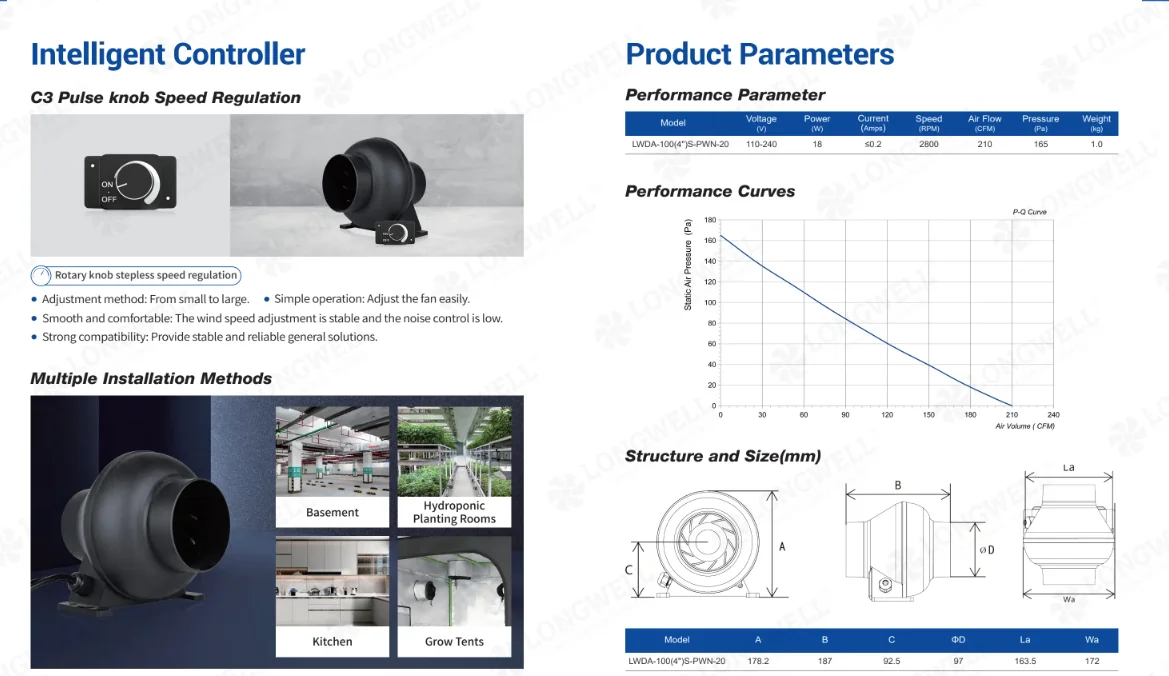
Meanwhile the technical specification sheet provides engineers with all nominal data, performance curves, dimensions, and compliance information for the LWDE-100(4″)S-PWN-20.
Open Technical Specification: LWDE-100(4")S-PWN-20-00 (PDF)
Here the image shows the assembled product and highlights its suitability for applications like grow tents, hydroponics, basements, and kitchens.
If you are specifying for a quiet space
Choosing a quiet inline duct fan for a room people sit or sleep in has a few traps.
- Read the noise figure with its conditions. A dB(A) rating is measured at a stated distance, usually at full speed and free delivery. However, against a filter and ductwork at your real duty point, the figure differs. So ask what conditions the number was taken under.
- Buy speed control for the acoustics, not the airflow. The biggest single noise reduction available to you is running the fan slower. That means sizing slightly generously and then turning it down, rather than sizing exactly and running flat out.
- Count your carbon filter in the pressure budget. Filters are the largest resistance in most grow room setups, and they get worse as they load. A fan sized without one will disappoint within weeks.
- Do not put a metal case where humidity lives. Plastic housings handle damp better, weigh less and cost less. Reserve metal for installations where the fan might be knocked or where temperature exceeds what plastic tolerates.
Browse our duct fan range, the EC inline fan section, or silent fans. Ventilation rates follow ASHRAE 62.1.
Questions about this fan
Is 28 dB(A) really quiet enough for a bedroom?
At that level, yes, since it sits near the background noise of a quiet room. However, the figure is measured at full speed at a stated distance in free air. Once ducting and a filter are added the fan works harder and gets louder, so leave headroom and plan to run it below maximum.
What does the knob controller actually do?
It varies fan speed steplessly rather than switching between fixed settings. That matters in a growing room where ventilation needs to follow the crop stage, and it matters acoustically, since a small speed reduction produces a disproportionate drop in noise.
Will it handle a carbon filter?
A short run with one filter, yes. Maximum static pressure is 165 Pa, and a loaded carbon filter consumes much of that alone. Consequently, for longer runs or heavier filtration, ask us for a higher-pressure model rather than accepting reduced airflow.
Why does halving the speed cut noise so much?
Because fan sound power rises roughly with the fifth power of speed, far faster than airflow does, which follows speed directly. So a modest reduction in speed costs you a little air and buys a lot of quiet. That relationship is why variable speed is the most effective acoustic tool available on a duct fan.
Technical Documentation & Resources
Need the same thing for your own unit?
Give us the numbers and the envelope, and you get a shortlist rather than a catalog. Meanwhile custom spec sheets and samples run to 90 days. Since 1990 Longwell has supplied EC fans and blowers to OEMs in HVAC, cold chain, data center and industrial markets.
Browse Related Products:
🏆 ISO 9001 / ISO 14001 / ISO 45001 | CE (TÜV) | UL/ETL | ATEX Zone 21/22 | AMCA 210/211 / ISO 5801 tested
Choose the right duct fan
Longwell manufactures 254 duct fans in-house. Send airflow, static pressure and voltage — an engineer replies with a matching model, performance curve and price within one working day.