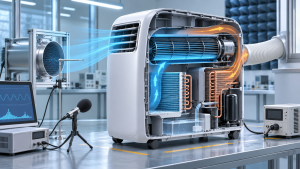
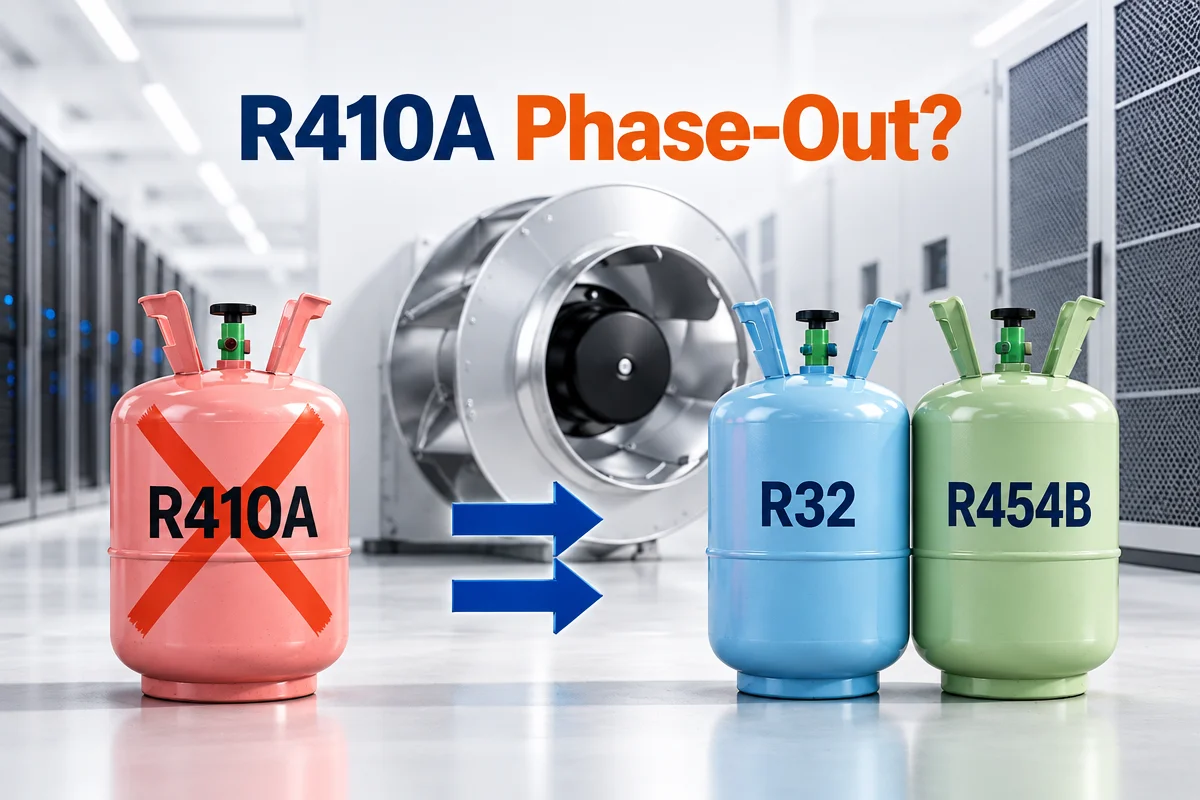
Most phase-out coverage treats the R-410A transition as a refrigerant label change. It is not. R-32 and R-454B move the condenser operating point: different latent heat, lower refrigerant mass flow, and temperature glide all shift the air volume and static pressure your condenser coils need.
For manufacturers and OEMs in the field of computer room air conditioning (CARC) systems, data center cooling, or HVAC units, the transition can trigger a wide equipment redesign. This article explains what the change means for CARC manufacturers, how refrigerant redesign can affect fan requirements, and how to select fan with such change.
What is R410A?
R-410A is a hydrofluorocarbon (HFC) refrigerant architecture widely used in air-conditioning systems. Though it is a reliable option for cooling, R410A has a relatively high Global Warming Potential (GWP) under the commonly cited reference, placing it above the 700 threshold applicable to covered CRAC equipment from January 1, 2027 .
Under the American Innovation & Manufacturing (AIM) Act, the U.S. Environment Protection Agency (EPA) is implementing a phasedown of HFC production and consumption, and specific restriction on the use of high-GWP including R410A.
Why Shift R-410A to R-454B and R-32?
The EPA has identified several potential refrigerant options for this subsector, including R-32, R-454B, R-513A, and other lower-GWP alternatives. So, why do R-454B and R-32 replace R410A? The most direct reason is the GWP.
R-454B and R-32 sit far below R-410A on global warming potential. R-32 is a single-component refrigerant. R-32 has no temperature glide during phase change, so the LMTD budget carries over more cleanly from an R-410A design. It is flammable classification A2L, and its higher discharge temperatures deserve compressor-side attention.
R-454B is a zeotropic HFC/HFO blend designed as a closer property match to R-410A, which eases compressor and expansion-device selection. The cost is temperature glide, which reshapes the condenser LMTD and, with it, the airflow requirement.
R410A Phase-Out Timeline in Brief
|
Date |
Milestone |
|
Jan 1, 2025 |
The prohibition and import of R-410A will be prohibited |
|
2026 (current) |
Installation enforcement is being proceed |
|
Jan 1, 2027 |
VRF installation cutoff |
|
2036 |
EPA aims to reduce the use of HFCs by 85% compared to 2011-2013 levels |
Importantly, the regulation does not mean that every existing R-410A system must be immediately removed from service. The 2027 requirement concerns the manufacture and import of covered new equipment, subject to the applicable regulatory provisions and compliance dates.
NAHB reported that EPA finalized a rule update allowing certain older equipment to remain installable beyond the original cutoff. OEMs should consider the design-freeze date rather than the installation deadline.
Compliance Baseline
- State and code-body adoption of A2L provisions varies by jurisdiction.
- Confirming local acceptance is the OEM’s and designer’s obligation, not the component supplier’s.
- Treat Federal Register entries and the EPA Technology Transitions page as the only authoritative sources.
R-410A vs R-454B vs R-32 Comparison
|
Specification |
R-410A |
R-454B |
R-32 |
|
GWP |
2,088 |
466 |
675 |
|
ASHRAE Safety Class |
A1 (non-flammable) |
A2L (mildly flammable) |
A2L (mildly flammable) |
|
Composition |
R-32 / R-125 |
R-32 / R-1234yf |
R-32 |
|
Refrigerant type |
HFC blend |
HFC/HFO blend |
Single-component HFC |
|
Drop-in retrofit |
– |
No |
No |
|
Cost |
Baseline |
Higher |
Higher |
What Happens to Fan Selection: A Re-Selection Method
A CRAC unit is a tightly integrated cooling system. When the refrigerant, compressor, and evaporator changes, the fan configuration will also change. Here is the sequence grafted onto the R-454B case. The ordering follows LONGWELL’s stated selection discipline: define the duty first, choose hardware last — never fix the fan model and back-calculate the airflow.
1. Define the new air demand. Run the cycle model on R-454B/R-32 and extract heat of rejection and target condensing temperature at rating and part load.
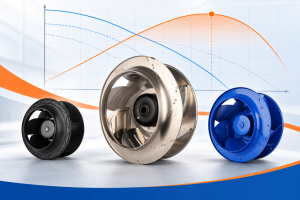
2. Re-measure or re-compute the system resistance curve. Coil pressure drop at the new airflow, plus casing, grilles, and discharge losses.
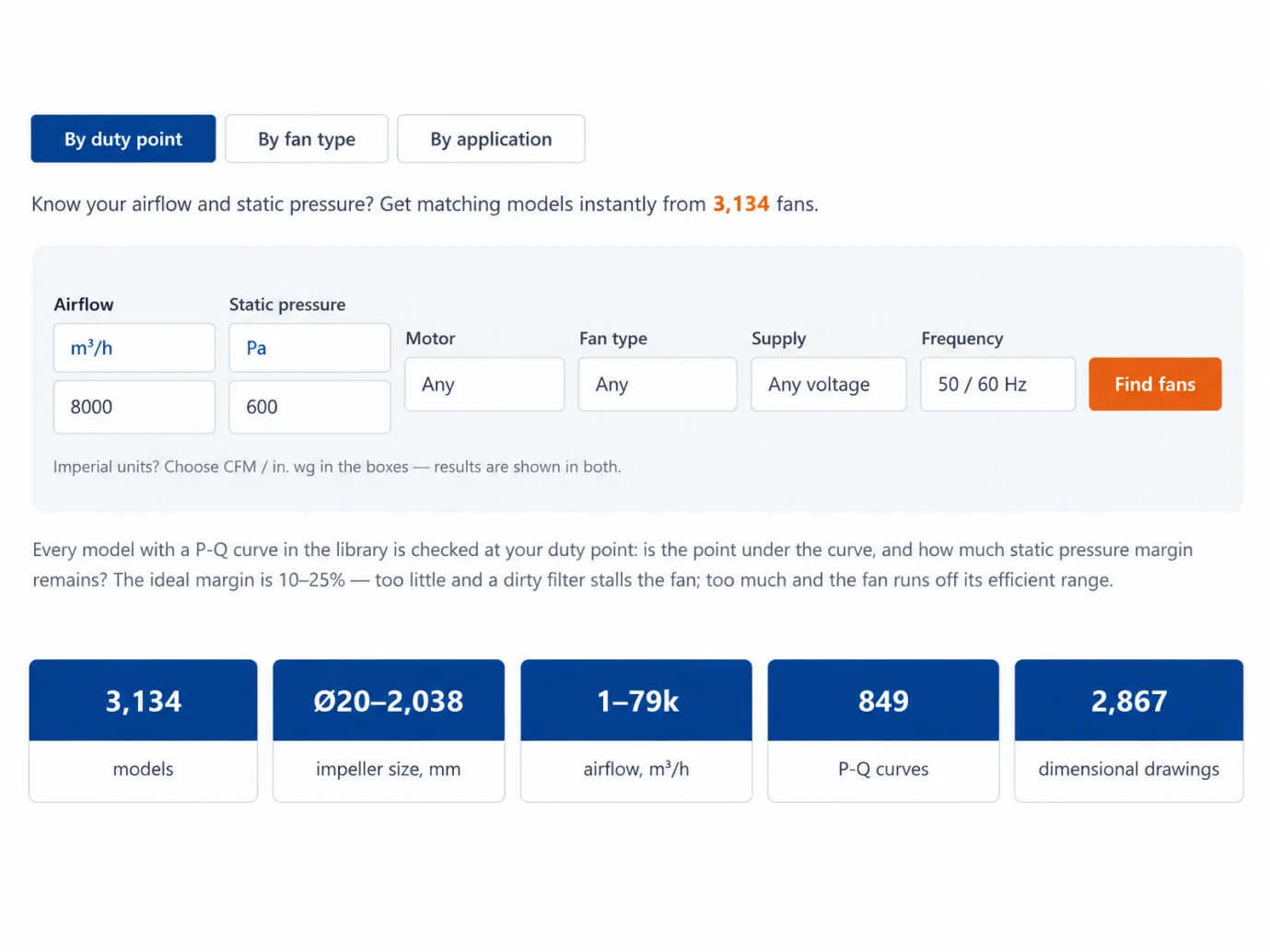
3. Select the operating point on the new resistance curve. Use a tool such as the fan operating point calculator rather than interpolating from memory.
4. Verify noise and motor limits. Higher airflow raises discharge noise — re-check against the unit’s sound rating, especially for residential and urban OEM products. Confirm speed ceiling, motor thermal margin, and stall boundary.
5. Validate part-load control strategy. Confirm how the fan modulates with compressor capacity and whether the EC control curve covers the full load map.
For an interactive selection pass, run the whole unit through LONGWELL’s fan selector — enter the new duty point, not the legacy one.
LONGWELL EC Fan Platform
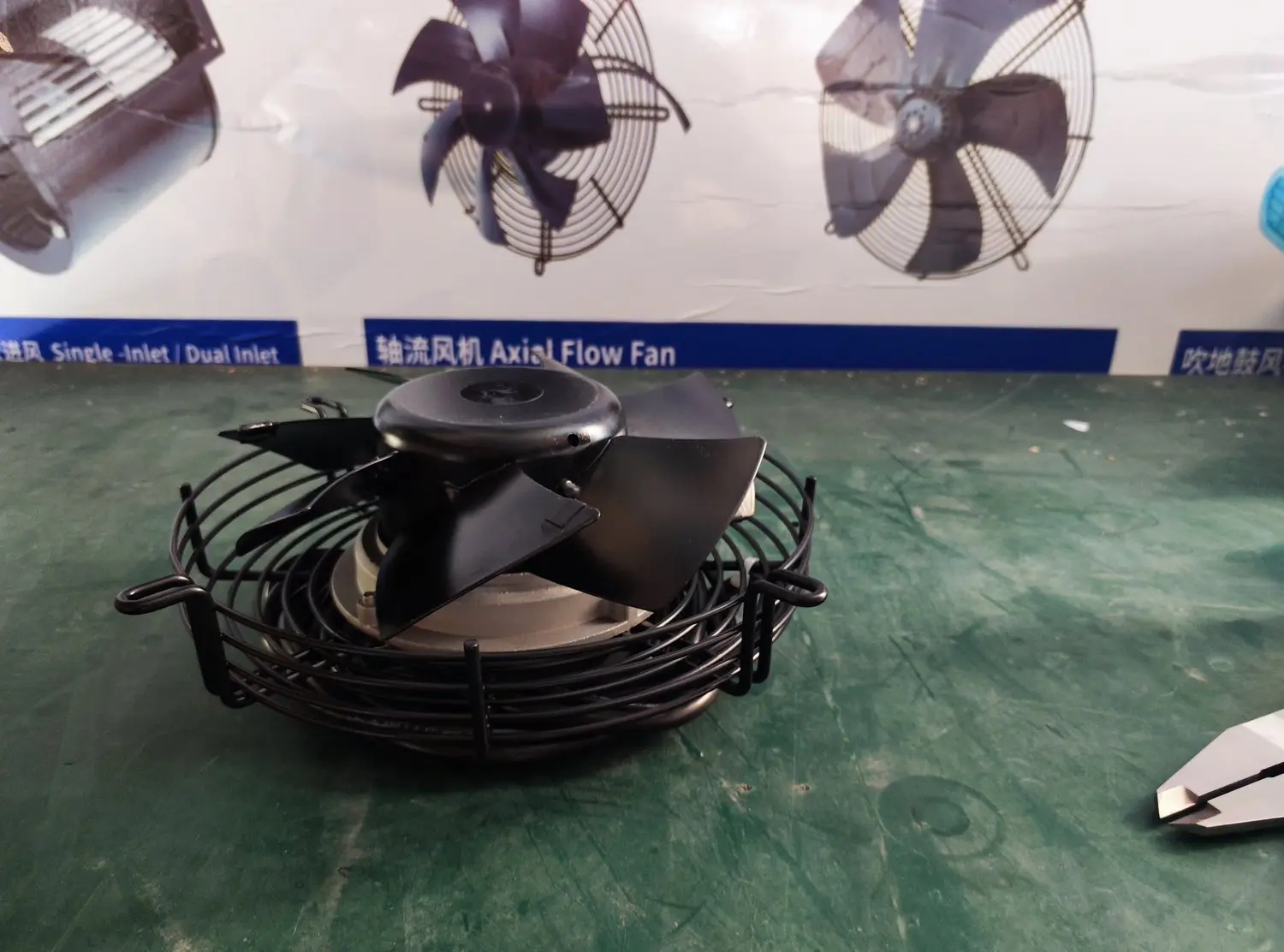
The airflow delta between R-410A and R-454B configurations sits within the speed range of a properly sized EC fan. An EC axial platform — LONGWELL’s LWAE3G series is designed for condenser axial duty — can carry both refrigerant variants of the same unit through control parameters and firmware configuration alone. An AC fan cannot: covering the shift requires a different motor, or an added speed control that introduces its own losses and failure points.
Platform benefits for OEM certification and delivery
• One fan SKU across both refrigerant generations narrows the certified component scope of the unit.
• Coil and fan inventory no longer bets on a single refrigerant generation.
• Supplier-side risk drops when the mechanical interface stays constant through the transition.
For OEM programs in commercial HVAC, LONGWELL co-engineers at the platform level; see our commercial HVAC solutions work with equipment manufacturers.
A2L Refrigerant Compliance
R-454B is an A2L refrigerant — mildly flammable. Current public guidance covers installation and servicing. What it does not cover is what A2L means inside the fan specification.
Three design consequences for fans
• Independent start and control capability. The designated ventilation must be capable of responding to the leak-detection signal when the main cooling system is standby . EC fans with controlled start/stop over a communication bus serve this interlock duty directly.
• Electrical and enclosure protection. Motor electrical protection and enclosure design must be declared suitable for the A2L application at the component spec-sheet level, before unit certification begins.
• Large-charge scenarios. Data centers and cleanrooms with significant refrigerant charge face additional constraints on exhaust routing and ventilation redundancy. LONGWELL addresses this class of duty in its data center cooling solutions work with CRAH and fangrid retrofits.
We make no certification claims here; LONGWELL’s certification scope and how ETL relates to UL listing are documented on our ETL/UL equivalence page.
Costing the Transition: Energy, Refrigerant, and Fan Efficiency in One TCO Account
Four cost lines
1. Unit energy consumption, including fan power — not compressor power alone.
2. Refrigerant cost and availability risk for the chosen blend.
3. Maintenance and refrigerant top-up over service life.
4. Fan efficiency differential between AC and EC at the new, higher airflow duty.
The fan line grows in weight after the transition: more air at the same coil means more fan power, and because that power scales with roughly the cube of speed, fan efficiency becomes a visible input to the unit’s SEER or IEP figure. Run the combined account with LONGWELL’s fan TCO calculator — the model’s parameters (annual run hours, load profile, electricity price) matter more than the component price tag.
R-410A Questions Engineers Still Ask
Can R-410A systems use R-454B?
No. These two refrigerants differ in different ratings, pressure, and engineering. R-454B cannot be a drop-in replacement to R-410A.
Will R-410A be available for servicing after 2030?
Supply continues to shrink under the phasedown schedule, but service use remains permitted. Whether to keep repairing an R-410A unit or replace it is a TCO judgment — apply the Section 7 framework with your own run hours and load factor.
Do I need a new fan on an existing system when switching refrigerant?
Only if the refrigerant switch comes with a heat-exchanger change. If the coil and the airflow path are unchanged, the fan selection stands. This article’s method applies when the transition alters the coil’s duty — which is the common case in new R-454B designs.