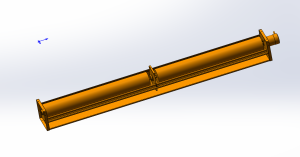
Build to this drawing
A North American appliance OEM sent a complete drawing and a short instruction: build this. Everything on it was standard except a motor thermal protector set to trip at 95C. In short, they needed a manufacturer rather than a design partner.
That one line changed how we read the rest of the sheet. The protector was wired into the windings themselves, not clipped to the outside of the motor.
What the rest of the sheet asked for
Otherwise the fan was modest. A tangential blower moving 23 m3/h against 8 Pa, on 115 VAC at 60 Hz.
- First, an overall length of 158mm, with a 108mm impeller.
- Next, a housing only 50mm high, set by the chassis it goes into.
- Meanwhile a 25 dB(A) ceiling, which is very quiet for a moving part.
- Finally, an ambient range of -25C to +60C.
What those two numbers together imply
Firstly, 25 dB(A) says people will be near this appliance and will notice it. So the product sits in an occupied room rather than a plant room.
The 95C protector says the fan lives inside an enclosure that can get hot. Put together, they describe something like a heated display cabinet or a fireplace insert: quiet, close to users, and warm inside.
Consequently the safety case matters as much as the airflow. Certification under an appliance standard was clearly in the customer plan.
Where the protector sits, and why there
Here the drawing matched our existing 30mm cross-flow platform closely, so this was verification work rather than new product development. Meanwhile the motor thermal protector was the one item that needed thinking about.
What a motor thermal protector actually does
A motor thermal protector is a temperature-sensitive switch buried in the winding. When the winding reaches its set point, it opens and the motor stops.
Above all, the point is where it sits. A motor thermal protector on the outside of the housing reads case temperature, which lags the winding badly. Consequently by the time the case is hot, the winding insulation may already have taken damage.
Therefore embedding it in the windings means it reads the thing that actually fails. That is why the customer specified the location and not just the trip point.
Why 95C and not higher
At first glance 95C sounds low for a motor. But the figure comes from the insulation class, not from comfort.
Set too high, a motor thermal protector protects the paperwork and not the motor. Set too low, it nuisance-trips on a warm day and the appliance looks faulty. The number has to sit between normal hot running and the point where insulation degrades.
Why the shaded pole motor stayed
Admittedly we could have offered a brushless DC motor with electronic control, which would run more efficiently.
However the customer system runs the fan at one speed and has no digital communication to talk to. So the efficiency gain would arrive with a controls change nobody asked for, on a build-to-print job.
Worth stating plainly: a shaded pole motor cannot be speed-controlled by a variable frequency drive. If you ever expect to add speed control, that decision has to be made now rather than later.
Technical Specifications
Two numbers on this sheet do the real work: 25 dB(A), and the 95C trip point on the protector.
| Parameter | Value |
|---|---|
| Model | LWCA-3090UN-06 |
| Voltage | 115 V |
| Frequency | 60 Hz |
| Motor Type | AC Shaded Pole Motor |
| Input Power | 6.3 W |
| Speed | 2400 RPM (±10%) |
| Maximum Airflow | 23 m³/h / 13.5 CFM |
| Maximum Static Pressure | 8 Pa |
| Noise Level | 25 dB(A) |
| Overall Dimensions (L x D x H) | 158 x 68 x 50 mm |
| Impeller Dimensions (Ø x L) | 30 x 108 mm |
| Bearing Type | Ball Bearing |
| Insulation Class | Class B / F / H Available |
| Operating Temperature | -25°C to +60°C |
| Safety Feature | Integrated 95°C Thermal Protector |
Technical Documentation
The following documents were central to the project’s successful execution. They represent the initial product family data and the final, approved engineering deliverable.
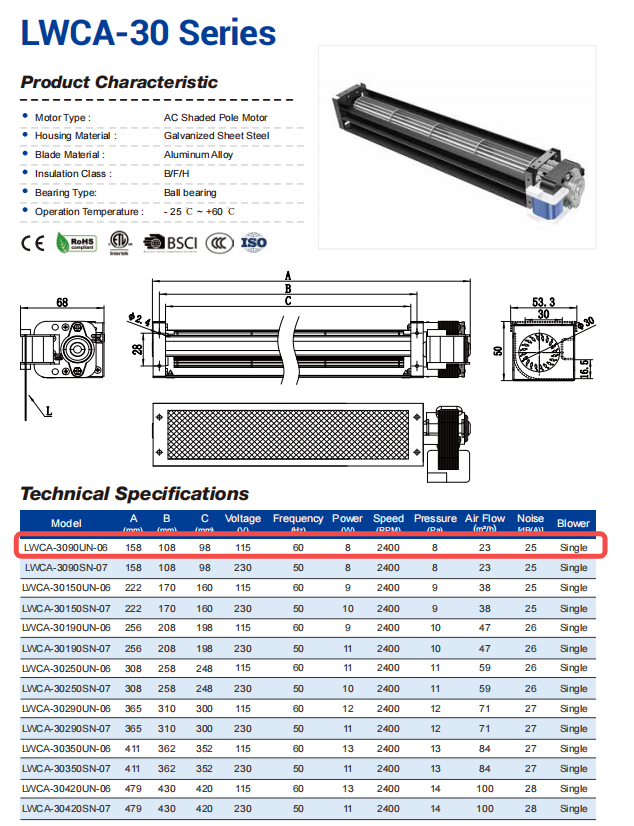
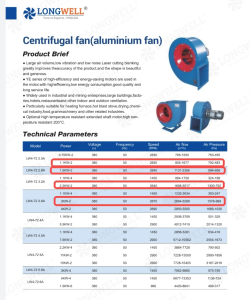
Meanwhile the LWCA-30 series product datasheet provides performance parameters and dimensional data for the full family of blowers, which procurement managers use for initial component selection.
View the LWCA-3090UN-06 document (PDF)
The final approved engineering drawing, LWCA-3090UN-06-00, contains precise mechanical dimensions, material specifications, and custom technical requirements like the 95°C thermal protector, essential for mechanical design engineers integrating the component.
Specifying thermal protection yourself
If you are writing a motor thermal protector into your own fan specification, four things decide whether it works.
- Say where the protector goes, not just its rating. A motor thermal protector in the windings and one clipped to the housing behave completely differently. The winding version reacts to the actual failure mode; the external one reacts late.
- Choose auto-reset or manual deliberately. An auto-reset protector restarts the fan once it cools, which can cycle a fault indefinitely without anyone noticing. A manual type forces a service call. Which you want depends on whether silent recovery or visible failure is safer in your product.
- Set the trip point from the insulation class. Look up the class of the winding insulation and work back. Guessing a round number invites either nuisance trips or a protector that never saves anything.
- Check it survives your certification. Appliance safety standards care about what happens under locked rotor and fault conditions. A protector is often what makes that test pass, so it belongs in the specification you submit, not in a later change note.
See our cross-flow fans range, the AC cross-flow fans section, or cross-flow impellers. Appliance safety requirements are published by UL Solutions.
Questions about thermal protectors
Auto-reset or manual reset, which should I specify?
It depends on what a repeat trip means in your product. Auto-reset keeps the appliance working after a one-off overheat, but it can hide a developing fault by cycling quietly for months. Manual reset makes the failure visible and forces someone to look at it.
Does a motor thermal protector replace a fuse?
No, they cover different faults. A fuse responds to overcurrent, typically a short. A thermal protector responds to temperature, which is what you get from a blocked inlet, a stalled rotor or a hot enclosure. Most appliance designs need both.
Why not just fit a protector with a higher trip point?
Because the trip point is set by the winding insulation, not by convenience. Raising it lets the winding run hotter before anything intervenes, which shortens motor life and can defeat the purpose of fitting protection at all.
Can a shaded pole motor be speed-controlled?
Not with a variable frequency drive. Shaded pole motors are not built for frequency control and a drive will damage one. Voltage reduction gives a limited speed range with a torque penalty, but if real speed control matters, choose a different motor type from the start.
Technical Documentation & Resources
Need the same thing for your own unit?
Give us the numbers and the envelope, and you get a shortlist rather than a catalog. Meanwhile custom spec sheets and samples run to 90 days. Since 1990 Longwell has supplied EC fans and blowers to OEMs in HVAC, cold chain, data center and industrial markets.
Browse Related Products:
🏆 ISO 9001 / ISO 14001 / ISO 45001 | CE (TÜV) | UL/ETL | ATEX Zone 21/22 | AMCA 210/211 / ISO 5801 tested