What the barn ventilation OEM needed
The headline number was 66,700 cubic meters an hour at free air. An OEM building ventilation systems for large livestock facilities needed an EC agricultural exhaust fan capable of that, on a 3-phase 380V, 50Hz supply.
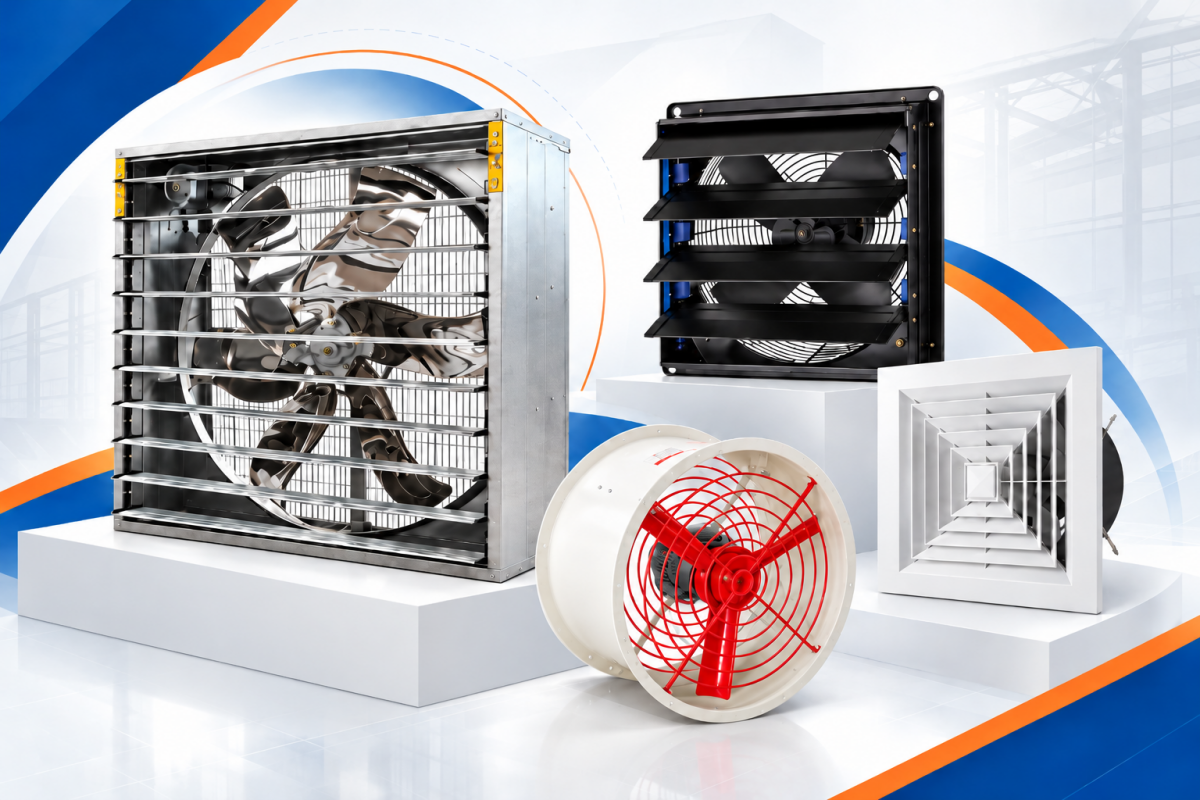
Here the format is a large wall exhaust fan, usually called a box fan in the trade. These go into poultry and livestock barns, where air quality and temperature decide how the animals do. Get the ventilation wrong and you lose birds. Consequently, nobody experiments here.
One constraint changed the whole job.
- A central climate controller runs every EC agricultural exhaust fan from sensor data.
- That controller speaks 0-10V analogue or PWM, so the fan had to listen.
- Simple on/off AC fans were therefore ruled out from the start.
- One sample first for validation, then production in 40-foot container quantities.
That last line matters as much as the airflow figure. After all, a supplier who builds one good sample but cannot fill containers every month is no use to an OEM with a season to hit.
Turning a proven box fan into an EC agricultural exhaust fan
The aerodynamics were, unusually, settled before we started. Our existing LWPVL-1448T box fan already produces 66,700 m3/h at 0 Pa. Furthermore, its 1448mm polyamide impeller and heavy chassis have years of barn service behind them.
The problem was the motor, not the fan
Meanwhile the standard model runs an IE3 AC induction motor. However, that motor cannot take a 0-10V or PWM signal without an external VFD bolted on beside it.
Why we did not just add a VFD
We considered it and rejected it quickly. A separate drive is another box for the OEM to buy, mount, wire and stock. It is also another thing to fail in a barn full of dust and ammonia. In practice it is usually the first thing that does. The customer wanted a fan it could drop into the wall and connect to the controller. That is a fair thing to want.
Fitting the SmartEC motor
So the work became an adaptation rather than a new design. Engineers picked a direct-drive EC motor able to make the 2.2 kW of shaft power that impeller needs at speed. That motor carries our SmartEC control board, which reads 0-10V, PWM and RS485 Modbus natively.
The result, designated LWPVL-1448T-01, keeps everything that already worked. The 2mm Zn-Al-Mg steel housing stays. Likewise the automated butterfly damper. Only the motor and its control changed, which is why this EC agricultural exhaust fan reached validation quickly instead of starting a full development cycle.
Technical Specifications
These are the figures from the approved drawing, not a catalog estimate. Note how airflow falls as the barn goes further into negative pressure, which is the number that actually sizes a house.
| Parameter | Value |
|---|---|
| Model | LWPVL-1448T-01 |
| Airflow @ 0 Pa | 66,700 m³/h |
| Airflow @ -25 Pa | 61,000 m³/h |
| Airflow @ -50 Pa | 56,020 m³/h |
| Airflow @ -75 Pa | 49,700 m³/h |
| Airflow @ -100 Pa | 43,100 m³/h |
| Motor Rated Power | 2.2 kW |
| Rated Voltage / Frequency | 3-Phase 380V / 50Hz |
| Rated Current | 4.7A |
| Control Interface | 0-10V / PWM / RS485 (SmartEC™) |
| Impeller Diameter | 1448 mm |
| Impeller Material / Blades | PA (Polyamide) / 3 pcs |
| Housing Material | 2mm Zn-Al-Mg Coated Steel (275g/m²) |
| Overall Dimensions (W×H×D) | 1530 × 1530 × 1100 mm |
| Drive Type | Direct Drive EC Motor |
Technical Documentation
Here the following documents were generated as final deliverables and archived for the LWPVL-1448T-01 project.
LWPVL-1448T-01 Datasheet
The PDF contains the full technical datasheet, including performance curves (P-Q), dimensional drawings, and electrical connection details required by design engineers for system integration.
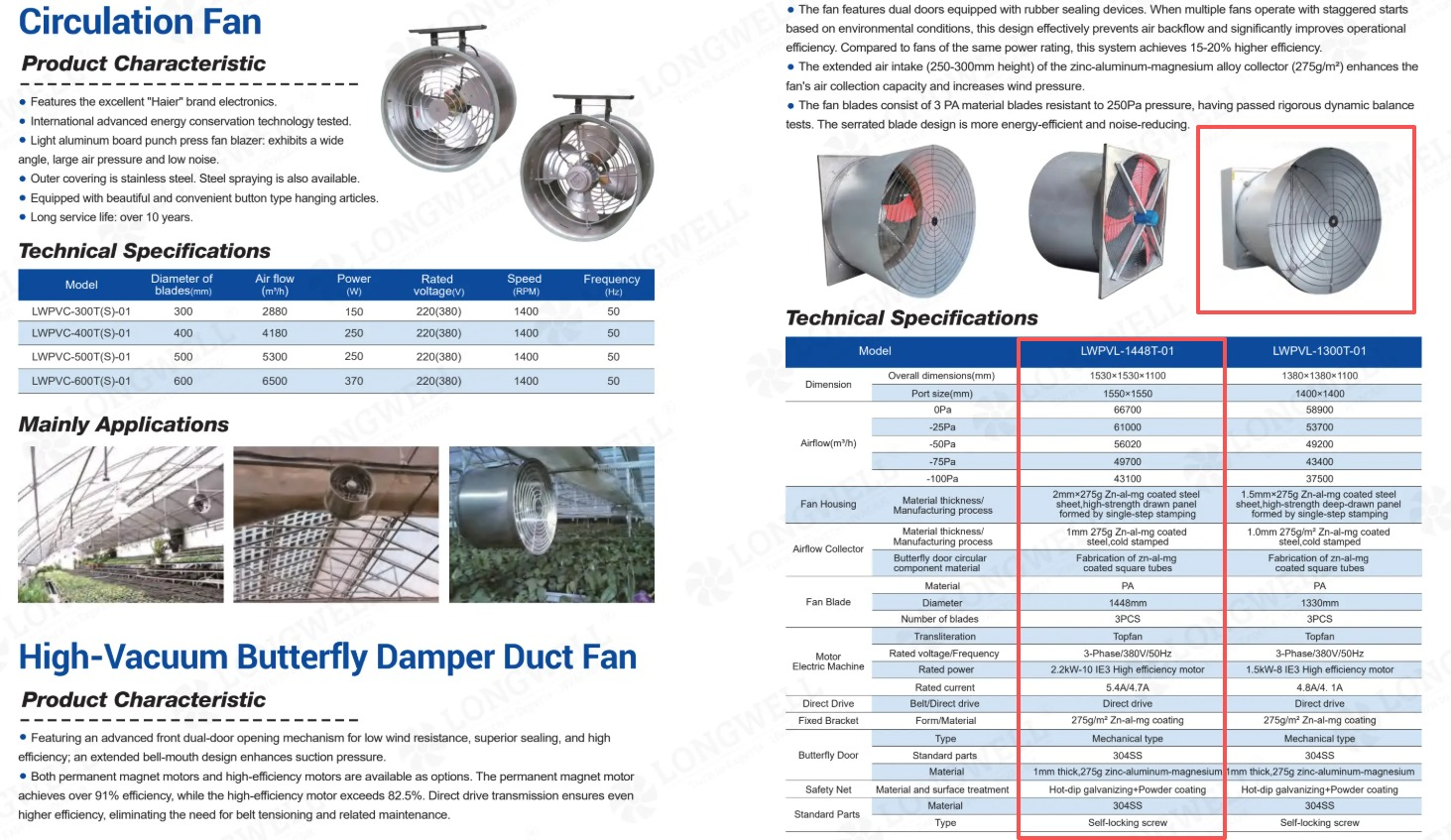
Here the product image shows the assembled fan, highlighting the robust square housing, protective safety grille, and automated butterfly damper mechanism that prevents backdraft.
Why agricultural OEMs buy here
Agricultural OEMs tend to weigh four things. In this case the project touched all four.
- An EC variant in 90 days, not 18 months. The customer wanted an EC version of a standard AC product. European suppliers often quote 12 to 18 months for that kind of change. We ran the engineering, prototyping and validation inside our normal 90-day cycle.
- Cost that suits a price-driven market. Reusing a high-volume chassis meant no new tooling, and fitting our own SmartEC motor meant no bought-in drive. In farm equipment, avoiding both of those is what makes the specification affordable at all.
- Containers, not samples. The client buys this EC agricultural exhaust fan by the 40-foot container. Our output, including over 30,000 cold chain ventilation units a year, is the evidence that lead times hold as volume rises.
- Numbers you can check. Airflow and pressure figures come from labs audited to AMCA 210/211 and ISO 5801 methods. So the OEM’s engineers design against measured data rather than a brochure.
See our poultry and agricultural exhaust fan range, where this EC agricultural exhaust fan sits alongside the AC versions, or the EC axial fan series for other formats. Ventilation rates for livestock housing are covered by ASHRAE in its Applications handbook.
Questions barn builders ask
What is the lead time on a 40ft container order?
Production runs 25 to 35 days from receipt of the purchase order for a make-to-order fan like this. A first sample for evaluation usually leaves within 10 to 15 working days. Frame agreements with rolling forecasts shorten it further.
Will the Zn-Al-Mg housing survive a livestock barn?
That is exactly why it was chosen. The housing is 2mm steel with a heavy 275g/m2 zinc-aluminum-magnesium coating. In practice it holds up far better than plain galvanizing against ammonia and constant humidity. The butterfly door mechanism and the main fasteners are 304 stainless for the same reason.
Can the SmartEC motor talk to something other than 0-10V?
Yes. Besides 0-10V and PWM, the board carries an RS485 interface running Modbus RTU. That lets the fan sit directly on a BMS or a PLC, reporting speed, status and faults rather than simply taking a command.
Why not run these fans flat out and switch them on and off?
Staged on/off ventilation swings barn temperature and stresses the birds. Modulating an EC agricultural exhaust fan holds conditions steady. It also cuts energy sharply, since fan power falls with the cube of speed. Running two fans at half speed uses far less energy than one at full speed.
Have a fan requirement like this one?
Send the datasheet you are working against, or simply the duty point. Then our engineers tell you what fits and what does not. Meanwhile custom spec sheets and samples take up to 90 days. Since 1990 we have been building fans for OEMs worldwide.
Browse Related Products:
🏆 ISO 9001 / ISO 14001 / ISO 45001 | CE (TÜV) | UL/ETL | ATEX Zone 21/22 | AMCA 210/211 / ISO 5801 tested
Choose the right exhaust fan
Longwell manufactures 241 exhaust fans in-house. Send airflow, static pressure and voltage — an engineer replies with a matching model, performance curve and price within one working day.