What the OEM asked for
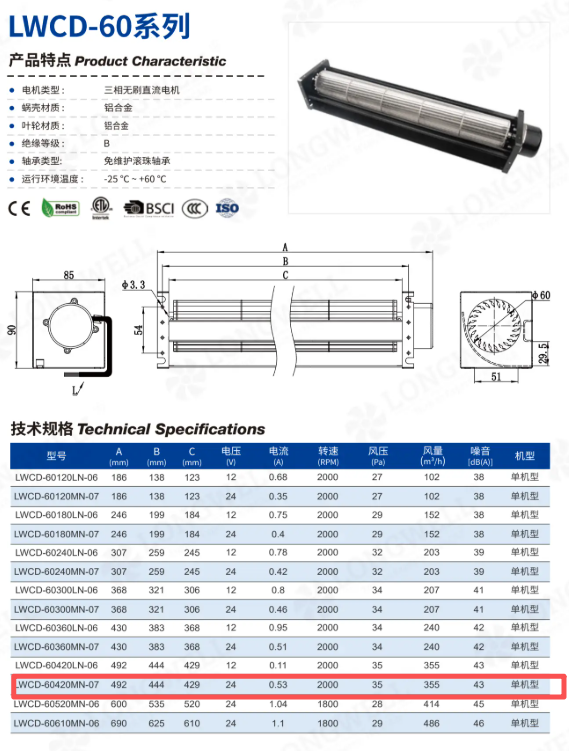
An OEM asked for a 24V DC cross-flow fan giving 355 m3/h, based on a standard model with a guard added. That guard is where the fan guard current margin comes in.
Their directive was plain: add a protective guard, and put custom mounting plates on both ends of the base.
The dimensions were asymmetric, which is the tell
Specifically they wanted a 6cm extension on the plate at the motor end, and 3cm on the opposite side.
Nobody specifies asymmetric extensions for aesthetic reasons. That pattern means the fan has to line up with mounting points that already exist in a larger assembly, so this is a drop-in into finished equipment.
- Airflow of 355 m3/h at 35 Pa had to be maintained.
- Meanwhile the 24 VDC rail was fixed, so an AC motor was never a candidate.
- Finally, a single sample was requested, which places this at their qualification stage.
Where the fan guard current margin came from
Aerodynamically and electrically the standard model was already right. The work was mechanical, plus one electrical decision that deserves explaining.
Turning plain language into a drawing
The request arrived as extend 6cm here, 3cm there. So our engineers drafted a new assembly drawing, adding custom iron side plates and an integrated aluminum and iron guard for finger protection.
Furthermore we issued a distinct part number, so the variant never gets confused with the catalog product on a shop floor.
The current figure that looks wrong
Here is the part worth knowing. The standard fan draws 0.53A, whereas the custom variant specifies 0.8A.
That is not an oversight, and it is not a different motor. Rather, the fan guard current margin is a deliberate increase in available torque.
Why the guard changes the electrical spec
Any guard adds resistance to the airflow path, however slight. So the fan works marginally harder to hold 2000 RPM and deliver its rated 355 m3/h.
Furthermore a customer system has voltage drop in its own wiring, which the fan sees as a lower supply. Specifying more current gives torque margin against both effects at once.
Consequently the variant reaches its rated airflow in the real installation rather than only on a bench with a clean supply.
What it cost
Power draw, plainly. Running at 0.8A instead of 0.53A costs energy the standard fan does not use.
That is what fan guard current margin costs on a real supply. However, if your run is short and clean and you can accept slightly less airflow, the standard model remains available and cheaper to run.
Technical Specifications
Here the current row below reads higher than the standard model. That is the fan guard current margin, and it is deliberate.
| Parameter | Value |
|---|---|
| Model Number | LWCD-60420MG-07-35 |
| Voltage | 24 VDC |
| Current | 0.8 A ±10% |
| Speed | 2000 RPM |
| Airflow | 355 m³/h (209 CFM) |
| Static Pressure | 35 Pa |
| Speed Control | 0-10V Analog (SmartEC™) |
| Bearings | Ball Bearing |
| Operating Temperature | -25°C to +60°C |
| Noise Level | 43 dB(A) |
| Overall Dimensions (L x H x W) | 480 x 90 x 73 mm |
| Impeller Diameter | 60 mm |
| Impeller Length | 429 mm |
| Materials | Aluminum (Impeller, Housing), Iron (Side Plates), Al+Iron (Grill) |
| Insulation Class | Class B |
Technical Documentation
The following documents were generated during the engineering process to define and validate the final custom product for the customer.
Product Specification Sheet (PDF) This document provides procurement managers and engineers with the baseline performance data for the LWCD-60 series, including airflow curves, noise levels, and standard electrical characteristics.
 Final Assembly Drawing (PNG)
This engineering drawing gives system integrators the exact dimensions of the final LWCD-60420MG-07-35 assembly, confirming the custom mounting plate and guard configuration for precise integration.
Final Assembly Drawing (PNG)
This engineering drawing gives system integrators the exact dimensions of the final LWCD-60420MG-07-35 assembly, confirming the custom mounting plate and guard configuration for precise integration.
If you are adding a guard to a fan
Adding a guard looks like a mechanical change and has electrical consequences. These are worth checking.
- Expect the guarded version to draw more. A guard adds impedance, so holding rated speed and airflow needs more torque. If a supplier quotes identical current for guarded and open versions, ask whether the airflow figure was retested or copied.
- Give your cable run and its length. Voltage drop at the fan is invisible on a datasheet and real in an installation. Fan guard current margin is partly there to absorb it, and a supplier can size it properly if you say what the run looks like.
- Insist on a separate part number for any variant. A guarded fan with custom plates looks similar enough to the standard model to be substituted by mistake. The designation is what prevents that.
- Send asymmetric dimensions as a sketch. Plain language like extend 6cm here and 3cm there is understandable and ambiguous about which end is which. A sketch removes an entire round of clarification.
See our cross flow fan range, the DC cross flow fan section, or fan accessories. Ingress ratings follow IEC 60529.
Questions about this variant
Why does the custom fan draw more current than the standard one?
To hold rated speed against the extra resistance the guard adds, and to leave torque margin against voltage drop in your wiring. Both effects would otherwise show up as slightly reduced airflow in the installed system. The higher figure is a specification decision, not a difference in the motor.
How much airflow does a guard actually cost?
It depends entirely on the guard geometry, which is why it is designed rather than assumed. A well-shaped wire guard costs a fraction of what a fine mesh does. Ask for the curve with the guard fitted rather than the open-fan curve plus an assurance.
Can I fit my own guard to the standard fan?
You can, although the performance figures then stop applying. We measured the published curve on the open fan, and your guard adds an unknown restriction. So if the airflow number matters, either take the guarded variant or retest the assembly as built.
Does the 0-10V control still work the same way?
Yes. The control interface is unchanged, so the same signal produces the same commanded speed. What differs is that the motor now has more torque available to reach that speed against the guard, which is the whole point of the change.
Technical Documentation & Resources
Got a duty point you need matched?
Tell us the airflow, the pressure and the space you have. Then we mark your duty point on a tested curve and send the drawing back. Meanwhile samples and custom spec sheets take up to 90 days. Since 1990 we have supplied OEMs across HVAC, refrigeration and industry.
Browse Related Products:
🏆 ISO 9001 / ISO 14001 / ISO 45001 | CE (TÜV) | UL/ETL | ATEX Zone 21/22 | AMCA 210/211 / ISO 5801 tested