Same fan, different environment
An OEM needed 200 units of an IP68 fan for outdoor electronics, and they already knew which platform they wanted. They had our 92 by 92 by 25.4mm platform in service and were happy with its airflow.
What they were not happy with was the sealing. A standard fan of this type is built open, and their equipment sees fine dust and sustained water immersion.
What they specified
- First, a 12 to 26.5 VDC rail, so the fan rides out supply fluctuation.
- Next, at least 64.94 CFM at zero static pressure.
- Meanwhile -10C to +60C, which a sealed enclosure in the sun reaches from the top end.
- Finally, IP68 rather than the open-frame rating, and 50,000 hours of life.
What IP68 actually demands
The two digits are separate tests. The 6 means dust-tight, with no ingress at all rather than merely a harmless amount.
Here the 8 means continuous immersion beyond one meter, to a depth the manufacturer states. So an IP68 fan is not a splash-proof one with a better seal. It is a different requirement.
Building an IP68 fan by encapsulation
The airflow, the voltage window and the footprint were all settled already. Only the sealing had to change, which sounds like a small job and is not.
Where an open fan leaks
On a standard build the stator, the windings and the control board sit exposed to the airstream. That is deliberate, because moving air over them is how they stay cool.
Consequently every one of those surfaces is also a route in for dust and water. Sealing the frame alone does nothing while the electronics are open.
Full encapsulation, and the option we rejected
For this IP68 fan we potted the motor electronics in epoxy, so there is no cavity for water to enter and no surface for dust to settle on.
A custom-molded sealed housing was the alternative and would arguably be the better long-term answer. For 200 units it was the wrong one: the tooling cost and the mold lead time would both have exceeded what this project could carry.
That judgment reverses at volume. If this became a 20,000-piece platform, molding would be worth revisiting.
The trade-off nobody mentions
Potting a motor traps heat. The compound fills the space the air used to move through, and the windings now shed heat by conduction rather than convection.
So the epoxy has to be thermally conductive, not merely waterproof. A general-purpose potting compound seals perfectly well and cooks the motor slowly.
That is the whole engineering content of an IP68 fan conversion, and it is where the work actually sits. The waterproofing is easy; keeping the life expectancy intact afterwards is the part that takes judgment.
What holds the life figure up
Two ball bearings rather than sleeve bearings, a PBT frame and impeller in UL 94V-0, and locked-rotor protection in the winding.
Our published life figure for this platform is quoted at a stated temperature and humidity rather than as a bare number, which is the only form in which such a figure means anything. Ingress ratings themselves are defined by the IEC in IEC 60529.
Technical Specifications
Meanwhile the suffix on the model number is the part that matters here. On this platform, -11 marks the sealed build.
| Parameter | Value |
|---|---|
| Model Number | LWAD9225MX-24-11 |
| Rated Voltage | 24.0 VDC |
| Operating Voltage Range | 12 ~ 26.5 VDC |
| Input Power | 4.8W (Max 6.0W) |
| Input Current | 0.2A (Max 0.25A) |
| Speed | 3850 RPM (±10%) |
| Max Airflow (@ 0 Static Pressure) | 72.16 CFM (122.6 m³/h) |
| Max Static Pressure (@ 0 Airflow) | 2.82 mmH₂O (27.65 Pa) |
| Acoustical Noise | 42.0 dBA (Max 45.0 dBA) |
| Dimensions | 92 x 92 x 25.4 mm |
| Weight | 75 grams |
| Bearing Type | Two Ball Bearings |
| Life Expectancy | 50,000 Hours @ 25°C, 15-65% RH |
| Protection Class | IP68 |
| Insulation Type | UL Class A |
| Operating Temperature | -10°C to +60°C |
| Storage Temperature | -40°C to +70°C |
Technical Documentation
The following documents were generated as deliverables for the project, providing all necessary data for procurement and system integration.
Project Specification Sheet (DOCX)
Here the editable specification sheet for system integrators to incorporate into their internal project documentation.
Final Technical Datasheet (PDF)
The final, approved PDF datasheet containing all performance data, mechanical drawings, and compliance information for engineering review and archival.

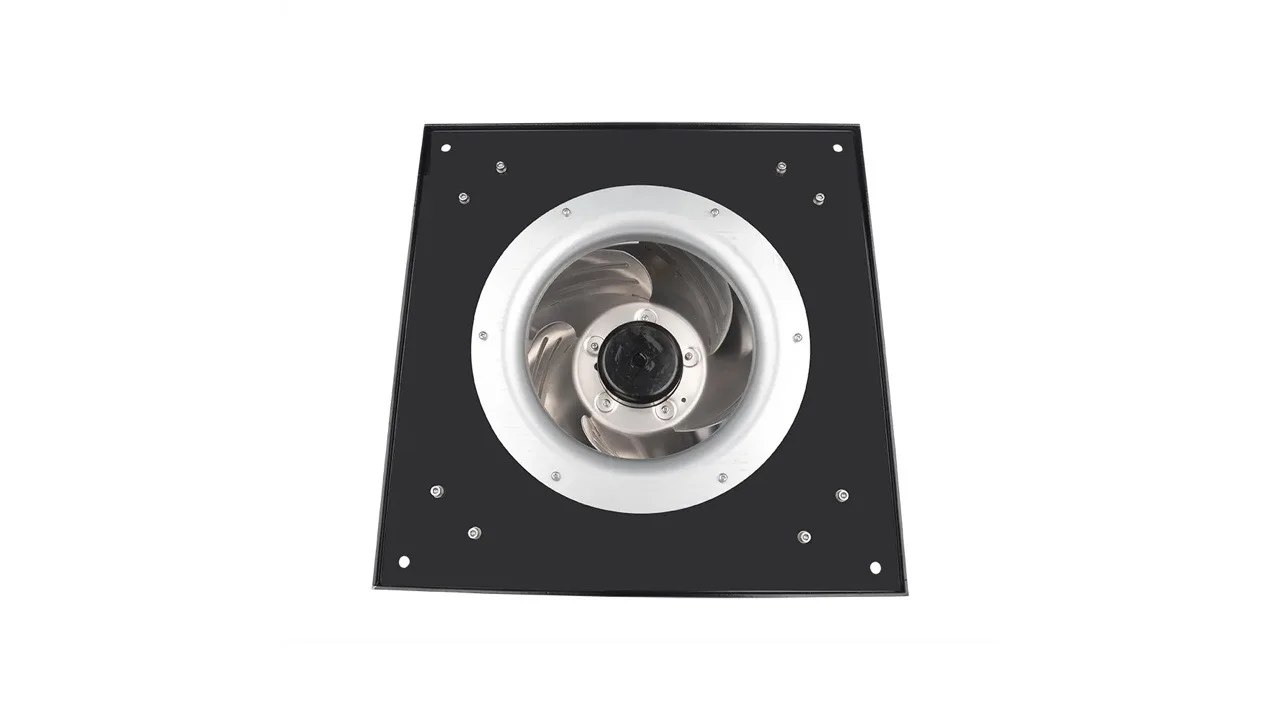
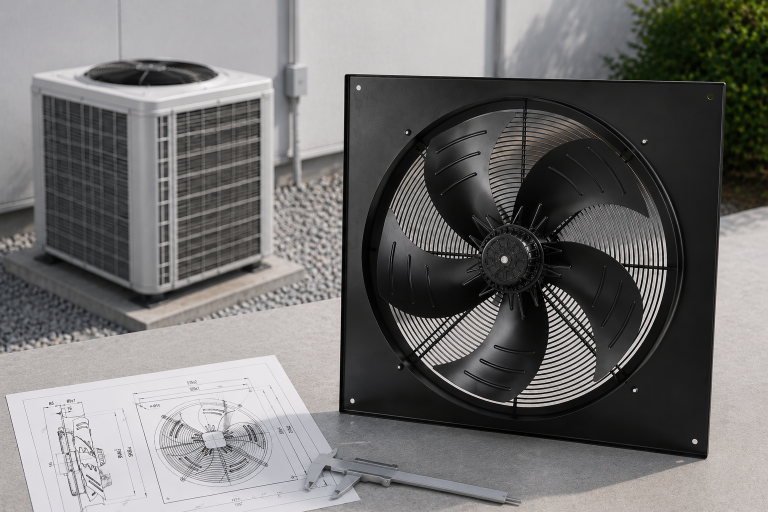
Meanwhile the LWAD9225MX-24-11 showing the 92mm frame and impeller design, dimensionally identical to the IP68-rated variant.
Specifying ingress protection
If you are writing an IP68 fan into your own specification, these four points save trouble later.
- State the immersion depth and duration. IP68 is the only rating where the manufacturer defines the test conditions rather than the standard. An IP68 fan tested at one meter for thirty minutes and one tested at three meters for a day are both honestly IP68, and they are not the same product.
- Ask what the sealing did to the thermal design. Any sealed motor loses convective cooling from its electronics. Ask whether the potting compound is thermally conductive, and whether the life expectancy figure was re-stated after potting or simply carried over from the open version.
- Do not over-specify the rating. IP68 costs more, weighs more and runs hotter than IP54 or IP55. If your equipment sees rain rather than immersion, the lower rating is the better engineering answer, not a compromise.
- Check whether a sealed variant already exists. On many platforms the sealed build is a suffix on an existing part number rather than a development project. That distinction is worth a question before anyone quotes you tooling.
See our axial fans range, the DC axial fans section, or DC cooling fans.
Questions about IP68 fans
Is IP68 always better than IP65 or IP55?
Only if your equipment is actually immersed. IP68 seals the electronics away from the airstream, which means they run warmer for the same duty. Where the real exposure is rain and dust, a lower rating gives you the protection you need without the thermal penalty.
Does potting shorten motor life?
It can, and that is the risk to manage rather than ignore. Trapped heat ages insulation and grease faster. A thermally conductive compound moves winding heat out into the frame and the airstream, which is what keeps the life figure intact after sealing.
Why does IP68 need a stated depth?
Because the standard leaves it to the manufacturer. IP67 has a defined test, one meter for thirty minutes, but IP68 only requires conditions more severe than that, agreed between supplier and customer. Without a depth and a duration on the datasheet, the rating tells you less than it appears to.
Can an existing open fan simply be sealed?
Sometimes, if the platform already has a sealed variant. Sealing one that does not usually means potting the electronics and re-checking the thermal behavior afterwards. It is a real engineering change, not a coating applied to a finished fan.
Technical Documentation & Resources
Need the same thing for your own unit?
Give us the numbers and the envelope, and you get a shortlist rather than a catalog. Meanwhile custom spec sheets and samples run to 90 days. Since 1990 Longwell has supplied EC fans and blowers to OEMs in HVAC, cold chain, data center and industrial markets.
Browse Related Products:
🏆 ISO 9001 / ISO 14001 / ISO 45001 | CE (TÜV) | UL/ETL | ATEX Zone 21/22 | AMCA 210/211 / ISO 5801 tested