What the HVAC OEM needed
An OEM building commercial HVAC equipment needed a custom AC motor to drive an impeller they already use. Namely our LWPI-Φ107×705-02 cross-flow wheel, 107mm across and 705mm long.
Specifically, the goal was a form, fit and function replacement for the existing motor, rated 32W at 0.36A with a top speed of 1050 RPM.
- 208 to 230V at 60Hz, as already installed.
- Three speeds, so high, medium and low settings work exactly as before.
- A PSC type motor, since the photograph they sent confirms it.
- Lastly, the same mounting and wiring, because nothing else may change.
Then our sales team hit a problem. Our standard YDK catalog motors run at 800 RPM. Unfortunately 800 RPM cannot drive that impeller to the airflow the product needs.
Consequently the whole project came down to one question. Namely, could a custom AC motor reach 1050 RPM without changing the mounting or the wiring?
Winding a custom AC motor to 1050 RPM
Initially this ran as minor development rather than a full NPI cycle, which suited both the size and the urgency.
Why the standard motor fails
Pairing the 800 RPM YDK motor with a 107 by 705mm impeller leaves a large airflow gap. Consequently the finished HVAC unit misses its cooling capacity, which is not a small failure.
Why not switch to EC
We considered an EC motor for efficiency and precise speed control, then rejected it.
Basically the customer system is built around a simple three-tap AC motor. Moving to EC would force a redesign of their control board and wiring harness, since it needs a 0-10V or PWM signal that does not currently exist. The objective was a drop-in, not a system overhaul.
Rewinding instead
Therefore we modified an existing YDK-series platform instead. The engineering sat in a new winding for the 6-pole motor.
Raising loaded speed from 800 to 1050 RPM on 60Hz meant recalculating coil turns and wire gauge. That shifts the torque-speed curve. Meanwhile the aim was to match it to the load curve of that specific impeller at the wanted operating point.
This is where making both parts helps. Knowing exactly how the impeller loads the motor lets you predict the loaded speed, rather than discover it afterwards.
What shipped
Finally, the custom AC motor LWYDK-32W-6P-001 hits the target precisely. Three wiring taps give 1050, 900 and 750 RPM, matching the existing control scheme.
Mechanically, meanwhile, nothing moved. The 127mm body, the 118mm length and the M6 threaded shaft all carry over. Consequently it is a direct physical replacement.
Technical Specifications
The three speeds below come from wiring taps on the custom AC motor, not from electronics. That is what keeps the customer control board unchanged.
| Parameter | Value |
|---|---|
| Longwell Model | LWYDK-32W-6P-001 |
| Voltage | 230 VAC |
| Frequency | 60 Hz |
| Input Power (Rated) | 32 W |
| Current (Rated) | 0.36 A |
| Speed (3-Speed) | 1050 / 900 / 750 RPM |
| Poles | 6 |
| Motor Body Diameter | 127 ±0.2 mm |
| Motor Body Length | 118 ±1.5 mm |
| Application Load | Cross-Flow Impeller LWPI-Φ107×705-02 |
Technical Documentation
Here the following documents were generated and approved during the project workflow, moving from ‘Sales Input’ to final ‘Archived’ status.

This is the final approved technical drawing for the LWYDK-32W-6P-001 motor, used by design engineers for system integration. Download the full PDF specification here.
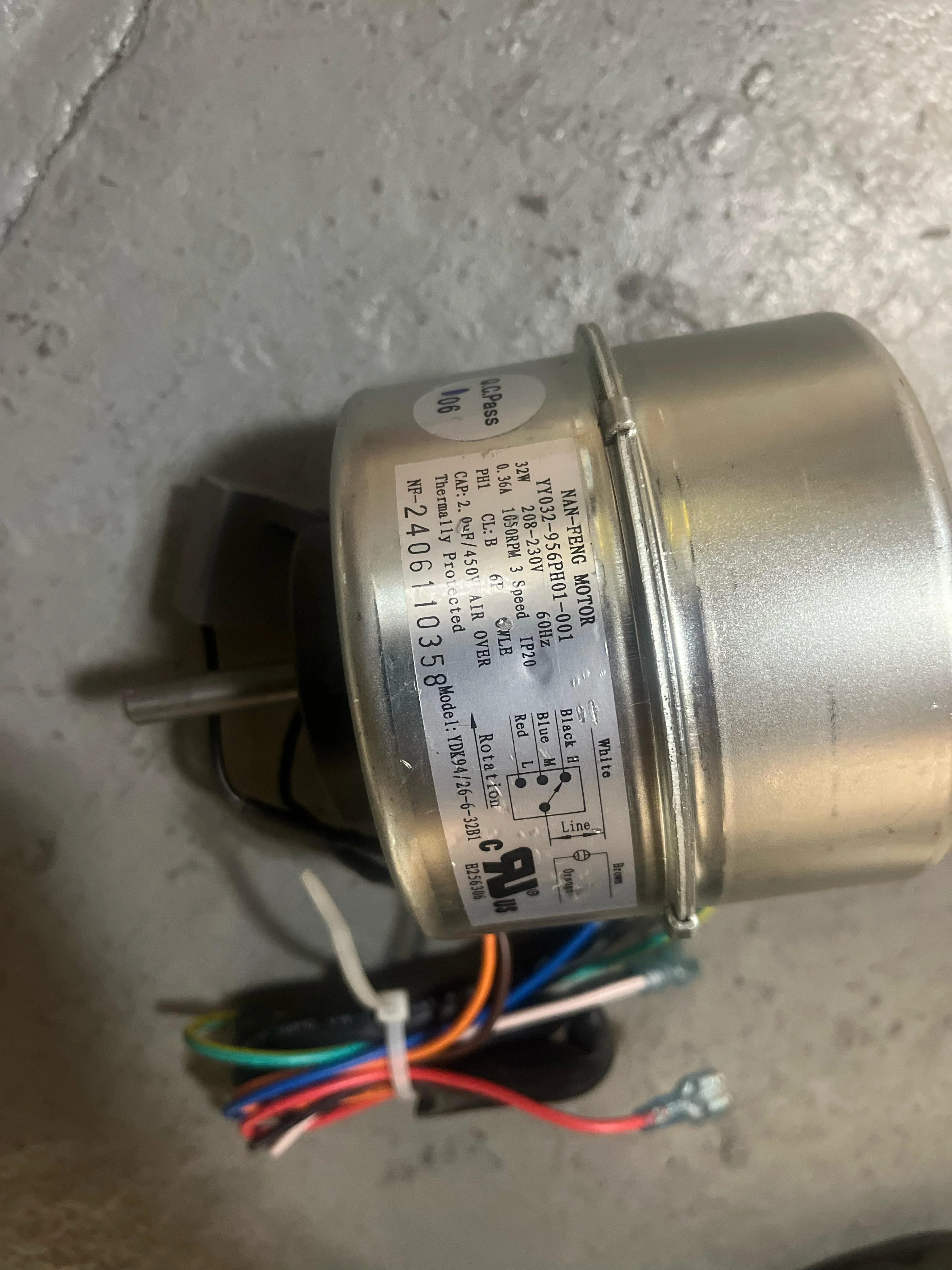
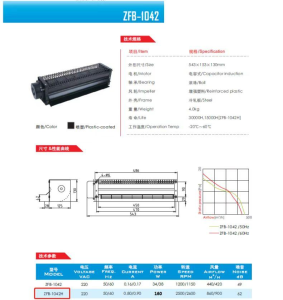
The image shows the competitor’s motor the customer sought to replace, providing baseline performance and dimensional targets.
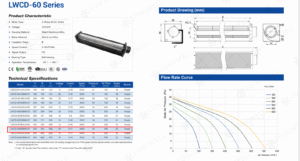
Here the document details the LWPI-Φ107×705-02 cross-flow impeller that the motor was designed to drive, critical for verifying load calculations. Download the impeller drawing here.
Why the rewind happened here
At 500 to 1,000 units a year, four things made a semi-custom motor viable.
- Triaged as minor development. The customer needed a 1050 RPM solution no catalog offers. Treating it as minor development returned confirmed drawings and quotes far faster than the 12 to 18 month NPI cycles imported European brands run for comparable work.
- A modified platform, not a new design. Adapting a high-volume YDK motor met every requirement, without a clean-sheet design or a needless jump to EC. Consequently the drop-in replacement lands materially below a European equivalent.
- We build both halves. This project needed a real understanding of how a 705mm cross-flow impeller loads a motor. Because we make motors and impellers, our engineers could model that load and commit to 1050 RPM under load, with performance verifiable to AMCA 210/211.
- Capacity behind a small order. Meanwhile the forecast is only 500 to 1,000 units a year. With over 30,000 cold chain units built annually, scaling from prototype batches to production runs does not disturb the 15 to 25 day make-to-order lead time.
Browse our AC motor range, or the cross-flow impeller section. Motor insulation classes are defined by the IEC in IEC 60085.
Questions about custom windings
What is the lead time for a custom-wound motor?
For a custom AC motor of this kind, engineering samples take roughly 45 to 60 days inside our structured NPI process. After design validation and acceptance, a production batch of 100 to 500 units runs 15 to 25 days on the standard make-to-order schedule.
Can you supply a 50Hz version?
Yes, though it needs its own winding. A 6-pole custom AC motor designed for 60Hz runs about 17% slower on 50Hz, so reaching a comparable 1050 RPM requires a new winding specification. That would run as a separate minor development project on a similar timeline.
Is it UL or CE certified?
The base YDK platform carries CE conformity. For this custom model, project-based UL 507 certification is available for North American entry. Our relationship with a China-local TUV NORD notified body shortens that timeline considerably, which matters when a launch date is fixed.
Why rewind rather than gear the motor up?
Because gearing adds a part, a noise source and a wear item to a product with none of those today. A rewind changes only what sits inside the housing. Consequently the customer sees an identical part with a different speed on the label. On a fan coil unit, that simplicity is worth a great deal.
Technical Documentation & Resources

Need the same thing for your own unit?
Give us the numbers and the envelope, and you get a shortlist rather than a catalog. Meanwhile custom spec sheets and samples run to 90 days. Since 1990 Longwell has supplied EC fans and blowers to OEMs in HVAC, cold chain, data center and industrial markets.
Browse Related Products:
🏆 ISO 9001 / ISO 14001 / ISO 45001 | CE (TÜV) | UL/ETL | ATEX Zone 21/22 | AMCA 210/211 / ISO 5801 tested
Choose the right fan coil unit
Longwell manufactures 14 fan coil units in-house. Send airflow, static pressure and voltage — an engineer replies with a matching model, performance curve and price within one working day.