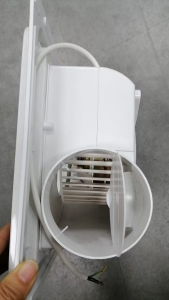
What arrived on the bench
An equipment manufacturer needed a 200mm cross-flow impeller with a matched AC motor, as an exact drop-in for an existing product line. A sample teardown is how we got there.
Rather than send a drawing, they sent a physical sample. So the project began with a sample teardown rather than a specification review.
What they wanted, and what they did not
- First, a 220V supply at 50Hz.
- Next, an initial order of 200 units.
- Meanwhile components only: the motor, the impeller and the mounting hardware.
- Finally, no housing at all.
That last point says something about their product. They build the enclosure themselves, and the fan is structural to it. Typically that means compact air curtains, electric fireplace inserts or built-in trench heaters.
What the sample teardown found
A sample is more useful than a drawing, although it needs different handling. So the first step was measurement rather than reading.
What the teardown measured
Initially our lab took the interfaces that decide whether a replacement fits. Impeller length at 200mm, diameter around 47mm, the motor mounting points, and a shaft at 4mm diameter with 28mm extension.
Those numbers became the search key. Notably a drawing gives intended dimensions. By contrast the sample gives what was built, and on a part made for years the two can differ.
The route we ruled out first
Naturally, designing a custom impeller and motor was rejected immediately.
That means new tooling and a 90-day cycle. Meanwhile it is unnecessary if stock parts already meet the dimensions. So the search came before any design work.
What the catalog held
Cross-referencing those measurements against our standard library produced a motor and an impeller. Together they match every interface the sample teardown recorded.
So no tooling, no development, and a lead time set by stock rather than by a mold.
What it cost
Nothing on this project, though the approach has a real limit worth stating.
It works because the sample fell on dimensions we already make. Had the shaft been 4.2mm, or the impeller 205mm, none of it applies and the answer becomes tooling. So a sample teardown tells you quickly which case you are in. That is most of its value.
Technical Specifications
The parts below are standard stock items. Notably nothing here was made for this project.
| Parameter | Value | Component |
|---|---|---|
| Voltage | 220V | Motor |
| Frequency | 50Hz | Motor |
| Motor Model | LWSPM4820-02 | Motor |
| No-Load Speed | 2900 ±5% RPM | Motor |
| No-Load Current | 0.09A | Motor |
| No-Load Power | 9.7W | Motor |
| Rotation | Clockwise (CW) | Motor |
| Shaft Diameter | Ø 4 mm (-0.01/-0.02 tolerance) | Motor |
| Impeller Model | LWMI-φ45X200-02 | Impeller |
| Impeller Diameter | Ø 47 mm (+0.3 tolerance) | Impeller |
| Impeller Length | 200 mm (±0.3 tolerance) | Impeller |
| Mounting Bushing | LW-C08-50-01 | Bushing |
| Bushing Material | EPDM Rubber | Bushing |
Technical Documentation
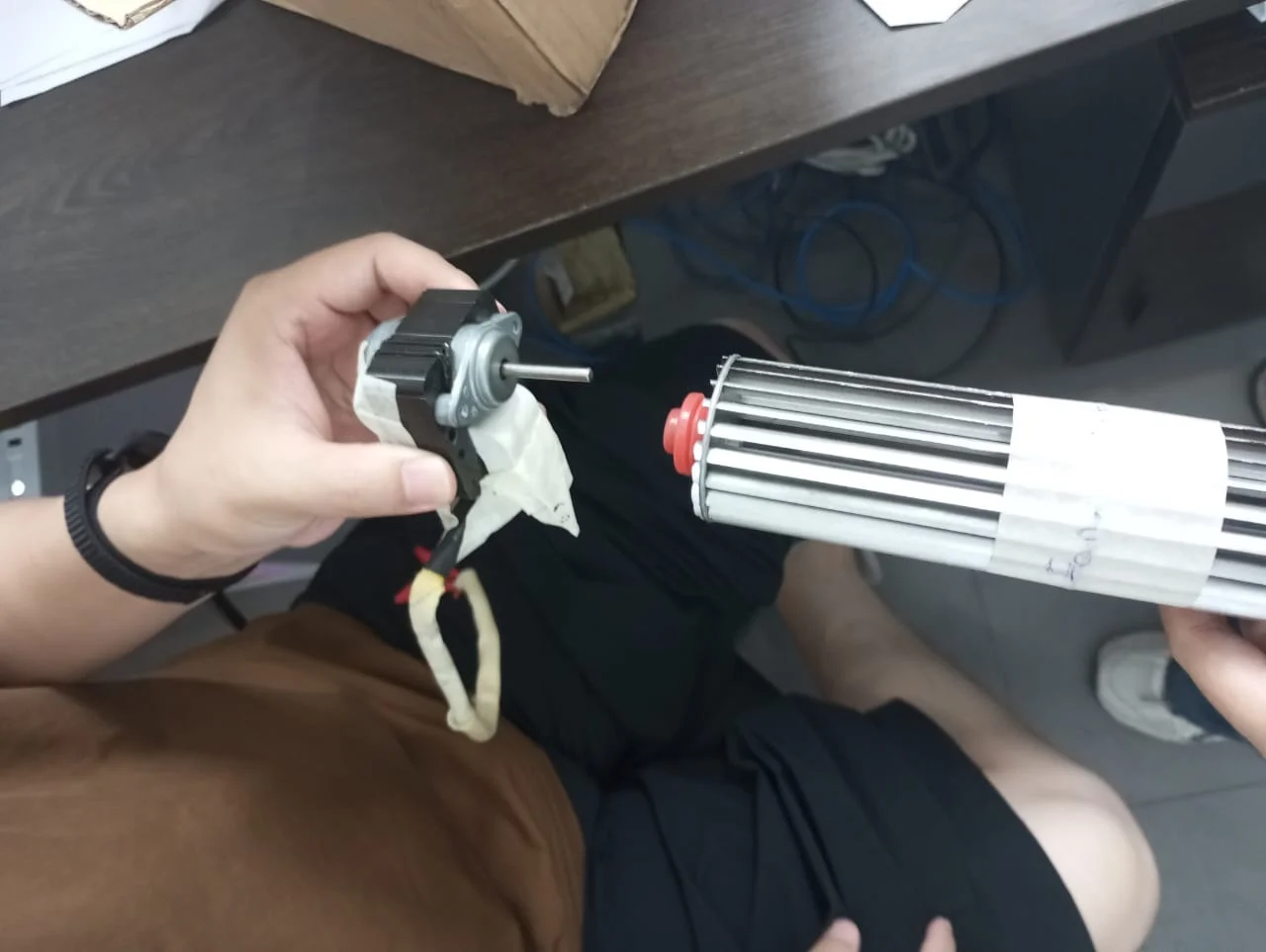
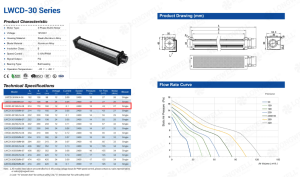
Here the customer’s original sample provided the physical benchmark for component selection.
LWSPM4820-02 Motor Specification Sheet
The document provides procurement managers and engineers with the critical electrical specifications and mechanical dimensions for the AC shaded pole motor.
LWMI-φ45X200-02 Impeller Drawing
Meanwhile the impeller drawing details its dimensions, material callouts, and required quality standards, including dynamic balancing and runout tolerances.
Here the drawing gives the specifications for the EPDM rubber mount, which is essential for vibration damping and ensuring a secure fit in the final assembly.
If you need a dimensional match
Matching an existing part is a measurement problem before it is an engineering one.
- Send the part, not a description. A sample teardown measures what was built. By contrast, drawings record what was intended. On a long-running product the two drift apart through changes nobody wrote down.
- Name the interfaces that must match. Shaft diameter and extension, impeller length and diameter, mounting pattern. Those four decide fit. Everything else is usually negotiable, and saying so widens the field of possible matches.
- Ask whether components alone are available. Buying a motor and impeller without a housing suits products where the enclosure is structural. Not every supplier sells that way, and it removes a housing you would otherwise pay for and discard.
- Match on function, not part number. A cross-reference between makers is approximate at best. Meanwhile measured interfaces are exact, which is why the sample beats the number on it.
See our cross flow impeller range, the cross flow fan section, or fan motors. Balance grades follow ISO 21940.
Questions about component supply
Why is a sample better than a drawing?
Because it records what was manufactured rather than designed. Long-running products accumulate running changes, supplier substitutions and tolerance drift that never reach the drawing. So when the requirement is that a part physically fits, a sample teardown beats the paperwork.
What should I measure before sending an enquiry?
Shaft diameter and extension, impeller length and diameter, and the mounting pattern with hole spacing. If you can add the supply voltage and the speed you observe, that is usually enough to search a catalog properly without a sample changing hands at all.
Can you supply components without a housing?
Yes, and many OEMs prefer it. Where the enclosure is part of the product structure, a supplied housing is something you pay for and then discard. Buying the motor, impeller and mounting hardware alone is normal for air curtains, fireplace inserts and trench heaters.
What happens if no standard part matches?
Then it becomes a tooling question, and the answer changes with your volume. A new impeller needs a mold and roughly 90 days. Below a few thousand a year that rarely pays. Usually it is better to adapt the housing than the fan.
Technical Documentation & Resources
Working on something similar?
Send us the duty point, the envelope and the supply, and our engineers come back with a shortlist rather than a catalog. Meanwhile custom spec sheets and samples run to 90 days. Since 1990 we have built fans for HVAC, cold chain, data center and industrial OEMs.
Browse Related Products:
🏆 ISO 9001 / ISO 14001 / ISO 45001 | CE (TÜV) | UL/ETL | ATEX Zone 21/22 | AMCA 210/211 / ISO 5801 tested