What the condenser OEM needed
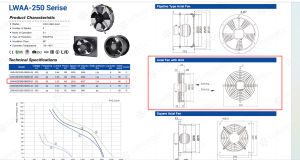
An existing OEM partner building large commercial HVAC systems asked us to issue specification sheets for two AC axial fan variants.
Each AC axial fan goes into a new series of high-capacity air-cooled condensers. Both also had to drop straight into an existing design, which fixed the envelope at 1045mm diameter and 275mm mounting depth.
Two duty points, one product line
The headline requirement was 26,500 m3/h from a 380VAC, 50Hz supply. Alongside it, they wanted a second, slower model at 21,250 m3/h for smaller condensers and for sites with tighter noise limits.
- Noise had to stay at or below 80 dB(A) on the high-performance unit.
- Ambient range ran from -30C to +60C, since these units sit outdoors in every climate.
- CE marking was mandatory for the European market, with RoHS and REACH compliance on materials.
- Finally, the datasheets had to satisfy EN 60335-1 so they could go into the customer technical file.
Two AC axial fan variants from one frame
Here the customer already used this AC axial fan family, so a new design would have been effort spent for nothing. The real question was how to reach two duty points from one platform.
We considered EC and said no
An EC version was tempting on efficiency and control. However, their condenser control system is built around simple three-phase AC motor control.
Putting an EC fan in would have forced a redesign of their control panels, which defeats the purpose of a fast, low-risk product refresh. Furthermore, the AC motor costs materially less than an equivalent EC model, and this is a price-sensitive market.
So an AC axial fan it was, for reasons that had nothing to do with aerodynamics.
One frame, two windings
Both share the same 1045mm frame and the same five-blade welded impeller in cold-rolled steel. Meanwhile the difference sits entirely in the motor winding.
- First, the -05 build runs at a nominal 920 RPM for 26,500 m3/h, drawing 2450 W at 80 dB(A).
- Second, the -06 build runs at 770 RPM for 21,250 m3/h, drawing 1550 W at 73 dB(A).
That slower variant shows how fans behave. Airflow drops by a fifth, yet power falls by more than a third and noise drops 7 dB(A). In short, slowing a fan down pays back out of all proportion, which is why it earns its own part number.
Both retain IP54 protection and Class F insulation for outdoor duty. Meanwhile the customer gets two documented options that share one set of mechanical parts, so their inventory and installation stay simple.
Technical Specifications
Two columns, one frame. Read across the speed row first, since every other difference follows from it.
| Parameter | LWAA6D910S-7MEB-05 | LWAA6D910S-7MEB-06 | Unit |
|---|---|---|---|
| Nominal Voltage | 380 | 380 | VAC |
| Frequency | 50 | 50 | Hz |
| Airflow (Max) | 26,500 | 21,250 | m³/h |
| Speed | 920 | 770 | RPM |
| Input Power | 2450 | 1550 | W |
| Current | 4.7 | 2.6 | A |
| Noise Level | 80 | 73 | dB(A) |
| Impeller Diameter | 910 | mm | |
| Overall Diameter | 1045 | mm | |
| Overall Depth | 275 | mm | |
| Operating Temperature | -30 to +60 | °C | |
| Protection Type | IP54 | ||
| Insulation Class | Class F | ||
| Life Expectance (L10) | 30,000 | Hours @ 40°C | |
| Certifications | CE, RoHS, REACH | ||
Technical Documentation
The following documents were the final approved deliverables for this project, confirming the fan’s performance and integration parameters for the customer’s design and compliance teams.
LWAA6D910S-7MEB-05 Datasheet: This is the full technical datasheet for the higher-speed model, which a system engineer needs to verify all performance, electrical, and acoustic data.
LWAA6D910S-7MEB-06 Datasheet: This is the technical datasheet for the lower-speed model, providing its specific performance curve and electrical parameters for noise-sensitive or lower-capacity applications.

Meanwhile the dimensional drawing provides the critical mechanical interface details, including mounting hole patterns and overall size, needed by a CAD designer or system integrator.
Why the OEM stayed on our platform
The request looked like paperwork. In practice it was a small engineering job with real commercial consequences.
- Variants from a platform, in days. The OEM needed documented options rather than a new product. Because the family is modular, creating and documenting the new series from the existing platform took days.
- No new tooling, no cost change. Reusing the existing high-volume line for the impeller, motor and guard kept the supply chain and the cost structure untouched. That is how the price stayed materially below European catalog levels with no tooling investment from the customer.
- The figures were measured. The airflow numbers are not calculated estimates. Both were measured in our on-site chamber, verified to AMCA 210/211 and ISO 5801 methods, so the OEM could put them in their own technical submittals.
- Compliance arrived with the fans. CE, RoHS and REACH documentation came as part of the package. Consequently their compliance team had what they needed for the whole condenser unit without chasing anyone.
See our axial fan range, or the condenser fan section. Performance testing follows AMCA 210.
Questions about these fans
What is the difference between the -05 and -06 models?
They share the 1045mm frame, the IP54 motor housing and the five-blade impeller. Only the internal winding differs. The -05 turns at 920 RPM for 26,500 m3/h, while the -06 turns at 770 RPM for 21,250 m3/h, at 73 dB(A) instead of 80 and 1550 W instead of 2450.
Can this AC axial fan run on a VFD?
Yes. The 380VAC three-phase asynchronous motor works with standard commercial variable frequency drives. However, for sustained running below 25 Hz, talk to our engineers first, since motor cooling depends on the fan itself. Where a wide efficient speed range is the real goal, a SmartEC fan is usually the better answer.
What is the lead time for 100 units?
A standard make-to-order batch of this size runs 15 to 25 days from order confirmation. Building over 2.2 million fan and motor units a year gives us some scheduling flexibility. Customers with frame agreements and rolling forecasts often draw on held stock and ship in under 5 days.
Why offer a slower fan rather than let the customer throttle the fast one?
Because throttling wastes energy while a slower fan simply uses less. A dedicated 770 RPM winding draws 1550 W to do its job. Running the 920 RPM fan against a damper to reach the same airflow would draw far more, and it would still be the louder machine.
Technical Documentation & Resources
Need the same thing for your own unit?
Give us the numbers and the envelope, and you get a shortlist rather than a catalog. Meanwhile custom spec sheets and samples run to 90 days. Since 1990 Longwell has supplied EC fans and blowers to OEMs in HVAC, cold chain, data center and industrial markets.
Browse Related Products:
🏆 ISO 9001 / ISO 14001 / ISO 45001 | CE (TÜV) | UL/ETL | ATEX Zone 21/22 | AMCA 210/211 / ISO 5801 tested
Choose the right ac axial fan
Longwell manufactures 218 ac axial fans in-house. Send airflow, static pressure and voltage — an engineer replies with a matching model, performance curve and price within one working day.