How the Fan Inlet Modification Was Planned
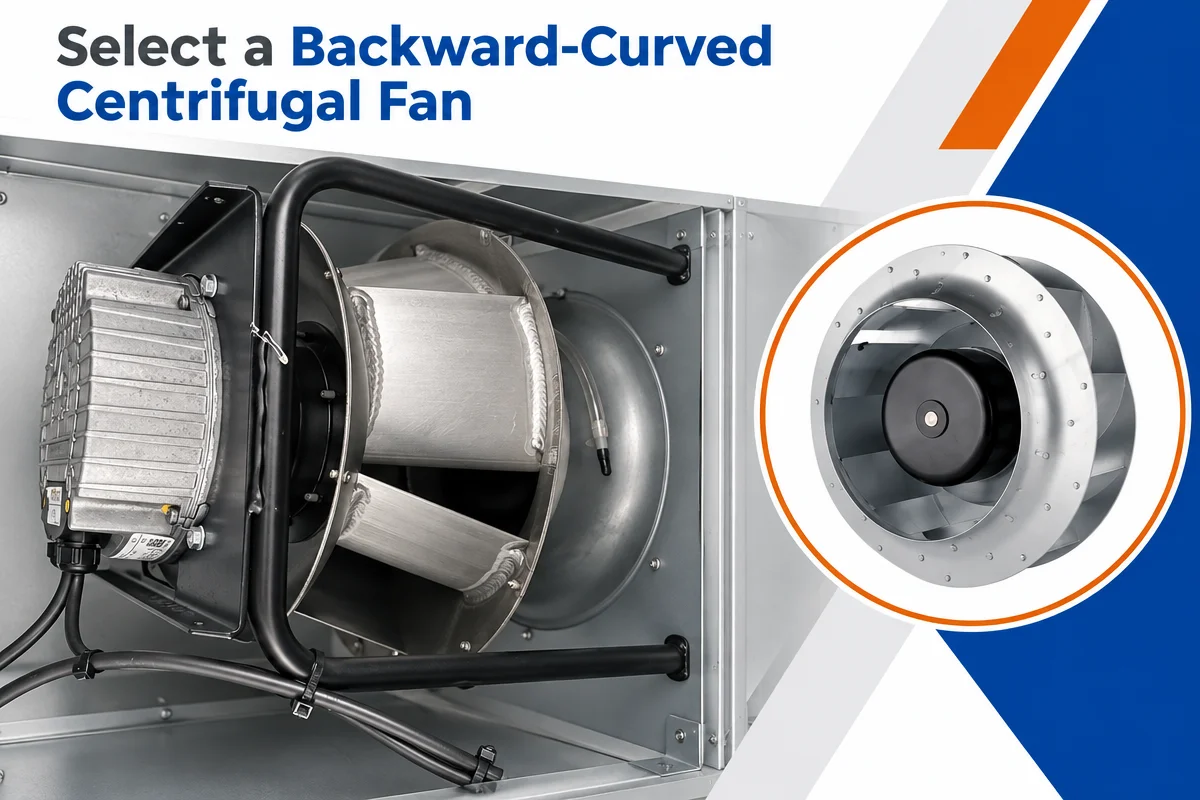
The customer asked for a fan inlet modification on a 280mm EC centrifugal wheel. This fan inlet modification had to last through hard winters. So the fan inlet modification had to hold up across a wide temperature range. In practice the system must run perfectly from -25°C up to +60°C.
We know the equipment lives outdoors because of this low limit. Next, the engineering team reviewed the core airflow targets. The HVAC system needs 3131 m3/h of air flow. Or, in imperial units, it requires 1842 CFM.
Furthermore, the unit must push this air against a high static pressure of 1118 Pa. The motor runs on a standard 230 VAC supply. It accepts input voltages from 200 VAC to 264 VAC at 50/60 Hz. Meanwhile, the noise output must stay under 82 dB(A) at the full speed of 3100 RPM.
We test performance to AMCA 210-16 methods. However, the customer faced a major mechanical problem. Their cabinet design could not fit the standard Z1 inlet ring. So, they needed a different inlet cone shape to match their bulkhead.
They asked us to swap the Z1 ring for our 28A1A1 cone profile. The customer also required the removal of the pressure measuring nozzle. Finally, the chosen design had to meet UL 507 and CE safety standards for global market access.
Choosing the Right Inlet Cone Profile
We looked at multiple ways to solve this mechanical clearance issue. First, we considered asking the customer to redesign their HVAC cabinet. We rejected this idea quickly. Changing the sheet metal would force the customer to retool their entire assembly line.
Instead, we decided to modify the 280mm EC centrifugal fan itself. Next, we evaluated building a completely new metal inlet ring from scratch. Our team rejected this option because it takes too much time. Custom tooling adds weeks to the initial sample lead time.
Therefore, we chose an existing part. We took the standard 28A1A1 inlet cone and adapted it to fit the base impeller.
Removing Unused Components
The customer explicitly asked us to remove the pressure measuring nozzle. Normally, the A1 cone includes this small nozzle. It allows a controller to monitor real-time air volume. However, this specific HVAC setup did not use a closed pressure loop.
The system only uses a standard 0-10V speed signal. So, keeping the nozzle provided zero value to the end user. By contrast, removing it smoothed out the intake path. We deleted the nozzle feature from the final engineering drawing.
Evaluating Trade-offs and Final Output
Every engineering choice comes with a specific cost. Here, a custom assembly stretched the sample production time by a few days. We had to draft and approve new mechanical drawings. Even so, this decision led to a materially lower cost in mass production.
We completely eliminated a brass fitting that the customer never used. Finally, we finalized the custom LWBE3G280-102NS-25-07 model. The final unit draws 620 W of input power and 2.7 A of current. It spins smoothly on double-sealed 6001-2RS rubber bearings.
Most importantly, the modified cone matched the tight cabinet space perfectly. The design easily maintained the critical 1118 Pa static pressure capability.
Technical Specifications
| Parameter | Value |
|---|---|
| Airflow (Max) | 3131 m3/h / 1842 CFM |
| Static Pressure (Max) | 1118 Pa |
| Input Power | 620 W (±10%) |
| Speed | 3100 RPM (±5%) |
| Nominal Voltage | 230 VAC (200-264 VAC range) |
| Frequency | 50/60 Hz |
| Current | 2.7 A (±0.3) |
| Noise Level | 82 dB(A) |
| Ambient Temperature | -25°C to +60°C |
| Weight | 4.8 Kg |
| Insulation Class | Class F |
| Protection Type | IP54 |
| Certifications | CE, ETL (UL 507, CSA C22.2#113), RoHS, REACH |
The 1118 Pa static pressure limit dictates how well the system forces air through dense heat exchangers. Consequently, hitting this high target is critical for effective cooling. Furthermore, the IP54 protection rating keeps the motor safe. It stops harmful dust and splashing water from damaging internal electronics during outdoor winter operation.
Reference: AMCA 210 covers the test method behind these figures.
Technical Documentation
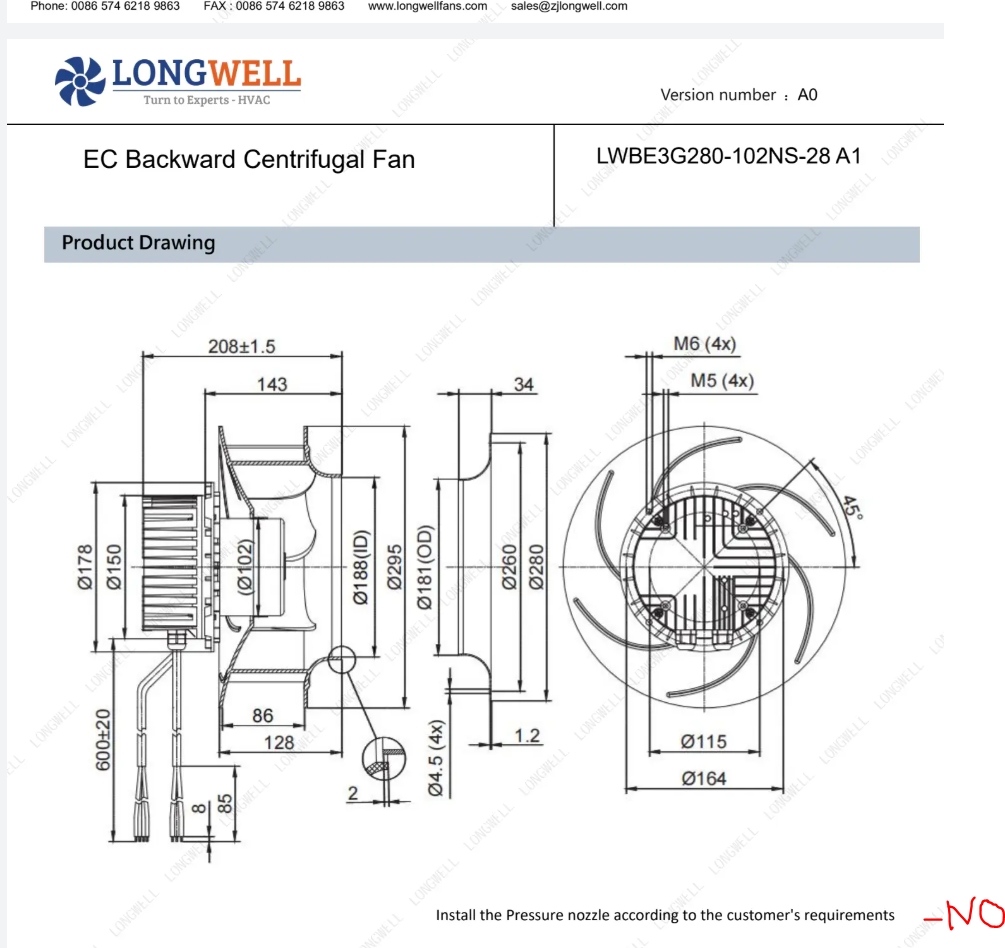
This engineering drawing highlights the pressure nozzle removal. It shows the exact shape of the new metal cone.
longwell-lwbe3g280-102ns-25-technical-doc-02.pdf
The final specification sheet details the electrical limits. It also shows the 0-10V control layout for the system integrator.
Original Z1 inlet drawing (PDF)
The original Z1 document outlines the old mechanical dimensions. It also lists the double-sealed bearing requirements.
How to Specify a Modified Inlet Cone
If you encounter a mechanical interference issue in your HVAC cabinet, review these practical steps. Following these guidelines helps you request the right parts from your supplier.
- First, test your required static pressure against the published performance curve. Changing the shape of an inlet cone alters the aerodynamic flow path. Therefore, you must confirm that the new cone still delivers enough air at your target RPM.
- Next, verify your actual control strategy. Engineers often leave a pressure nozzle on a print by mistake. If your system only uses a 0-10V or PWM signal, you do not need that nozzle. Removing it eliminates a potential air leak and lowers your total part count.
- Then, check your extreme ambient temperatures. Outdoor applications need proper lubrication to survive freezing conditions. We make the impeller in-house, so we can fit 6001-2RS rubber-sealed bearings packed with specialized cold-weather grease.
- Finally, share your exact cabinet dimensions with the engineering team. You should provide the maximum depth and the precise mounting hole locations. Consequently, the first prototype will bolt right into your sheet metal without extra cutting.
Related: Centrifugal Fans.
Common Engineering Questions
Technical Documentation & Resources
A fan inlet modification starts from a standard wheel, and a fan inlet modification is often cheaper than a new size. Browse our centrifugal fans range, the backward-curved fans section, or forward-curved fans.
Have a Similar Fan Requirement?
Longwell’s engineering team delivers custom spec sheets and samples within 90 days. Since 1990, we have supplied EC fans and blowers to OEMs across HVAC, cold chain, data center, and industrial applications worldwide.
Browse Related Products:
🏆 ISO 9001 / ISO 14001 / ISO 45001 | CE (TÜV) | UL/ETL | ATEX Zone 21/22 | AMCA 210-16 / ISO 5801 tested
Choose the right centrifugal fan
Longwell manufactures 1,130 centrifugal fans in-house. Send airflow, static pressure and voltage — an engineer replies with a matching model, performance curve and price within one working day.