What the OEM specified
An OEM building specialized HVAC systems needed a centrifugal fan delivering 1000 m3/h against 700 Pa, with a specific fan IP rating attached.
That combination, moderate airflow with high pressure, describes a system with real internal resistance. Typically dense filter banks, long ductwork or a multi-row coil.
The constraints
- First, 220V single-phase at 50Hz.
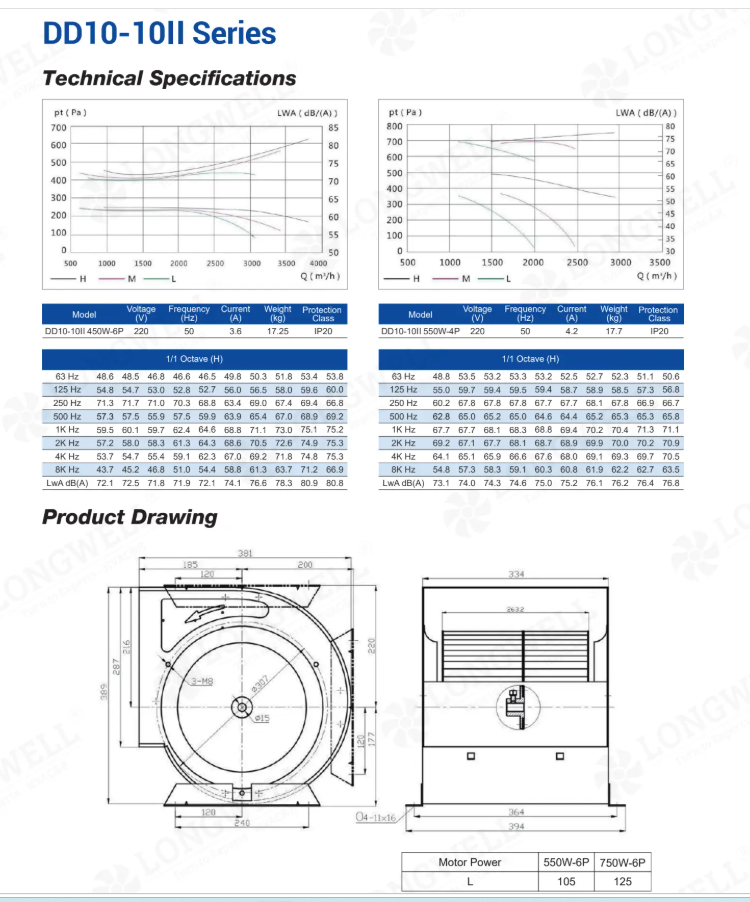
- Next, the mechanical envelope had to stay inside their existing chassis, roughly 394 by 389 by 381 mm.
- Meanwhile performance had to be verifiable against AMCA 210/211.
- Finally, they asked for a fan IP rating of IP55.
The duty point was straightforward and fell inside an existing model curve. However, the fan IP rating request needed a conversation.
Getting the fan IP rating right
IP55 is achievable. However, on this motor frame it needs custom seals and maybe a new enclosure. That adds cost and time.
So before quoting it, we asked a question.
Where does the fan actually sit
Here the answer changed the specification. Their fan sits inside the air handling unit cabinet, shielded from rain and washdown entirely.
What it does see is ambient humidity, plus the occasional splash during maintenance. Nothing in that description requires protection against water jets.
What each rating actually covers
IP44 protects against solids above 1mm and water splashing from any direction. Meanwhile IP55 adds dust protection and resistance to low-pressure jets.
Consequently the gap only matters outdoors, or where kit gets hosed down. Inside a cabinet, the higher rating guards against a threat that is not there.
We proposed IP44 and explained why. The customer agreed.
Why an AC motor
Furthermore the application runs at one speed continuously, so variable speed control has nothing to do.
A 550W four-pole AC motor at 1250 RPM, coupled straight to a forward-curved steel impeller, is simpler and cheaper than EC here. Adding EC would mean paying for capability the system never uses.
The detail that keeps it quiet
The drawing specifies residual imbalance under 150mg. That is tighter than it sounds. Consequently vibration stays out of an air handling unit where the fan runs continuously beside sensitive equipment.
What it cost
Honestly, nothing on this project. The customer received a lower price and a shorter lead time than the specification they asked for.
Meanwhile the caveat is worth stating: if their installation later changes, and the fan ends up somewhere exposed, IP44 will not be enough. That decision is now documented rather than assumed, which is the point of asking.
Technical Specifications
The protection class row below is the one this project turned on. Everything else was settled from the start.
| Parameter | Value |
|---|---|
| Model | DD10-10II 550W-4P |
| Operating Point | 1000 m³/h @ 700 Pa |
| Input Power | 550 W |
| Voltage | 220 V |
| Frequency | 50 Hz |
| Max Current | 4.2 A |
| Speed | 1250 RPM |
| Ingress Protection | IP44 |
| Dimensions (W x H x D) | 394 mm x 389 mm x 381 mm |
| Weight | 17.7 kg |
| Motor Type | 550W-4P AC Induction |
Technical Documentation
Here the following documents were generated and approved during the project workflow, from PM Assignment through to Archived.
DD10-10II-007 Specification Drawing
The dimensional drawing provides mechanical engineers and system integrators with all necessary mounting points, overall dimensions, electrical data, and material requirements for integration.
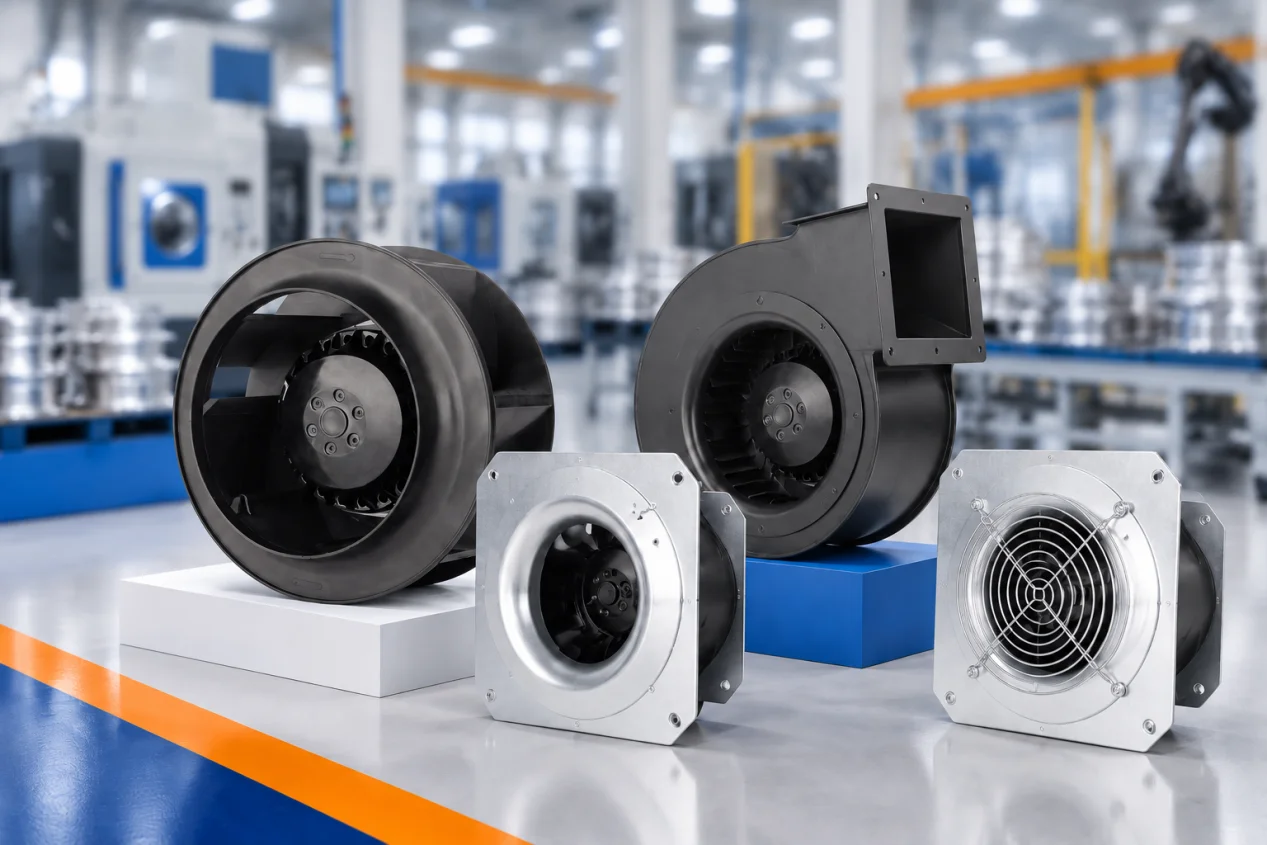
Meanwhile the final assembled DD10-10II 550W-4P direct-drive centrifugal fan, showing the integrated AC motor and compact scroll housing design.
How to choose an IP rating
A fan IP rating gets over-specified more than almost anything else on a datasheet. So these help you pick the right one.
- Describe the location, not the rating. Tell your supplier whether the fan sits inside a cabinet, outdoors under a cowl, or in a washdown area. A good supplier derives the fan IP rating from that, and it is often lower than you assumed.
- Read the two digits separately. The first is solids, the second is water. Many applications need good dust protection and almost no water protection, or the reverse. Asking for a blanket higher number pays for both when you need one.
- Remember corrosion is a separate problem. An IP rating says nothing about chemical resistance. Chlorine, salt air or cleaning agents need a coating specification, not a higher IP number.
- Price the rating before you fix it. Going one grade higher on a motor frame that was not designed for it can mean custom seals and a longer lead time. Ask what it costs before writing it into a specification.
See our centrifugal fan range, the direct drive fan section, or air handling units. Ingress ratings follow IEC 60529.
Questions about this fan
What is the real difference between IP44 and IP55?
Both digits change. IP44 stops solids over 1mm and splashing water. Meanwhile IP55 adds dust protection and resistance to low-pressure jets from any direction. Inside a sealed cabinet that jet protection has nothing to guard against, which is why the lower fan IP rating was right here.
When would IP55 genuinely be needed?
Outdoor mounting where driven rain reaches the motor, food and beverage plants where equipment is hosed down, or dusty industrial environments where fine particles would otherwise reach the windings. If any of those describe your site, specify it and we will build to it.
Why not use an EC fan for better efficiency?
Because this system runs at a single fixed speed. EC efficiency shows clearly at part load, where a modulating fan spends most of its time. A fan that runs flat out continuously captures far less of that benefit, so the extra cost is harder to justify.
Why does residual imbalance matter so much?
Because imbalance becomes vibration, and vibration travels through the mounting into the whole unit. Under 150mg stops the fan exciting panel resonances, and it saves its own bearings. On kit that runs all day, that figure affects service life more than most headline numbers.
Technical Documentation & Resources
Need the same thing for your own unit?
Give us the numbers and the envelope, and you get a shortlist rather than a catalog. Meanwhile custom spec sheets and samples run to 90 days. Since 1990 Longwell has supplied EC fans and blowers to OEMs in HVAC, cold chain, data center and industrial markets.
Browse Related Products:
🏆 ISO 9001 / ISO 14001 / ISO 45001 | CE (TÜV) | UL/ETL | ATEX Zone 21/22 | AMCA 210/211 / ISO 5801 tested
Choose the right centrifugal fan
Longwell manufactures 1,130 centrifugal fans in-house. Send airflow, static pressure and voltage — an engineer replies with a matching model, performance curve and price within one working day.