Cooling a cabinet that fights back
An industrial OEM needed a control cabinet cooling fan delivering 824 m3/h through a 225 by 225mm cutout, no deeper than 80mm. The cabinet was already built, so the fan had to fit the hole that existed.
Inside that cabinet sat dense rows of contactors and motor drives, which is what made this a pressure problem rather than an airflow problem.
The envelope
- First, 380 VAC three-phase, taken directly from the factory grid.
- Next, up to 186 Pa of static pressure through the packed interior.
- Meanwhile 58 dB(A) maximum, because operators work beside it.
- Finally, -30C survival, IP44, S1 continuous duty at full speed, and CE with EN 60335-1.
Why 186 Pa is the number that matters
A fan datasheet headline comes from free air, with nothing in the way. Meanwhile a packed cabinet is the opposite of that.
Every contactor row and cable duct steals pressure. Consequently a fan selected on its free-air figure delivers a fraction of it once the door closes, and the cabinet cooks slowly while the fan spins convincingly.
A control cabinet cooling fan meets resistance
The control cabinet cooling fan had to hold 824 m3/h at the real operating point, not at zero resistance. That drove the blade and motor choices.
Direct on 380 volts, deliberately
Here the cabinet runs on three-phase 380 VAC, so we wound the fan for that supply directly. In other words, no step-down transformer, which saves the DIN rail space one would occupy.
We considered a low-voltage EC motor and rejected it: rectifying 380 VAC three-phase down for an EC drive would add electronics, cost and heat inside an 80mm depth that had no room for any of them.
Seven blades, in steel
Next, a seven-blade 200mm impeller in cold-rolled steel handles the pressure while staying inside the noise cap at 2300 RPM.
Steel was not a durability flourish. After all, the specification demands -30C survival, and polymer impellers turn brittle in that range. On a fan that must start after a cold weekend shutdown, that is a first-start failure waiting.
What continuous duty changes
S1 duty means this control cabinet cooling fan runs day and night at full rating. There is no rest cycle for heat to drain away.
So the margin lives in the components: the winding runs 65 W against a 0.21 A ceiling, and the bearing grease was chosen for years of uninterrupted rotation rather than intermittent service.
What the customer did right
They specified the pressure, not just the airflow. That single number is what let us size the control cabinet cooling fan correctly the first time.
Airflow and pressure figures follow ISO 5801 test methods, which is what makes two curves comparable.
Technical Specifications
The static pressure row matters more than the airflow row here. Free-air figures do not survive contact with a full cabinet.
| Model Number | LWAA2D200S-7MKW-29 |
| Nominal Voltage | 380 VAC |
| Voltage Range | 342~412 VAC |
| Frequency | 50 Hz |
| Speed | 2300 RPM |
| Current | 0.21 A |
| Power Input | 65 W |
| Air Flow (Max) | 824 m³/h (485 CFM) |
| Static Pressure (Max) | 186 Pa |
| Noise Level (LpA) | 58 dB(A) |
| Operating Temperature | -30°C to +60°C |
| Insulation Class | Class F |
| Protection Type | IP44 |
| Work System | S1 (Continuous) |
| Life Expectancy | 30,000 Hours (L10) |
| Balancing Standard | G6.3 (JB/T 9101-1999) |
| Impeller Material | Cold-rolled sheet |
| Bearings | Maintenance-free deep groove ball bearings |
| Certifications | CE, RoHS, REACH |
| Dimensions | 225 x 225 x 80 mm (Ø 200 mm impeller) |
Technical Documentation
Final Engineering Specification Sheet (PDF)
Provides the complete electrical and mechanical parameters, including the tested P-Q performance curve, for system integration engineers.
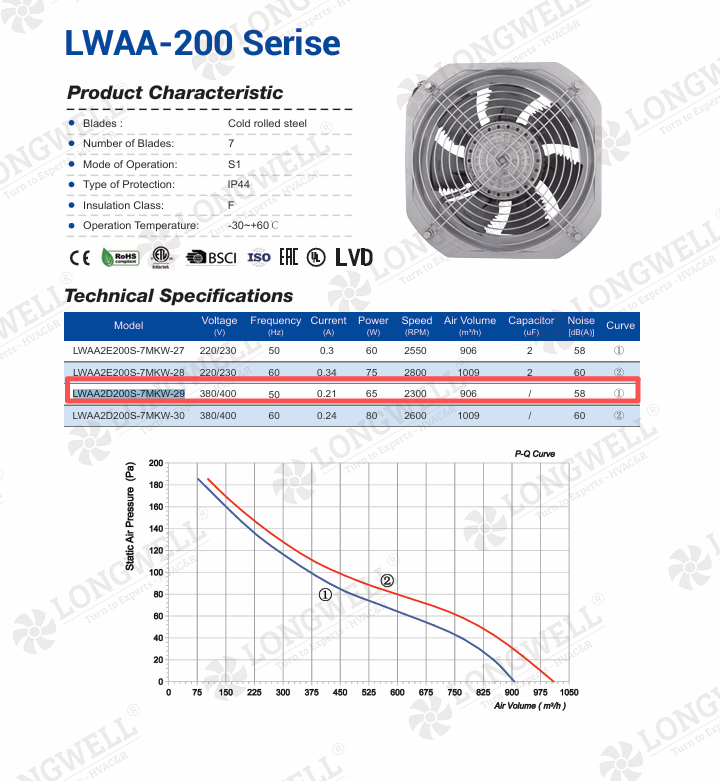
Displays the catalog performance metrics, acoustic ratings, and physical appearance of the 7-blade AC axial fan series.
Original Customer Input Draft (DOCX)
Contains the editable technical specification draft used by the application engineering team during the initial design phase.
Specifying a cabinet fan properly
If you are selecting a control cabinet cooling fan yourself, these four steps prevent the usual failures.
- Estimate the pressure drop before choosing anything. Add the filter, the packed components and the exit grille. A control cabinet cooling fan selected at free air and installed against 150 Pa or more delivers far less air than its headline, and the shortfall is invisible until something trips.
- Check the curve at your operating point. Two fans with the same free-air figure can differ enormously at 186 Pa. Ask for the P-Q curve and read it where your cabinet actually sits.
- Remember filters load up. The pressure drop on day one is the best it will ever be. Size with margin for a half-blocked filter, or schedule filter changes as seriously as you schedule anything else.
- Match the supply, including phases. A fan wound for your grid voltage directly saves a transformer and its heat. State voltage, phase count and frequency in the enquiry rather than leaving them to be assumed.
See our axial fans range, the AC axial fans section, or compact axial fans.
Questions about cabinet cooling
How do I know the pressure drop of my cabinet?
Estimate it from the filter rating, component density and grille area, or measure it with the cabinet running. If neither is possible, tell the fan supplier what the cabinet contains; an experienced application engineer can bound it well enough to select safely.
Why does my cabinet overheat when the fan seems fine?
Usually because the fan was chosen on its free-air figure and the cabinet resistance eats most of it. A loaded filter makes it worse. Check the actual airflow at the exit, not whether the fan is spinning.
Is a filter fan unit better than a plain fan?
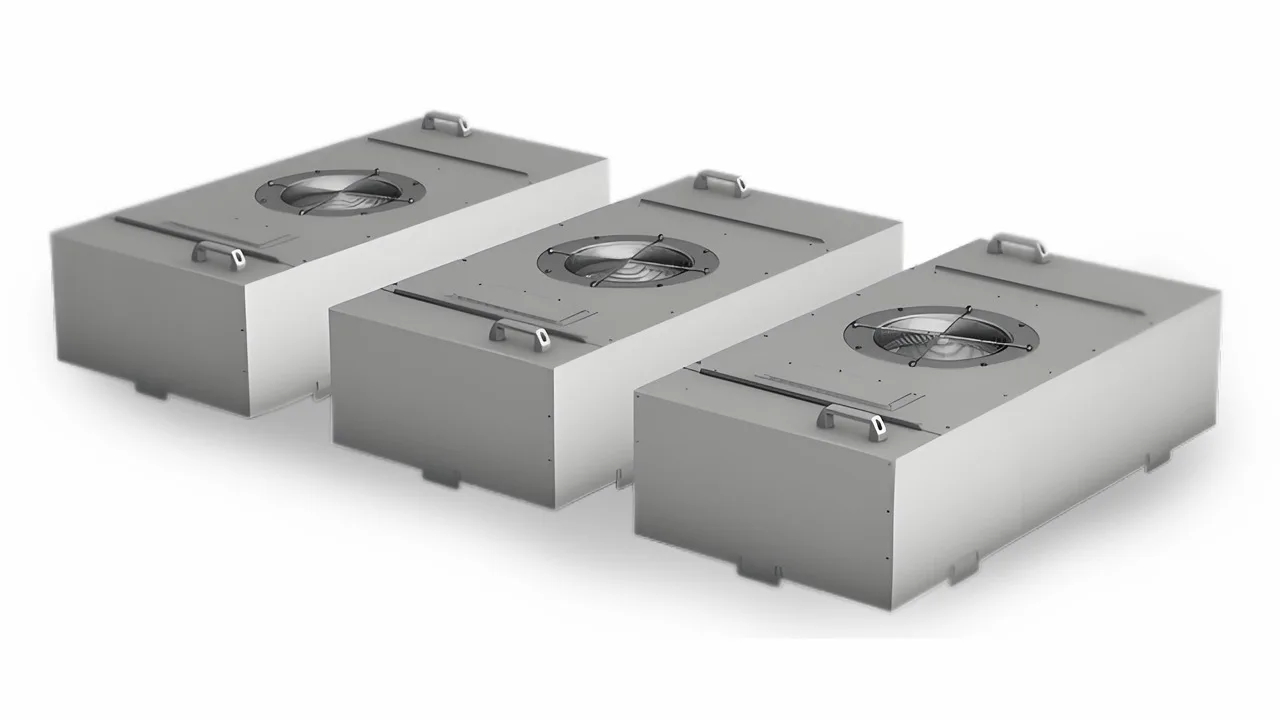
It keeps dust out, which the electronics appreciate, but the filter adds pressure drop that grows as it loads. Whichever you choose, the selection has to include the filter resistance at end of life, not out of the box.
Does running a fan continuously wear it out faster?
Continuous running is actually gentle in one way, since start-ups stress a motor most. What it removes is recovery time for heat, so the winding and grease must be rated for the steady state. That is what an S1 duty rating certifies.
Technical Documentation & Resources
Need the same thing for your own unit?
Give us the numbers and the envelope, and you get a shortlist rather than a catalog. Meanwhile custom spec sheets and samples run to 90 days. Since 1990 Longwell has supplied EC fans and blowers to OEMs in HVAC, cold chain, data center and industrial markets.
Browse Related Products:
🏆 ISO 9001 / ISO 14001 / ISO 45001 | CE (TÜV) | UL/ETL | ATEX Zone 21/22 | AMCA 210/211 / ISO 5801 tested