What the OEM was designing
A European OEM was designing two capacities of commercial fan coil unit. Each needed an EC cross-flow fan sized to its own enclosure.
They came to us for both at once. Their first ask was practical rather than commercial: production-accurate 3D STEP models, so the team could drop each fan into a CAD assembly and check clearances at once.
The two envelopes
- First, the smaller unit needed under 475mm of length and roughly 450 m3/h of airflow.
- Second, the larger unit had 640mm to work with and had to reach 850 m3/h.
- Both had to run from 230V at 50/60Hz and accept a 0-10V signal from a building management system.
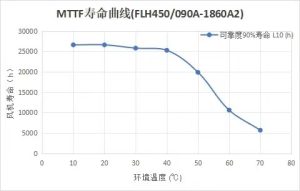
- Finally, minimum L10 life was 40,000 hours at 40C ambient.
The finished equipment sells into the EU, so full CE and RoHS compliance was required from every sub-component, not just the finished unit.
Picking the EC cross-flow fan pair
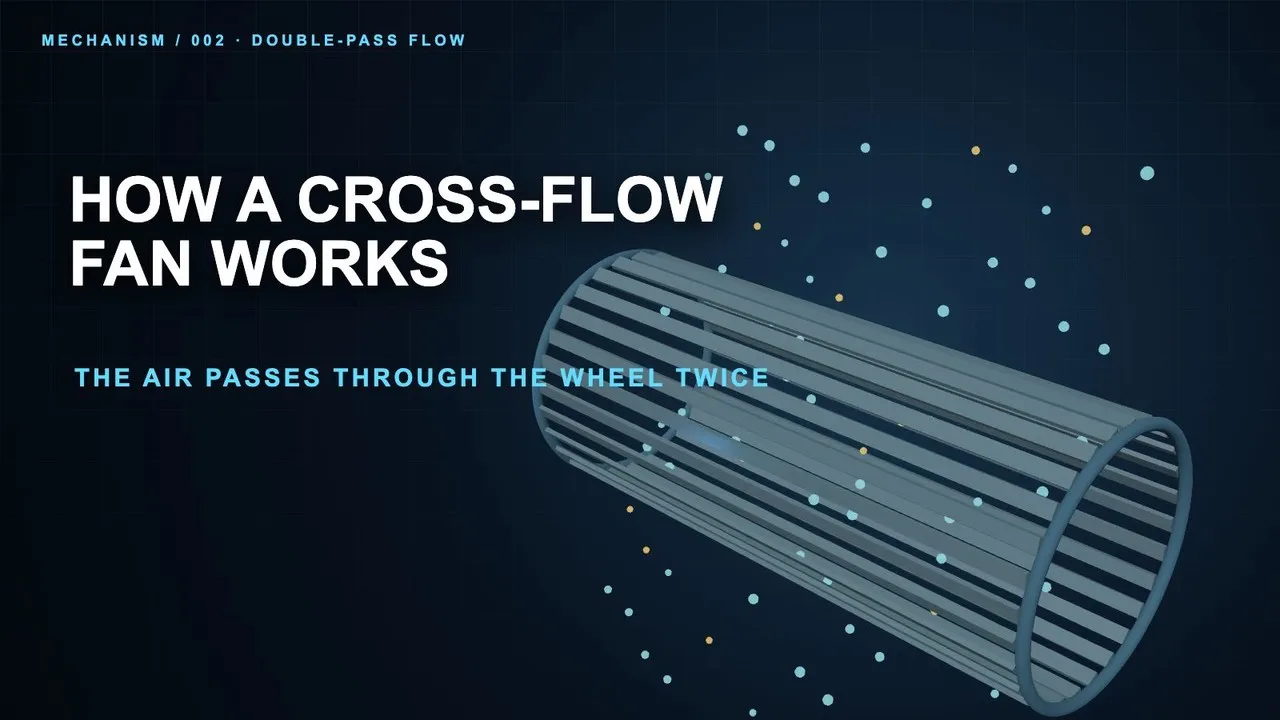
Here the application settled the fan type before we opened it. An EC cross-flow fan gives a wide, even sheet of air inside a shallow enclosure. Meanwhile nothing else does that as well in the same space.
EC rather than AC plus a drive
We looked at an AC motor briefly. However, the variable speed requirement would have forced an external VFD into every unit. That adds cost, wiring and another component that can fail.
Our SmartEC platform takes 0-10V or PWM directly, so the control architecture stayed simple. Furthermore it keeps the finished product on the right side of the ErP directive.
The decision worth explaining
For the smaller unit, the LWCE-80350SN-06 matched cleanly: an 80mm impeller, 350mm long, hitting 450 m3/h inside the stated envelope.
The larger unit is where the thinking happened. Admittedly the easy route was a longer 80mm impeller, since the length was available.
Instead the team proposed the LWCE-90520SN-06, an EC cross-flow fan with a 90mm impeller. That extra diameter reaches 850 m3/h at only 1500 RPM.
Lower speed means less noise, and these units hang in commercial offices where people work all day. Consequently the wider impeller was worth the different part number, even though it complicates the customer bill of materials slightly.
What was delivered
Both models run on high-precision ball bearings, which underwrites the 40,000-hour figure. Meanwhile we generated the STEP files straight from our master models. So what the customer dropped into CAD matched what would arrive on a pallet.
Technical Specifications
Both fans appear below, side by side. Notice that the speed row is identical, while the impeller row is not.
| Parameter | LWCE-80350SN-06 | LWCE-90520SN-06 |
|---|---|---|
| Airflow | 450 m³/h (265 CFM) | 850 m³/h (500 CFM) |
| Static Pressure | 40 Pa | Not specified in drawing |
| Speed | 1500 RPM | 1500 ± 150 RPM |
| Input Power | 16 W | Not specified in drawing |
| Voltage | 230 V | 230 V |
| Frequency | 50/60 Hz | 50/60 Hz |
| Overall Length (A) | 473 mm | 638 mm |
| Impeller Dimensions | Ø 80 x 350 mm | Ø 90 x 520 mm |
| Noise Level | 51 dB(A) | Not specified in drawing |
| Bearings | Ball Bearing | Ball Bearing |
| Speed Control | 0-10V / PWM | 0-10V / PWM |
| Operating Temperature | -25°C to +60°C | -25°C to +60°C (Typical) |
| L10 Life Expectancy | >40,000 Hours @ 40°C | 40,000 Hours @ 40°C |
| Certifications | CE, UL, RoHS, ISO 9001 | CE, UL, RoHS, ISO 9001 |
Technical Documentation
Procurement managers and design engineers require detailed documentation for component validation and system integration. Below are the key documents for this project.
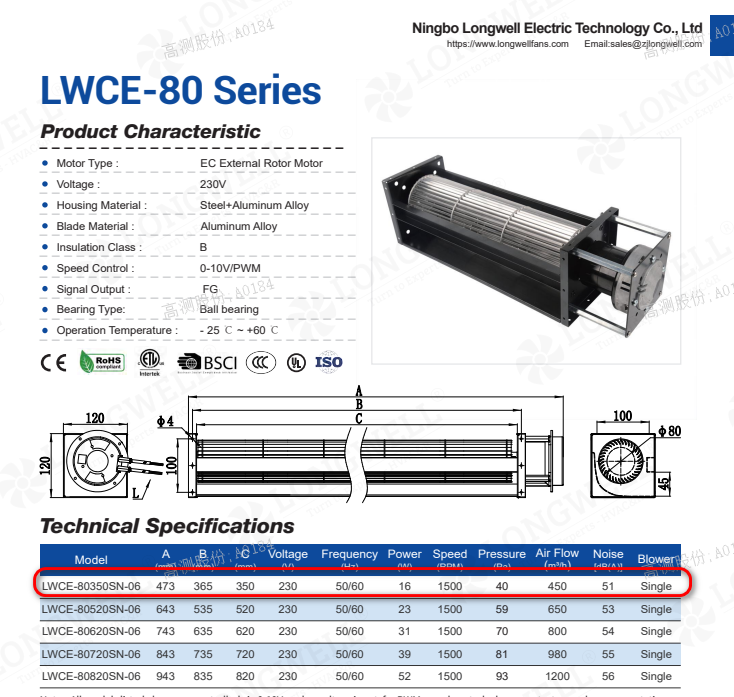
Meanwhile the LWCE-80 Series cross-flow fan, specified for this OEM project, features a compact design with an external rotor EC motor for integration into space-constrained applications.
Download the LWCE-80 datasheet (PDF))
The technical datasheet details the performance parameters for the LWCE-80 series, including the LWCE-80350SN-06. An engineer would use this document to verify airflow, pressure, noise, and electrical characteristics against system requirements.
Why the OEM chose us over European suppliers
Here the oEM had European suppliers available. Even so, four things tipped the decision our way.
- CAD models in two days. The request for 3D models came back within 48 hours as production-accurate STEP files. Consequently virtual integration and CFD work started immediately, rather than after the weeks other suppliers often take.
- Cost without an engineering compromise. The LWCE series brought EC motor technology into a standard product line rather than a flagship one. That happened because we build the motors ourselves, not because anything was left out of them.
- Certification already held. The platform carries CE via TUV, UL 507 and RoHS. So there was no certification delay and no compliance risk for their European and North American markets.
- We build the motor and the drive. The SmartEC motor, its drive electronics and its firmware are all made in-house. That gives an OEM one point of contact for the whole air-moving system, and it makes control changes possible rather than theoretical.
See the cross flow fan range, or the EC cross flow fan section. Efficiency rules come from the EU ErP directive.
Questions about these fans
What is the lead time after prototype approval?
Standard make-to-order lead time for the LWCE series is 15 to 25 days. High-volume OEMs with a frame agreement and a rolling forecast are different: we hold regional stock against the forecast, which brings shipment from Ningbo down to 1 to 5 working days.
Do these meet EU ErP efficiency requirements?
Yes. The whole EC-motor LWCE platform is built to meet the Energy-related Products directive, including both models here. An efficient external rotor motor plus integrated variable speed control is what gets OEM equipment certified for sale in the EU.
Can the SmartEC firmware be customized?
Yes, and OEMs ask for it regularly. Standard firmware handles 0-10V and PWM control. Meanwhile anything beyond that runs through our 90-day NPI process, which has covered custom start-up sequences, alarm conditions and ramp behavior triggered from a dry contact.
Why not just use a longer version of the smaller impeller?
It would have worked, and it would have been louder. Airflow rises with both length and diameter, whereas noise rises steeply with tip speed. So going wider let the larger EC cross-flow fan hit the target at 1500 RPM, rather than spinning faster to make up the difference.
Technical Documentation & Resources
Working on something similar?
Send us the duty point, the envelope and the supply, and our engineers come back with a shortlist rather than a catalog. Meanwhile custom spec sheets and samples run to 90 days. Since 1990 we have built fans for HVAC, cold chain, data center and industrial OEMs.
Browse Related Products:
🏆 ISO 9001 / ISO 14001 / ISO 45001 | CE (TÜV) | UL/ETL | ATEX Zone 21/22 | AMCA 210/211 / ISO 5801 tested
Choose the right ec cross flow fan
Longwell manufactures 24 ec cross flow fans in-house. Send airflow, static pressure and voltage — an engineer replies with a matching model, performance curve and price within one working day.