What the integrator asked for
An HVAC system integrator asked for a specification sheet on a ducted axial fan, quoting an exact model number and a specific fan mounting configuration.
Their target was 2,606 m3/h against 124 Pa of system resistance. They had clearly done their homework, having already found the right model in our range.
So it should have been a documentation job. Instead it turned into something more useful.
Why fan mounting configuration changed the answer
We already held a sheet for a closely related model. Same motor, same impeller, different fan mounting configuration.
So the task looked like adapting that document to the pipeline housing variant the customer wanted. Then a reviewer noticed the numbers did not agree.
The discrepancy
The existing document for the panel-mount version listed a maximum static pressure of 286 Pa. However, the P-Q curve printed on the same sheet did not support that figure.
Meanwhile the customer own data for the pipeline version showed 124 Pa. Two of our documents disagreed, and one of them was wrong.
Which figure was right
So we went back to the AMCA 210/211 lab data rather than either document. That confirmed 124 Pa as the verified static pressure for the pipeline build.
Here the corrected sheet went to the customer. Meanwhile the panel-mount document was flagged for correction, which is the part that matters beyond one order.
Why fan mounting configuration changes the number
Underneath sits a piece of engineering that is easy to overlook.
A fan in a full pipeline housing sits inside a duct, with air constrained along its whole path. By contrast a panel or grille mount discharges into open space. The impeller is the same, yet the airflow field around it is not.
Consequently pressure capability, and the shape of the whole curve, differ between the two. Treating a mounting variant as cosmetic is how a wrong figure reaches a design calculation.
What was not in question
Notably the customer chose a 220V single-phase AC model deliberately. Certainly a 380V three-phase version exists for higher-power duty, and an EC version offers variable speed.
Neither was wanted. Their system runs at a fixed duty point on single-phase supply, so a cost-optimized AC fan was the right answer.
What it cost
A day, plus an uncomfortable internal correction. Honestly, a document we had published was wrong, and it took a customer order before anyone checked it against the curve.
The customer got accurate data before designing around it. That is the outcome that matters, though it is worth saying plainly that the error existed.
Technical Specifications
Meanwhile the static pressure row below is the corrected figure. The paragraph above explains why it changed.
| Parameter | Value |
|---|---|
| Model Number | LWAA2E300S-5MEB-14 |
| Rated Voltage | 220 V |
| Frequency | 50 Hz |
| Speed | 2350 RPM |
| Input Power | 180 W |
| Current | 0.82 A |
| Max Airflow | 2606 m³/h / 1533 CFM |
| Max Static Pressure | 124 Pa |
| Noise Level | 69 dBA |
| Impeller Diameter | 300 mm |
| Overall Depth | 214 mm |
| Ambient Temperature Range | -25°C to +60°C |
| Protection Class | IP54 |
| Insulation Class | Class F |
| Certifications | CE, ETL (UL 507, CSA C22.2#113) |
Technical Documentation
The finalized technical specification sheet provides all performance data, dimensional drawings, and wiring diagrams for the LWAA2E300S-5MEB-14 model, essential for system integrators and design engineers.
Download Technical Datasheet: LWAA2E300S-5MEB-14
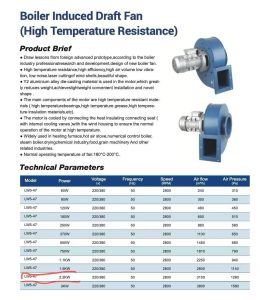
Here the customer’s initial inquiry included this product family overview, which procurement managers can use to compare different models within the LWAA-300 series, including 4-pole and 380V options.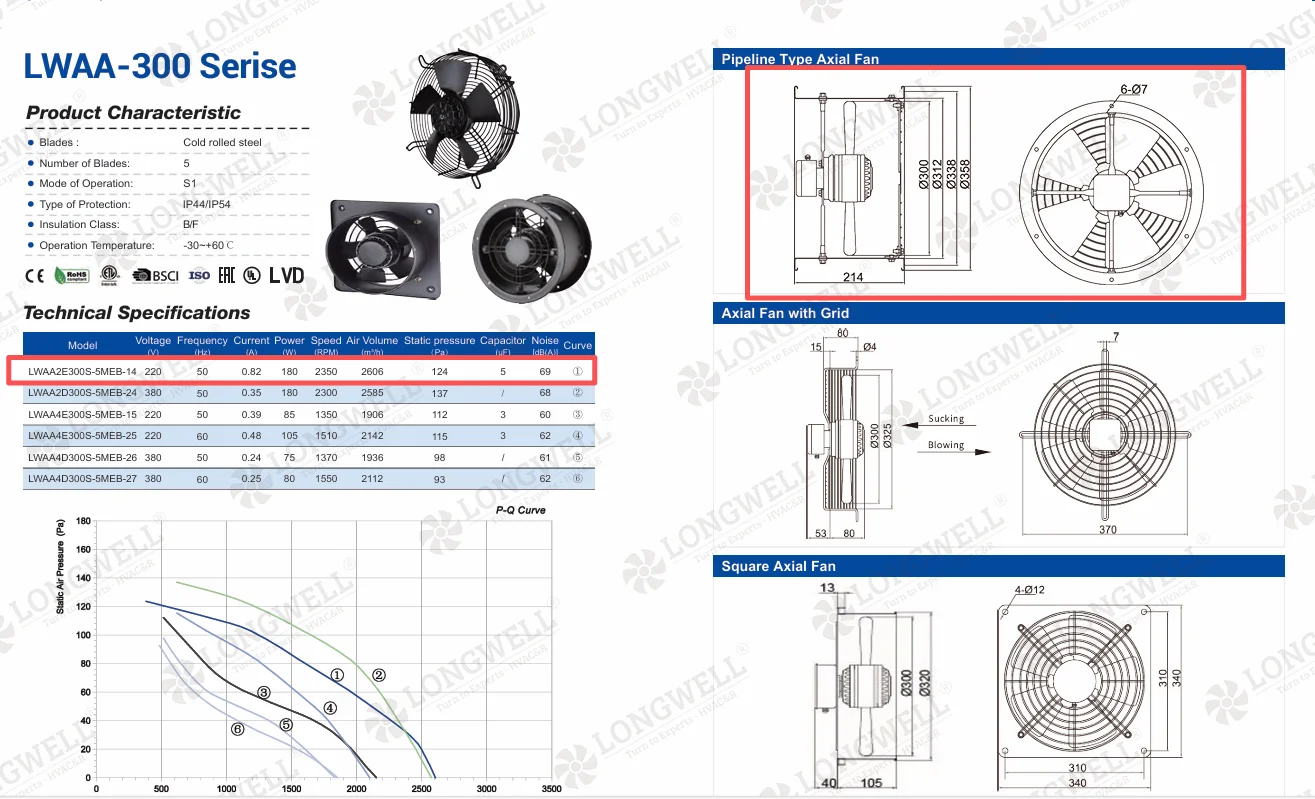
How to sanity-check a fan datasheet
Datasheets contain mistakes, ours included. So these checks catch most of them before they reach a calculation.
- Read the stated maximum against the curve. If a sheet claims a peak static pressure, find that point on the P-Q curve. When the two disagree, the curve is usually the measured one and the number is usually the typo.
- Confirm the fan mounting configuration matches your installation. Panel, ring, pipeline and grille mounts change the airflow field around the same impeller. A datasheet for the wrong variant will be optimistic in exactly the region you care about.
- Ask which standard the data came from. AMCA 210/211 or ISO 5801 means a defined test chamber and a repeatable method. Data with no stated method is not comparable across suppliers, however precise it looks.
- Query anything that looks too good. A figure well above what similar fans achieve is worth one email. Suppliers who test properly will show you the curve; the answer either reassures you or finds a mistake.
See our axial fan range, the duct fan section, or inline fans. Airflow testing follows AMCA 210.
Questions about this fan
Does the mounting really change performance that much?
It can, and here it more than halved the stated maximum. A pipeline housing constrains airflow along its length, whereas a panel mount discharges into open space. The impeller is unchanged, although the pressure the assembly develops is not. So always take data for the exact fan mounting configuration you will install.
How do I check a P-Q curve against a stated figure?
Find the point where the curve meets the pressure axis, at zero flow. That is the maximum static pressure the fan can develop. If the headline number sits above that intercept, the two are inconsistent and one of them is wrong.
What made 124 Pa the trustworthy figure?
It came from lab data measured to AMCA 210/211, not from either document. When two published figures disagree, the resolution is the underlying measurement rather than whichever sheet looks more official.
Would an EC version have suited this application better?
Only if the duty point moved. This system runs fixed, driven by single-phase supply and a firm cost target, so variable speed had nothing to do. An EC fan would be more efficient and more controllable, and neither benefit would have been used here.
Technical Documentation & Resources
Have a fan requirement like this one?
Send the datasheet you are working against, or simply the duty point. Then our engineers tell you what fits and what does not. Meanwhile custom spec sheets and samples take up to 90 days. Since 1990 we have been building fans for OEMs worldwide.
Browse Related Products:
🏆 ISO 9001 / ISO 14001 / ISO 45001 | CE (TÜV) | UL/ETL | ATEX Zone 21/22 | AMCA 210/211 / ISO 5801 tested