What the OEM asked for
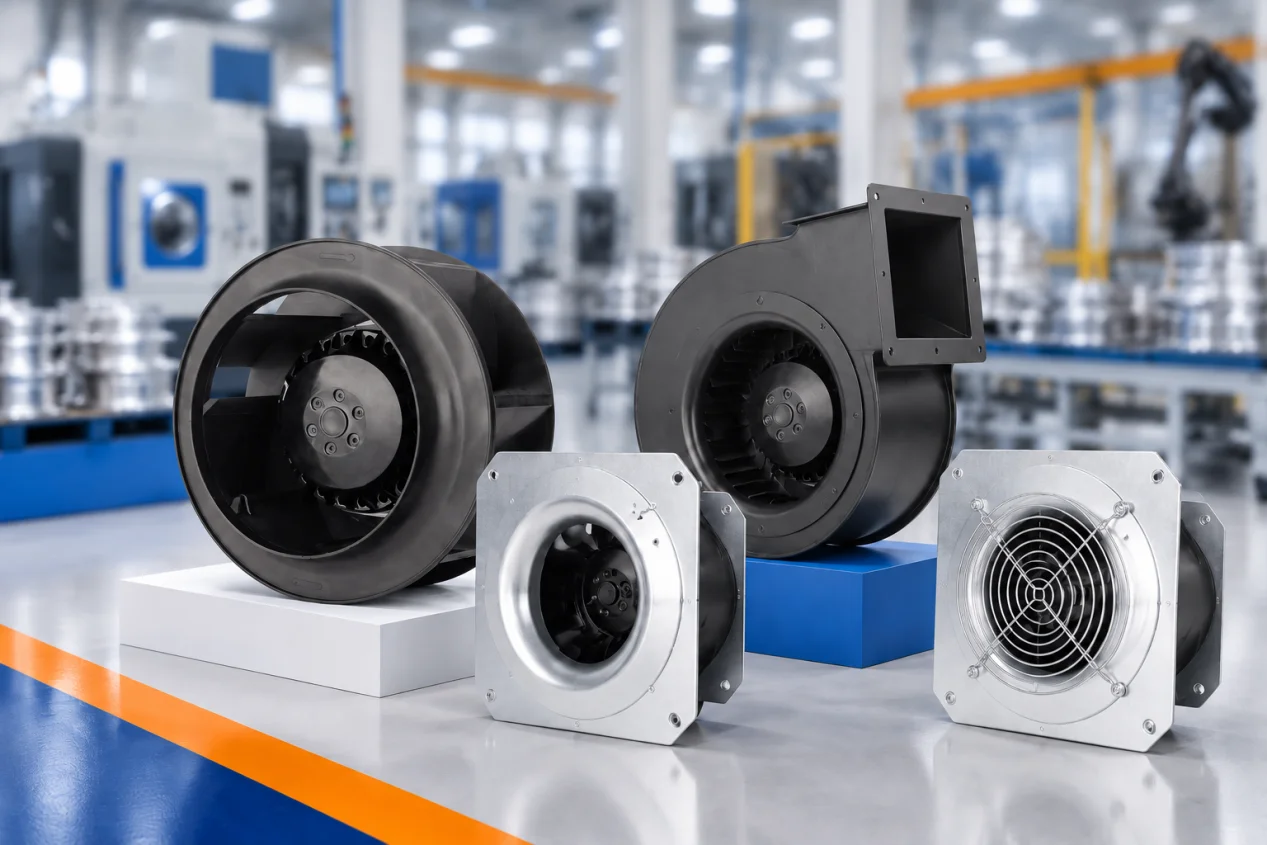
An OEM building compact HVAC cooling modules asked for a quotation and drawings on a 190mm backward curved fan, adapted with a mounting bracket.
On the surface that is a small mechanical change to a standard part. However, the interesting work turned out to be elsewhere.
What the choice of fan revealed
Notably, a 190mm backward curved fan on a 24V rail says plenty about the application even when the brief does not.
That combination belongs in packed enclosures: telecom cabinets, battery storage systems, heat recovery units. All are high-impedance, so the air must be pushed rather than merely moved.
- A 24 VDC rail, with tolerance from 16 to 28 VDC.
- Roughly 265mm across and 79.5mm deep, which is tight.
- Meanwhile enough static pressure to overcome heavy internal resistance.
- Finally, CE marking and data tested to ISO 5801, since their product needs certifying.
Matching the backward curved fan to the system
We started from the model the customer named. Usefully, it was already right in the ways that matter: 24V, backward curved, 190mm.
The bracket, handled differently
They asked for a bracket. Instead we proposed our standard flanged housing, which carries a square 225mm mounting pattern built into the part.
An add-on bracket introduces a second interface, and a second interface is where vibration and misalignment start. Consequently an integrated flange is both more stable and simpler on their assembly line.
Why not a different fan type
A forward-curved wheel of the same size cannot build the pressure this application needs. Meanwhile a larger backward curved fan would break the size limit. Evidently the customer had already reached the right conclusion.
The change that actually mattered
The base model runs at 3300 RPM, giving 495 Pa maximum pressure and 685 m3/h free-air delivery. So we retuned the controller to 3100 RPM.
That drops maximum pressure to 453 Pa. Yet free-air delivery climbs to 731 m3/h.
Both figures sit at opposite ends of one curve. Consequently lowering speed does not simply reduce everything. It reshapes the curve, and we moved it to put their operating point in the efficient part of the range rather than near the pressure limit.
What it cost
Headroom. Losing 42 Pa of maximum pressure leaves less margin if the system proves more restrictive than modeled, or if filters load over time.
That is a real risk and worth naming. It is acceptable here because the operating point was known, and because the fan runs on our EC platform with 0-10V or PWM control plus tachometer feedback. If the enclosure gets more restrictive, the controls can push the fan harder rather than needing a different part.
Technical Specifications
Compare the speed, airflow and pressure rows below with the base model figures given above.
| Parameter | Value |
|---|---|
| Model Number | LWBD3G190-072NM-04 |
| Nominal Voltage | 24 VDC |
| Voltage Range | 16 – 28 VDC |
| Rated Speed | 3100 RPM |
| Rated Input Power | 75 W |
| Rated Current | 3.1 A |
| Max. Airflow | 731 m³/h (430 CFM) |
| Max. Static Pressure | 453 Pa |
| Noise Level | 70 dBA |
| Operating Temperature | -25°C to +60°C |
| Protection Class | IP42 |
| Insulation Class | F |
| Impeller Material | PA66+25GF |
| Bearing Type | Maintenance-free deep groove ball bearing |
| Certifications | CE, RoHS, EAC, LVD |
Technical Documentation
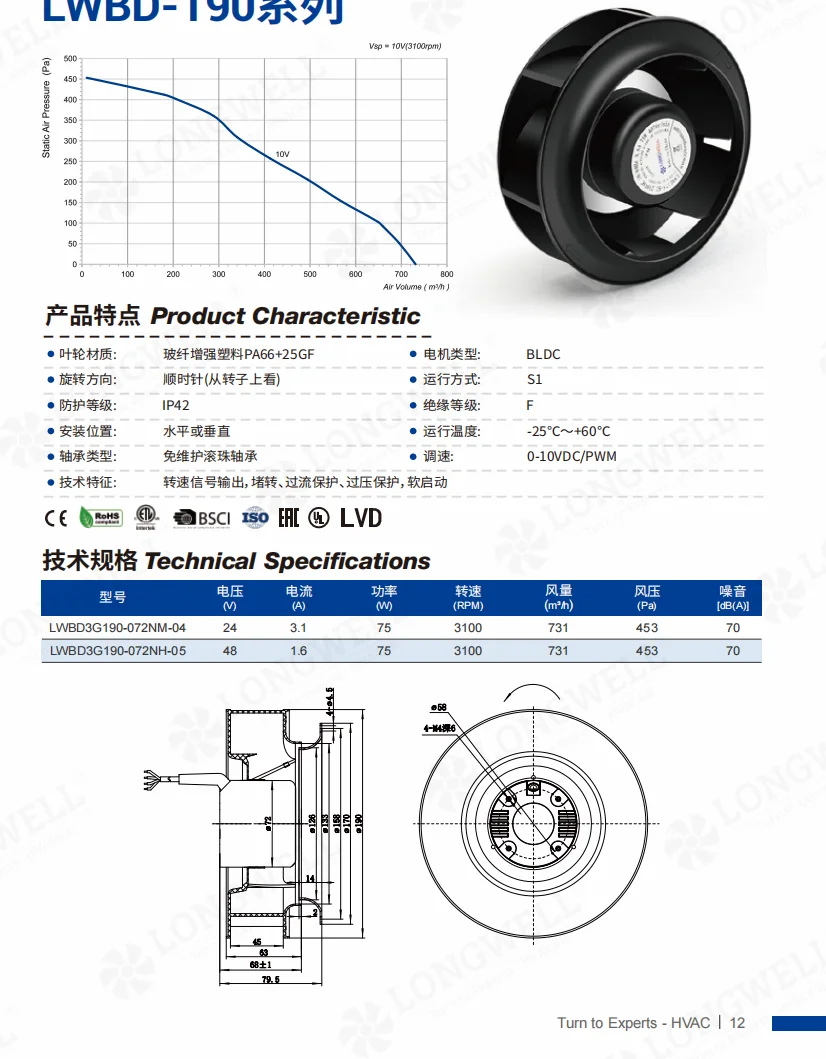
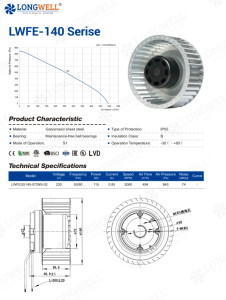
Here the one-page specification sheet provides procurement managers and engineers with the key performance data and dimensions for the final LWBD3G190-072NM-04 solution.
The full technical specification for the base LWBD3G190-072PM-01 model is available here. Open (PDF). This document served as the engineering starting point for the project and provides in-depth details on control wiring, materials, and compliance standards.
If you are tuning a fan to a cabinet
Fitting a backward curved fan to a sealed cabinet goes wrong in familiar ways. So check these early.
- Measure the system curve, do not estimate it. Cabinet impedance depends on inlet grilles, cable routing and internal layout. Furthermore estimates are usually optimistic. A measured pressure drop at a known flow lets a supplier place the fan on its curve properly instead of guessing.
- Ask for a fan matched to your point, not the biggest number. Maximum static pressure is a headline figure at zero flow, where the fan moves no air at all. What matters is what the fan delivers where your system actually sits.
- Prefer an integrated flange to an add-on bracket. Fewer interfaces means less vibration, easier assembly and one less part to source. Ask what mounting patterns exist as standard before designing a bracket around a plain housing.
- Keep some control authority in reserve. A fan with speed control lets you recover from an enclosure that turns out more restrictive than planned. Without it, the only fix is a new fan and a new qualification.
See our centrifugal fan range, the backward curved fan section, or DC cooling fans. Airflow testing follows AMCA 210.
Questions about this fan
How can a slower fan deliver more airflow?
Because airflow and pressure trade against each other along the fan curve. Reducing speed lowers maximum pressure at zero flow, whereas a retuned curve can sit higher in the open-flow region. In short, the two headline numbers come from opposite ends of the curve, so they do not move together.
Is 453 Pa enough for a packed cabinet?
It depends entirely on your system curve, which is why we ask for it. For most telecom and battery enclosures with reasonable inlet area, yes. By contrast, for a cabinet with restrictive filters or a crowded layout, measure before committing. Maximum pressure is not the figure you will operate at.
What does the tachometer feedback give us?
Confirmation that the fan is actually turning, and how fast. In a sealed cabinet a failed fan is invisible until something overheats, so the tacho output lets your controller raise an alarm on a stalled or slowing fan rather than discovering it after a thermal shutdown.
Does an IP42 rating suit a sealed cabinet?
For an internal circulation fan, generally yes, since the enclosure itself provides the environmental barrier. IP42 covers solids over 1mm and dripping water at a tilt. However, if the fan sits at an inlet exposed to outside air, ask about a higher rating.
Technical Documentation & Resources
Need the same thing for your own unit?
Give us the numbers and the envelope, and you get a shortlist rather than a catalog. Meanwhile custom spec sheets and samples run to 90 days. Since 1990 Longwell has supplied EC fans and blowers to OEMs in HVAC, cold chain, data center and industrial markets.
Browse Related Products:
🏆 ISO 9001 / ISO 14001 / ISO 45001 | CE (TÜV) | UL/ETL | ATEX Zone 21/22 | AMCA 210/211 / ISO 5801 tested
Choose the right centrifugal fan
Longwell manufactures 1,130 centrifugal fans in-house. Send airflow, static pressure and voltage — an engineer replies with a matching model, performance curve and price within one working day.