What the drawing actually said
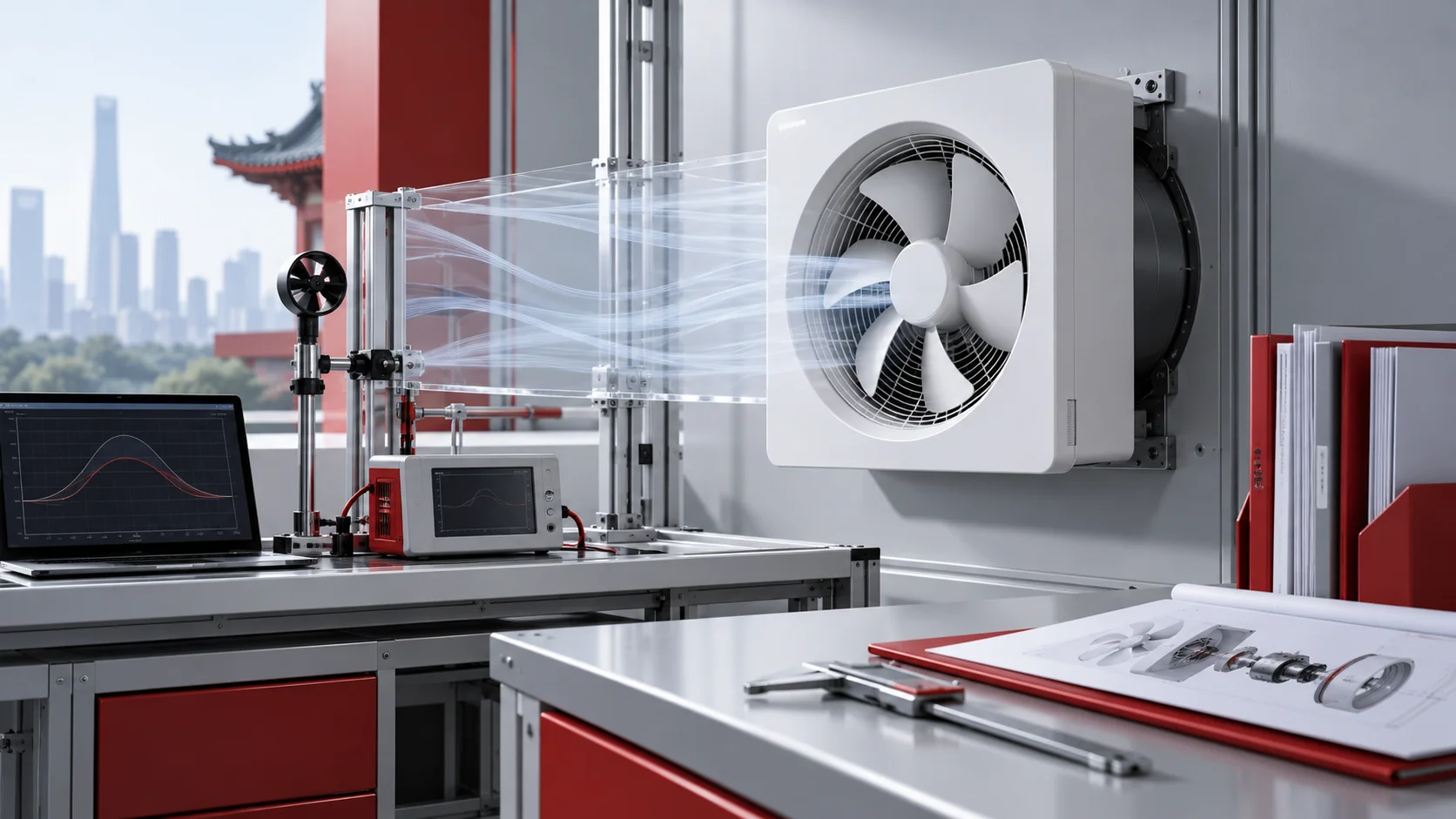
The enquiry looked routine at first. A European HVAC OEM wanted 3D drawings for two 300mm fans on 220 VAC, one EC and one AC. Then you look at the attached drawing, and it is really a reversed airflow axial fan request.
Someone had crossed out the airflow arrow. In our part numbers an S means suction, so air is drawn in over the motor. The customer had struck that through. Instead, they marked the opposite direction, B for blowing, where air is pushed away from the motor.
That mark is the whole enquiry. It tells you this is a condenser, since no condenser designer wants hot exhaust air passing over the motor and its electronics. A reversed airflow axial fan is therefore the standard answer.
- Two models wanted, one EC and one AC, in the same 300mm envelope.
- 220V at 50Hz, fixed by the target market.
- Blowing direction, rather than the catalog suction default.
- Accurate 3D CAD, so their engineers could check fit and run CFD in the real housing.
Asking for both technologies in one frame size usually means one thing. In short, the OEM was building a platform and planning two price tiers from it.
Specifying the reversed airflow axial fan
Here the application engineer started with that marked-up drawing. That was, as it turned out, the right place to start.
Why you cannot simply run a fan backwards
Reversing motor polarity does not give you a reversed airflow axial fan. Blade pitch, motor supports and guard geometry are all shaped for one direction. Consequently, pushing air the wrong way through them collapses performance by roughly 40 to 50%. Noise climbs sharply too. It is one of the more expensive mistakes available in fan selection.
The customer needed a variant, not a custom fan
Here is the useful part. The customer had asked for a 300S with the airflow reversed. Functionally, though, that is simply a 300B, which we already build and stock. Reading the request that way avoided a custom development cycle. It would have cost weeks and money for no benefit at all.
So the AC part became LWAA4E300B-5MEB-02, and the EC part became LWAE3G300ST-5MEW-08. The change from S to B, and from SS to ST, marks a genuinely different assembly. It is not a paperwork difference.
What the comparison showed
Supplying both let the OEM see the trade-off directly. The AC fan moves 1803 m3/h for 115W. Meanwhile the EC version moves a near-identical 1751 m3/h for 90W, which is about 22% less power for the same job.
The EC unit also carries our SmartEC platform, so it accepts 0-10V, PWM or RS485 Modbus. That matters more than the headline efficiency figure. A condenser rarely needs full airflow, and a fan that can slow down at part load saves far more than 22% over a season.
Technical Specifications
Both fans below share the same 300mm frame and the same mounting. Compare the power column rather than the airflow column, because that is where the two technologies part company.
EC Fan: LWAE3G300ST-5MEW-08-00
| Parameter | Value |
|---|---|
| Voltage | 220 VAC |
| Frequency | 50/60 Hz |
| Airflow | 1751 m³/h |
| Speed | 1600 RPM |
| Input Power | 90 W |
| Current | 0.7 A |
| Impeller Diameter | 295 mm |
| Protection Class | IP44 |
| Weight | 2.1 kg |
AC Fan: LWAA4E300B-5MEB-02-00
| Parameter | Value |
|---|---|
| Voltage | 220 VAC |
| Frequency | 60 Hz |
| Airflow | 1803 m³/h |
| Speed | 1600 RPM |
| Input Power | 115 W |
| Current | 0.51 A |
| Impeller Diameter | 300 mm |
| Protection Class | IP54 |
| Weight | 2.5 kg |
Technical Documentation
Correct documentation was delivered to the customer, enabling immediate integration work. The documents were archived internally, marking the successful completion of the technical review phase.
EC Axial Fan Drawing (LWAE3G300ST-5MEW-08-00)
The document provides the certified mechanical drawing and performance specifications for the EC fan model, used by mechanical engineers for system layout.
AC Axial Fan Drawing (LWAA4E300B-5MEB-02-00)
Here the pDF contains the full specifications for the AC fan alternative, required by procurement and engineering for cost-benefit analysis.

This initial customer markup illustrates the critical requirement for reversed airflow, which was the key technical driver for the project.
Why product knowledge beat custom engineering
Above, the project turned on knowing the catalog rather than on engineering effort.
- We read the intent, not just the request. Sending the drawings exactly as asked would have been faster and wrong. Identifying the correct B-type models from stock saved the customer weeks of design time on a part that would not have worked.
- Both technologies from one supplier. We have built AC and EC motors here since 1990. As a result, matched options in one 300mm platform let the OEM create two SKUs at two price points without adding a second vendor.
- Documents that actually unblock design. The request was for a 3D model. Even so, we sent 2D PDFs, STP models and DWG source files together, since that is what a design-in really needs.
- An efficiency upgrade the customer can afford. Moving to a reversed airflow axial fan with an EC motor only makes sense when the payback period is short enough to justify the change. Building the motor and its electronics ourselves is what keeps that period short rather than theoretical.
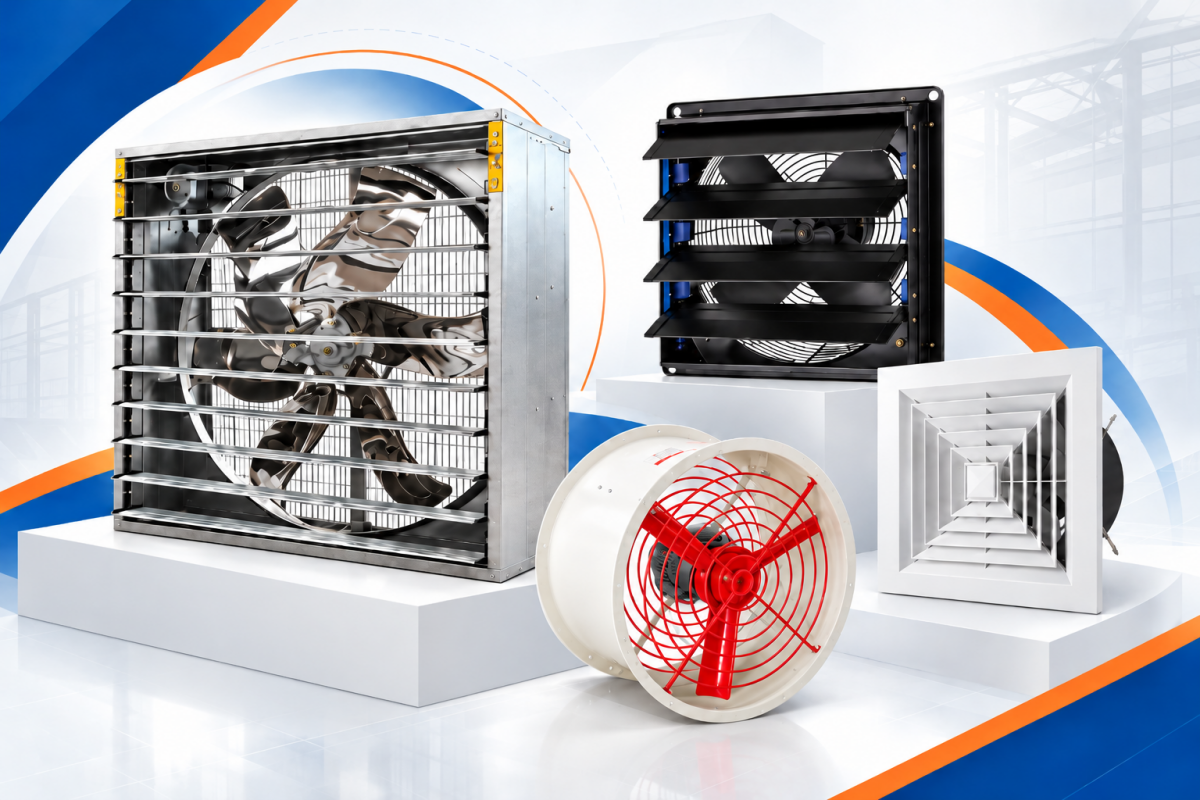
Browse the full axial fan range, or the EC axial fan series if a reversed airflow axial fan with speed control suits your unit better. Motor efficiency classes are defined by the IEC in IEC 60034-30-1.
Questions about airflow direction
What is the difference between S and B type axial fans?
Meanwhile the letter states which way air moves relative to the motor. An S type draws air over the motor, which incidentally helps cool it. A B type pushes air away from the motor. Blade pitch, motor supports and guard are shaped for one direction only, so always order the type that matches your airflow path.
Can I just wire the fan to run in reverse?
You can, but you should not. A blade designed for one direction loses most of its efficiency running the other way, typically 40 to 50% of the airflow. It also gets noticeably louder. The saving on the part is lost several times over in performance.
Why do condensers usually need blowing type fans?
Because the motor and its electronics sit in the airstream. In a condenser that air is hot, having just picked up heat from the coil. A reversed airflow axial fan keeps the hottest air off the windings. That is a large part of why condenser fans last as long as they do.
Is the EC version worth the extra cost on a condenser?
Usually yes, though it depends on run hours. The 22% saving at full speed is only part of it. Most condensers spend the year below full load. An EC fan that slows down there saves considerably more, since fan power falls with the cube of speed.
Technical Documentation & Resources

Got a duty point you need matched?
Tell us the airflow, the pressure and the space you have. Then we mark your duty point on a tested curve and send the drawing back. Meanwhile samples and custom spec sheets take up to 90 days. Since 1990 we have supplied OEMs across HVAC, refrigeration and industry.
Browse Related Products:
🏆 ISO 9001 / ISO 14001 / ISO 45001 | CE (TÜV) | UL/ETL | ATEX Zone 21/22 | AMCA 210/211 / ISO 5801 tested
Choose the right axial fan
Longwell manufactures 1,086 axial fans in-house. Send airflow, static pressure and voltage — an engineer replies with a matching model, performance curve and price within one working day.