Designing a 115v ac centrifugal fan for Tight Spaces
A European OEM makes large commercial air handling units. They needed a 115v ac centrifugal fan. This specific fan helps them sell their products into North America. Space was very tight inside their gear.
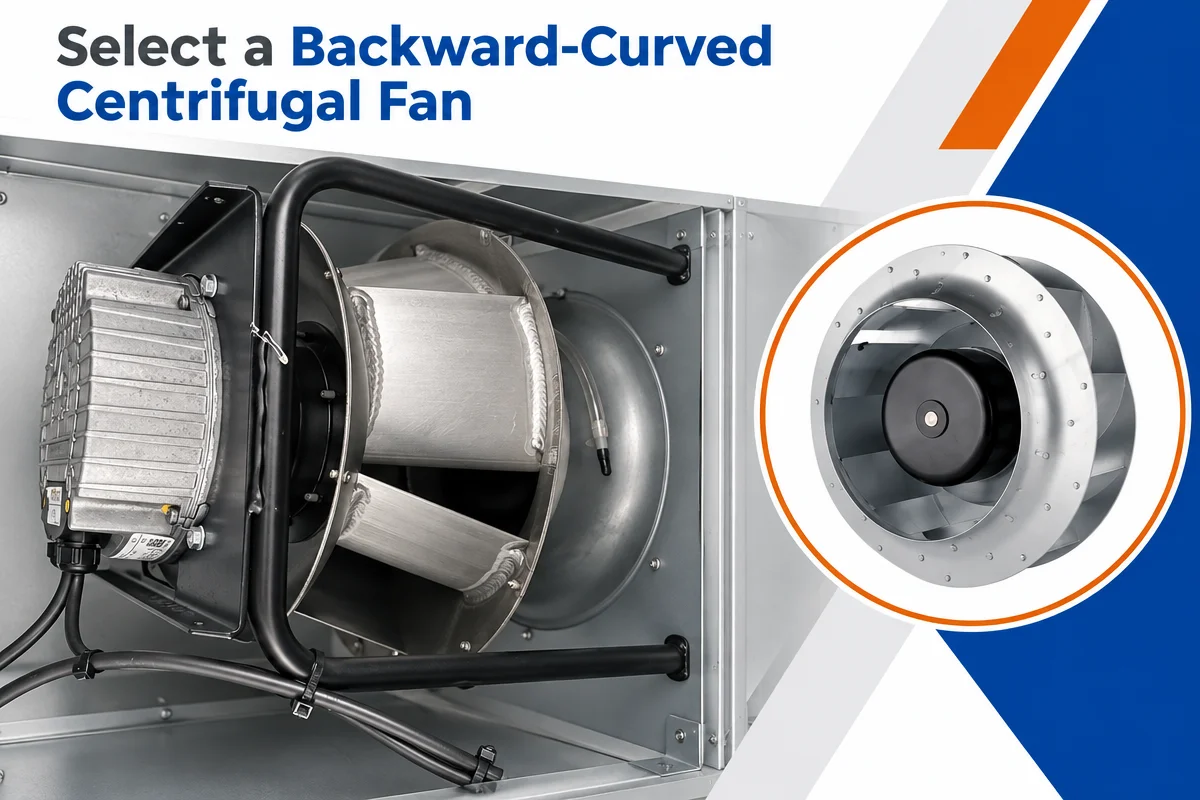
First, they required backward curved impellers. They needed exact 190 mm and 225 mm diameters. We previously supplied the 225 mm unit in a 220V format. Now, the customer wanted a dedicated 115V version of that fan.
Next, they needed both 115V and 220V models for the smaller 190 mm size. The new 115v ac centrifugal fan sits completely outdoors all year long. So, the fan had to survive freezing winter air down to -30 °C. It also had to handle hot summer days up to 60 °C.
The customer also gave us a strict layout rule. Their electrical control box contained many other parts. Thus, they could only fit round motor run capacitors. They refused standard square block capacitors entirely.
The square ones simply hit the cabinet walls. Finally, the equipment had to meet standard IEC 60335-1 safety rules. In short, the project required an exact electrical match. We could not change the aerodynamic footprint or the mounting holes.
Engineering the 115v ac centrifugal fan
We checked several ways to engineer the 115v ac centrifugal fan on 115V power. First, we looked at adding a step-down transformer to the cabinet. This would let the customer use the old 220V fans directly. But we rejected this option fast.
Transformers weigh too much. They add too much bulk to the control box. They also raise the final cost of the machine. So, we dropped that idea completely.
Next, we evaluated EC motors. EC fans run on multiple voltages easily. They automatically adapt to the power supply. Still, the OEM rejected this upgrade.
Their old control board only sends basic AC power. It lacks the smart 0-10V signal that EC motors need to run. Also, EC motors cost more money upfront. Thus, we chose traditional AC motors.
Instead, we designed custom 115V AC stators for this job. We paired them with our standard PA66 plastic impellers. These parts spin on maintenance-free deep groove ball bearings. The bearings reduce friction and keep the fan quiet. We balance the whole spinning mass to a strict G6.3 vibration grade.
Winding the Motor and Sourcing Capacitors
Running a fan on 115V draws much more current than on 220V. For example, the 225 mm fan pushes 1360 m3/h at 772.5 Pa of static pressure. On 115V, it draws 1.5 Amps. It uses 180 Watts of power while spinning at 3000 RPM.
A 220V motor doing the exact same work pulls much less current. So, we wound the 115V stator with thicker copper wire. This meant packing the thick wire carefully inside the external motor shell. We also added built-in thermal protection.
The motor cuts power automatically if the coil hits 150 °C. Next, we solved the capacitor problem. Standard fans usually use cheap square housing capacitors. But the tight space blocked those standard parts.
So, we found special heavy-duty round capacitors for them. The 115V 190 mm fan uses an 8 μF capacitor. The larger 225 mm fan needs a huge 16 μF version. These round parts cost more money.
They also took longer to get from suppliers. Even so, they saved the customer from redesigning their metal box.
Technical Specifications
| Parameter | LWBA2E190-092NU-11-00 | LWBA2E190-092NS-12-00 | LWBA2E225-092NU-23-00 |
|---|---|---|---|
| Voltage | 110-120 VAC | 198-242 VAC | 110-120 VAC |
| Frequency | 60 Hz | 50 / 60 Hz | 60 Hz |
| Speed | 2700 RPM | 2500 / 2700 RPM | 3000 RPM |
| Input Power | 70 W | 60 / 76 W | 180 W |
| Current | 0.60 A | 0.27 / 0.35 A | 1.50 A |
| Airflow | 594 m3/h | 556 / 597 m3/h | 1360 m3/h |
| Static Pressure | 375 Pa | 361 / 453 Pa | 772.5 Pa |
| Noise Level | 67 dB(A) | 65 / 68 dB(A) | 73 dB(A) |
| Capacitor | 8 μF / 500V (Round) | 2 μF (Round) | 16 μF (Round) |
| Operating Temp | -30 °C to +60 °C | -30 °C to +60 °C | -30 °C to +60 °C |
| IP Rating | IP54 | IP54 | IP54 |
| Insulation | Class F | Class F | Class F |
| Certifications | CE, RoHS, Reach | CE, RoHS, Reach | CE, RoHS, Reach |
| Balancing | G6.3 | G6.3 | G6.3 |
These rows show the major current differences between voltage lines. Engineers must size their relays to handle the 1.5 Amps on the 115V fan. By contrast, the 220V fan draws a fraction of that current. Also, the strict -30 °C rating proves the plastic parts withstand deep cold. The Class F insulation protects the thick copper windings from high internal heat. The thermal disconnect switch adds a final layer of fire safety. It physically breaks the circuit if the motor stalls and overheats.
Reference: AMCA 210 covers the test method behind these figures.
Technical Documentation

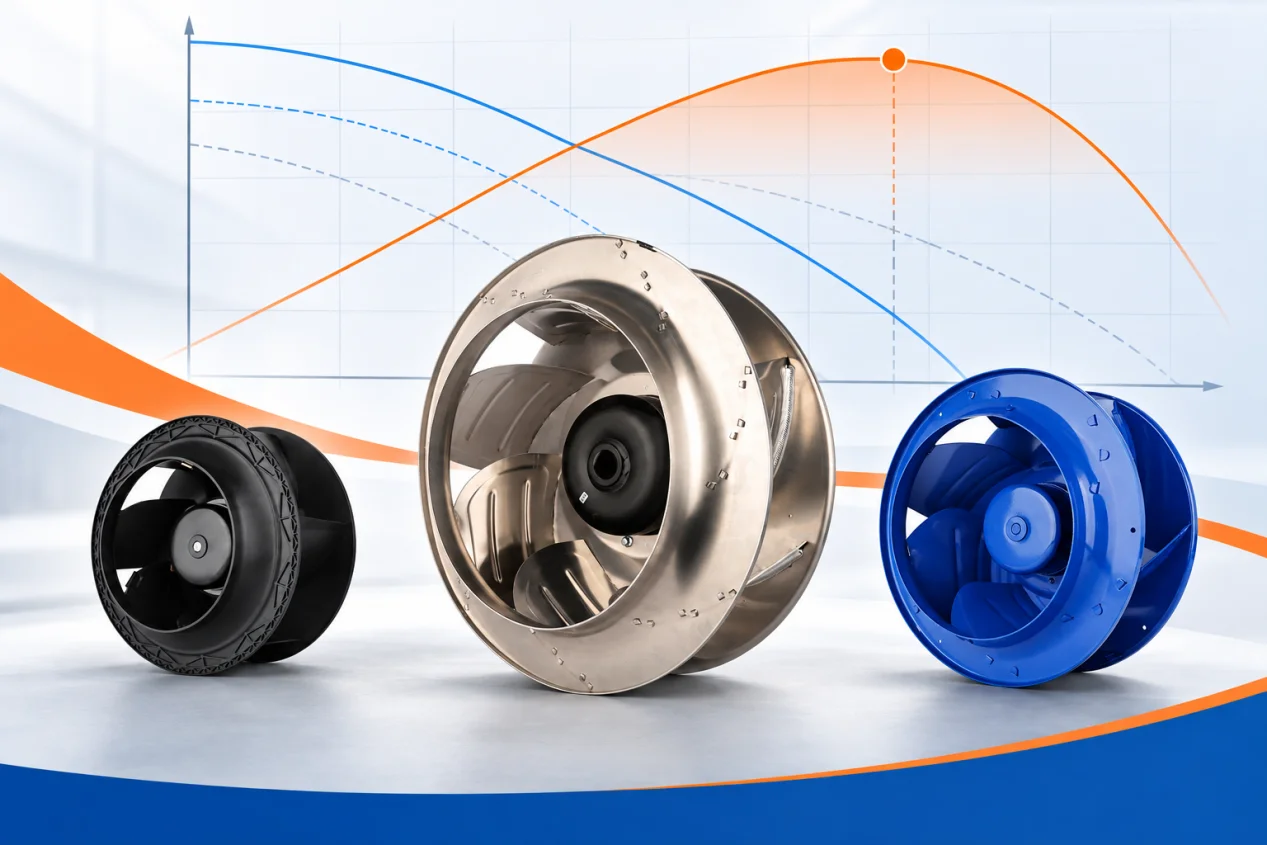
First, this performance curve helps engineers verify the 225 mm unit reaches 800 CFM.
190mm 115V AC Fan Specification Sheet
Next, this document details the exact 60Hz electrical needs for the North American 190 mm model.
190mm 220V AC Fan Specification Sheet
Also, engineers use this file to confirm the 50/60Hz data for the European equivalent 190 mm model.
225mm 115V AC Fan Specification Sheet
Furthermore, this drawing shows the thick stator wire required to pull 1.5 Amps safely.

Finally, the diagram defines the exact mounting bolt pattern for the 190 mm envelope.
Sourcing Dual-Voltage Fan Platforms
When you specify a 115v ac centrifugal fan for different countries, you must track electrical changes closely. Here is what to check before you buy.
- First, calculate the higher current draw on 115V lines. You must ensure your system wires and control relays can handle up to 1.5 Amps per fan.
- Next, measure your control box space carefully. Round and square capacitors perform the exact same electrical job. But a tight box might force you to specify round ones only.
- Finally, tell your factory if you plan to reuse an old control board. This stops them from quoting smart EC motors when you only have simple AC switches. We build our AC impellers in-house, so we wind custom stators for older boards quickly.
Related: Centrifugal Fans.
Questions About Regional Voltage Changes
Technical Documentation & Resources
Browse our centrifugal fans range, the backward-curved fans section, or forward-curved fans.
Have a Similar Fan Requirement?
Longwell’s engineering team delivers custom spec sheets and samples within 90 days. Since 1990, we have supplied EC fans and blowers to OEMs across HVAC, cold chain, data center, and industrial applications worldwide.
Browse Related Products:
🏆 ISO 9001 / ISO 14001 / ISO 45001 | CE (TÜV) | UL/ETL | ATEX Zone 21/22 | AMCA 210-16 / ISO 5801 tested
Choose the right centrifugal fan
Longwell manufactures 1,130 centrifugal fans in-house. Send airflow, static pressure and voltage — an engineer replies with a matching model, performance curve and price within one working day.