The customer asked for the motor, not the fan
An OEM building film blowing and packaging machinery needed a compact centrifugal blower, and asked specifically for an EC motor retrofit rather than the AC and drive combination they had been using.
Their brief had already been written around an AC induction motor with an external variable frequency drive. Then they asked for an EC motor retrofit instead.
What they were trying to get rid of
An external drive is a separate box to source, mount, wire and commission.
It also brings EMC considerations into a machine that otherwise would not have them. Consequently the customer wanted the control electronics inside the fan, not beside it.
The numbers around it
- First, 3100 to 5000 m3/h across a static pressure band of 730 down to 580 Pa.
- Next, 380 V three-phase at 50 Hz, with a 1.5 kW nominal motor.
- Meanwhile an envelope of roughly 350 by 354 by 300mm, set by the machine chassis.
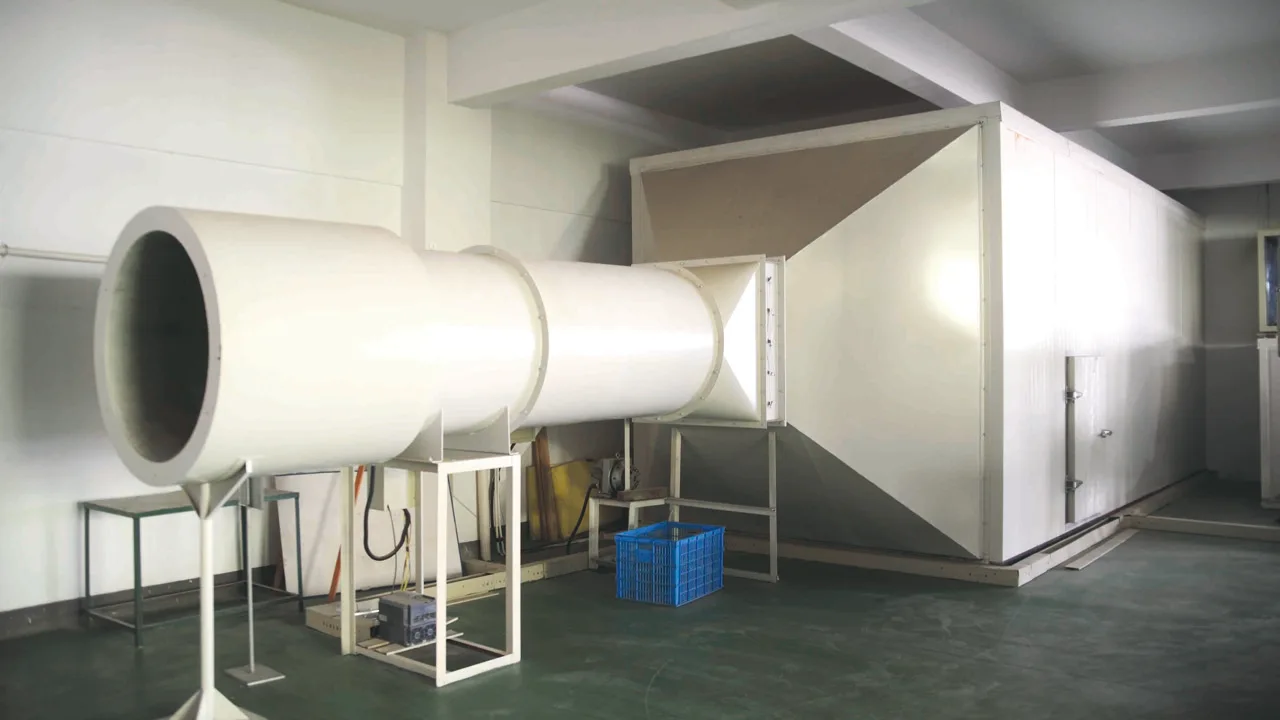
- Finally, data verifiable against AMCA 210/211 and ISO 5801 methods, because their machine specification depends on ours.
They wanted a sample first, to validate fit and performance before committing to production quantities. That is the sensible order.
What carried over and what had to be made
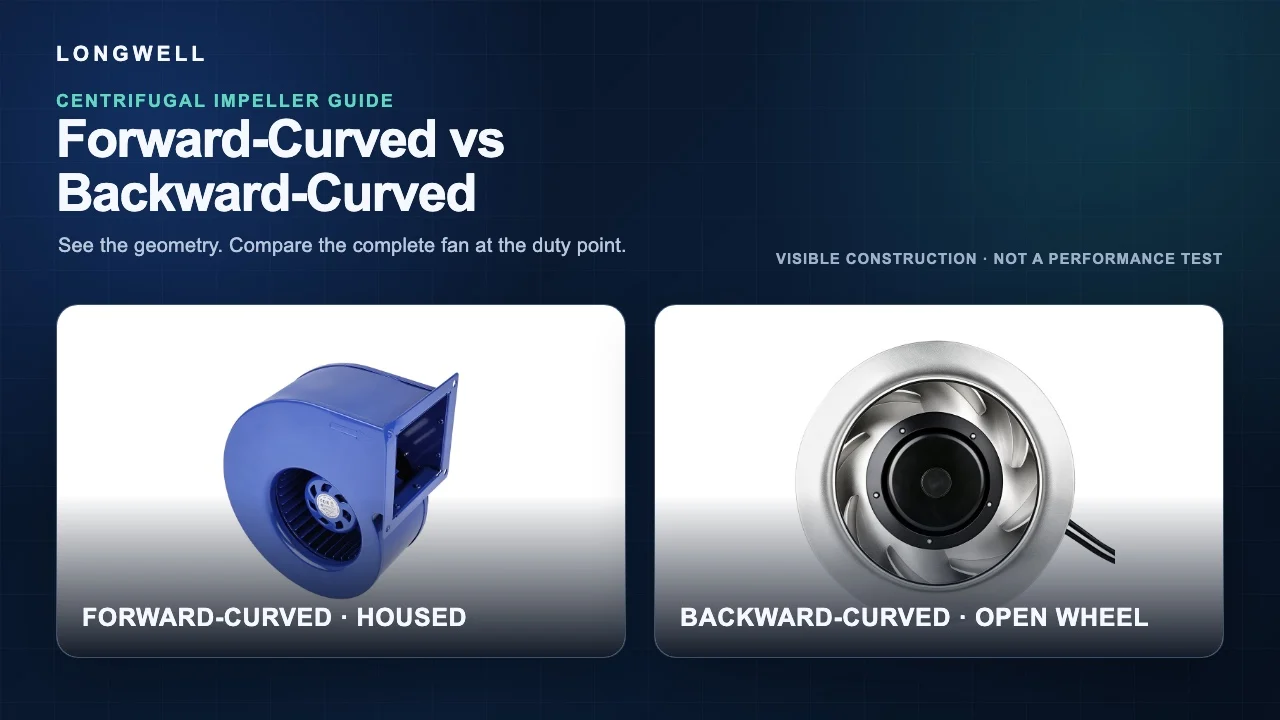
Our existing forward-curved blower already hit the aerodynamic points with a 1.5 kW AC motor. So the question was never whether the fan worked, only what an EC motor retrofit would take.
The option we rejected
The quick answer was to ship that blower and let the customer buy a drive. We evaluated it and turned it down.
It solves our problem rather than theirs. They would still be sourcing a component, finding panel space, running screened cable and handling the EMC consequences.
What an EC motor retrofit reuses
Here the scroll and the impeller carried over unchanged. That is the whole point of the approach, because the housing is where the tooling money sits.
A new scroll means new tooling and a fresh aerodynamic validation. Reusing a proven one means the airflow behavior is already known and only the drive is new.
What had to be made
The EC motor has a different frame and a different shaft geometry, so it does not simply bolt into the space the AC motor left.
A new motor mounting plate and a shaft adapter had to be designed. Getting these wrong is not a cosmetic problem: a shaft adapter that shifts the impeller axially changes its position in the scroll, and a mounting plate that is not square introduces vibration into a wheel that was balanced correctly.
This is why an EC motor retrofit gets classified internally as heavy development rather than as a variant. The parts are small and the tolerances are not.
What the customer gained
After the retrofit, the onboard electronics let us program the performance curve to the duty point, landing at 3500 to 5000 m3/h across 620 to 500 Pa.
Control comes in over 0-10V, PWM or RS485 directly. The drive, the panel space and the extra cable disappear along with it.
Test methods are published by AMCA as AMCA 210/211, which is what makes a curve comparable rather than merely plausible.
Technical Specifications
Meanwhile the aerodynamic figures below come from a housing that already existed. Only the drive behind them is new.
| Parameter | Value |
|---|---|
| Model | LWFDF-11-3A-1.5-4P-3-001 |
| Voltage | 3~380 VAC |
| Frequency | 50 Hz |
| Input Power | 1500 W |
| Speed | 1450 RPM |
| Airflow | 3500 – 5000 m³/h |
| Static Pressure | 620 – 500 Pa |
| Motor Type | Electronically Commutated (EC) with SmartEC™ Control |
| Protection Class | IP44 |
| Overall Dimensions (approx.) | 350mm x 353.5mm x 300mm (W x H x D) |
| Inlet Diameter | Ø260 mm |
Technical Documentation
The final approved technical drawing (LWFDF-11-3A-1.5-4P-3-002) provides dimensional data, mounting points, and performance specifications for OEM system integration.
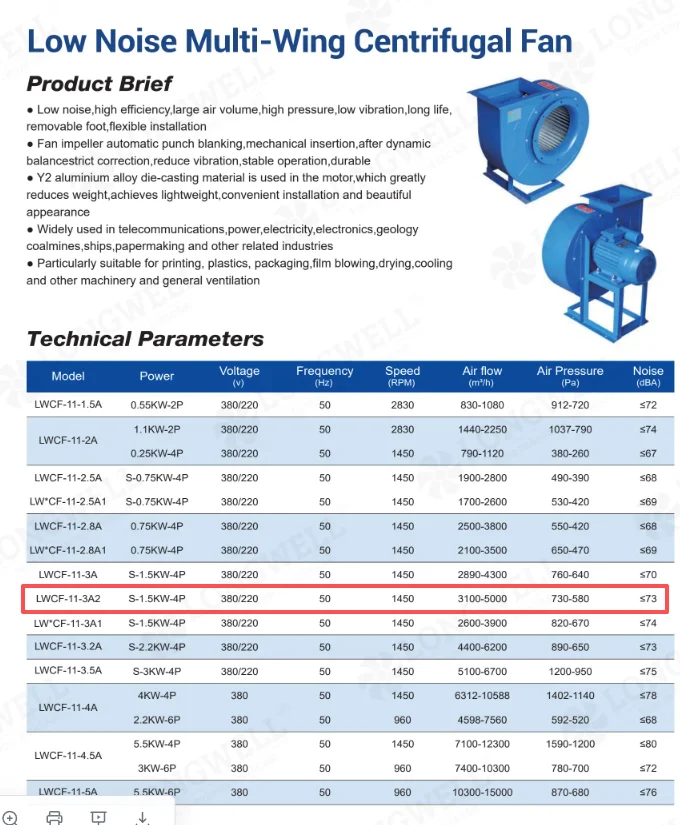
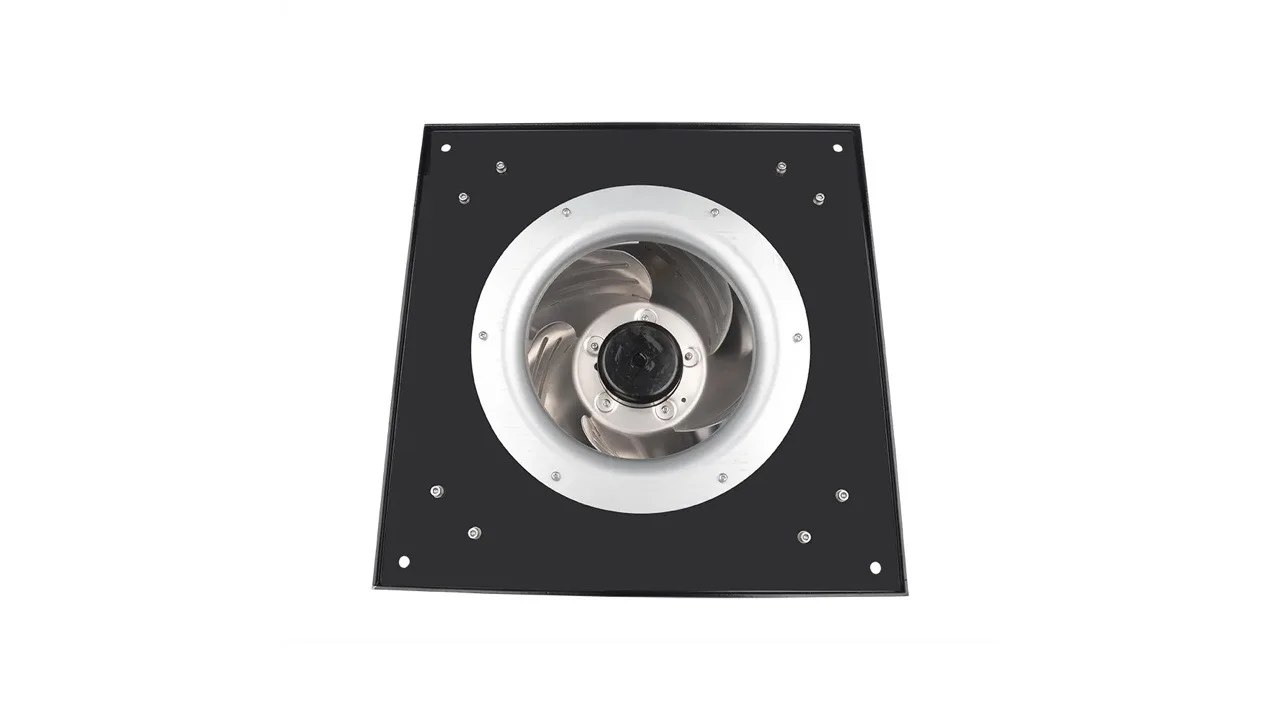
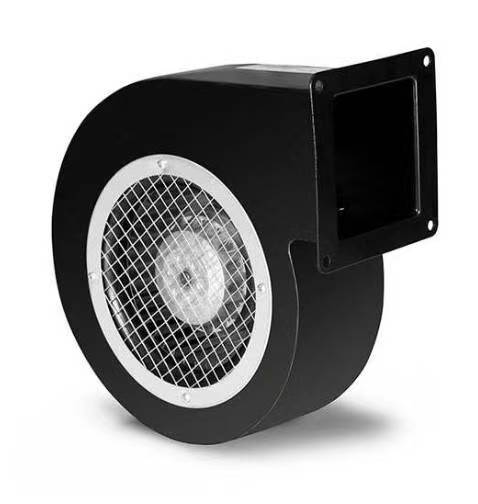
Here the baseline AC-powered LWCF-11-3A2 multi-wing centrifugal fan from which the custom EC solution was developed.
Before you retrofit a motor
An EC motor retrofit into an existing housing is often the right move. These are the things that decide whether it goes well.
- Check the axial position of the impeller, not just that it fits. An EC motor retrofit changes shaft length and shoulder position. If the wheel ends up even a few millimetres out of its designed position in the scroll, the curve you validated is no longer the curve you get.
- Re-balance after assembly, not before. A wheel balanced on the old shaft is not necessarily balanced on a new adapter. Balance the rotating assembly as built, to a stated grade, and put that grade on the order.
- Confirm the new motor fits the thermal situation. EC electronics live inside the motor and dislike heat. A motor that was fine in open air may not be fine buried in a machine chassis, so check the ambient rating against the real installed environment.
- Ask what the control signal will be before the mechanical work starts. 0-10V, PWM and Modbus are not interchangeable in the customer control panel. Settling this late means re-opening a design that is otherwise finished.
See our centrifugal fans range, the forward-curved fans section, or EC fans.
Questions about EC retrofits
Is an EC retrofit cheaper than a new blower design?
An EC motor retrofit is usually cheaper, because the scroll and impeller tooling already exists and the aerodynamics need no revalidation. The saving shrinks if the mounting interface turns out to need substantial new parts, so it is worth confirming the mechanical scope before assuming the retrofit route is the light one.
Why not just add a VFD to the AC motor?
It works, and it is the faster answer. What it does not do is remove a component from the customer bill of materials, free up panel space, or avoid the screened cabling and EMC work an external drive brings. Whether that matters depends on whose problem you are solving.
Does reusing the scroll mean the performance is identical?
Close, but not identical. The impeller position, speed and any change in motor blockage all shift the curve slightly. That is why a sample was built and measured rather than the original curve simply being reissued under a new part number.
What is the most common failure in a motor swap like this?
Vibration, and it usually traces back to the interface parts rather than the motor. A mounting plate that is not perpendicular or an adapter that runs slightly out of true will put a balanced wheel out of balance, and the symptom appears as bearing noise months later.
Technical Documentation & Resources
Got a duty point you need matched?
Tell us the airflow, the pressure and the space you have. Then we mark your duty point on a tested curve and send the drawing back. Meanwhile samples and custom spec sheets take up to 90 days. Since 1990 we have supplied OEMs across HVAC, refrigeration and industry.
Browse Related Products:
🏆 ISO 9001 / ISO 14001 / ISO 45001 | CE (TÜV) | UL/ETL | ATEX Zone 21/22 | AMCA 210/211 / ISO 5801 tested
Choose the right centrifugal fan
Longwell manufactures 1,127 centrifugal fans in-house. Send airflow, static pressure and voltage — an engineer replies with a matching model, performance curve and price within one working day.