What the contractor needed on site
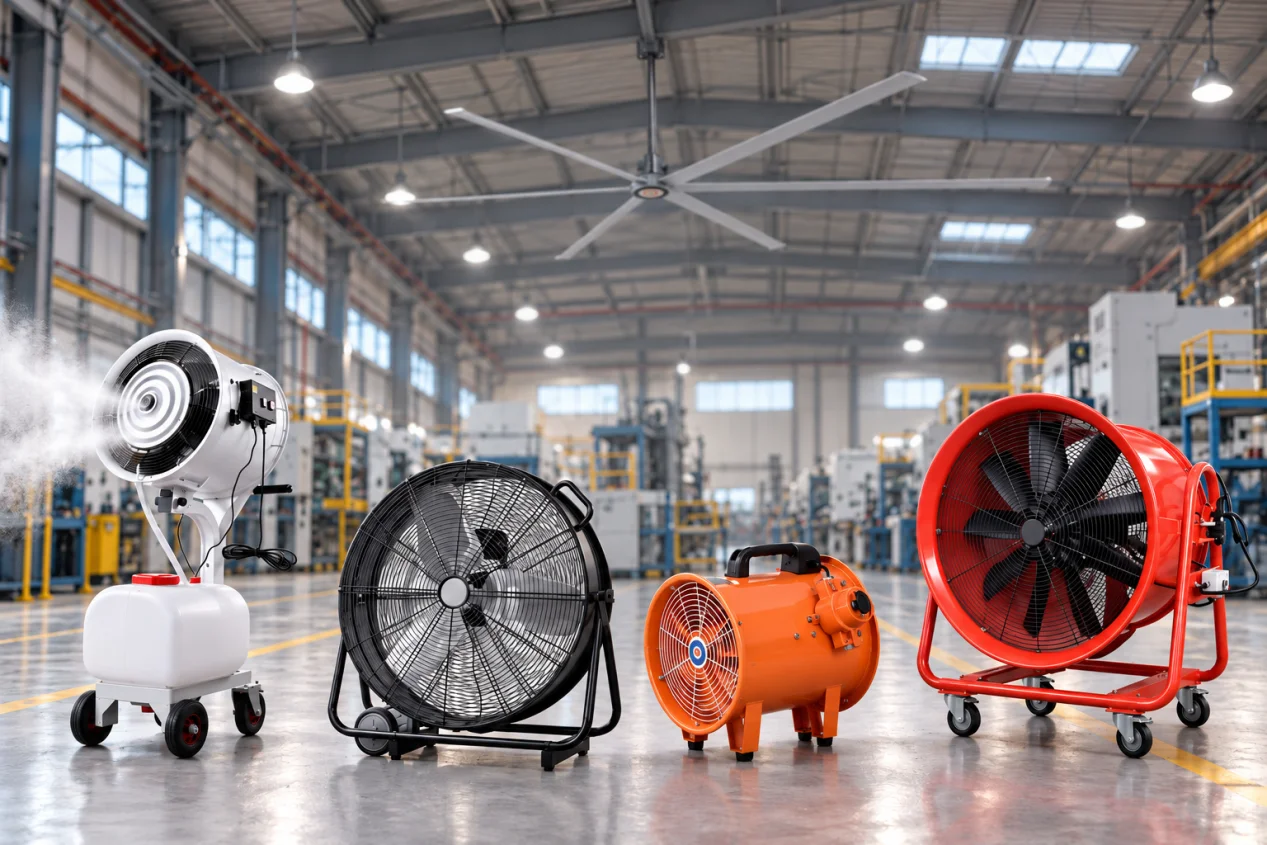
An industrial services contractor needed a portable axial blower for temporary ventilation and fume extraction across a range of sites. The work is purging enclosed spaces before and during maintenance: storage tanks, ship holds, utility tunnels.
The airflow target was 37,250 m3/h. However, the number that shapes the whole job is the second one. The fan had to make at least 400 Pa, because the air travels down 30 meters or more of flexible duct before it reaches the space being purged.
Here the other constraints were practical rather than technical.
- 380V, 50Hz three-phase, the supply available across their facilities.
- Movable by one or two people, over uneven ground, without a forklift.
- Roughly 1.2 meters in height and width, so it fits through access hatches and into vans.
- A steel frame and proper guards, since this equipment gets treated roughly.
- Compliance with industrial safety norms including IEC 60335.
Anyone who has tried to ventilate a tank with an undersized fan knows why the pressure figure matters. A blower rated in free air can move almost nothing once 40 meters of flexible duct is attached.
Sizing the portable axial blower
The task was to find a standard or near-standard portable axial blower that meets a demanding duty point without inflating the price.
Why not EC
We reviewed an EC motor for its efficiency and control. Then we rejected it. This equipment runs intermittently, so annual energy use is low. Consequently the payback never arrives. What the customer actually values is raw power and a low purchase price. A plain AC motor on the 380V supply also avoids onboard power electronics, which are exactly what fails first in a dusty field environment.
Why 800mm and not 710mm
Here is the real engineering decision. A 710mm fan reaches the airflow figure on paper. Against 420 Pa of backpressure, though, it cannot. Analysis showed it falling well short at the actual duty point. Therefore the selection moved up to an 800mm, or 32-inch, impeller.
Meanwhile the LWA-800(32″)TM-01 uses a six-blade axial impeller. Six blades is the balance point: enough to build pressure against ducting, not so many that airflow and efficiency suffer. Behind it sits a 4000W induction motor, sized so the fan holds its 1450 RPM duty point under load rather than stalling when the duct run is long.
The frame
The impeller lives in a heavy-gauge rolled steel casing, mounted on a tilting tubular steel frame with industrial casters. Tilting matters more than it sounds. Namely, it lets an operator aim airflow into a hatch without propping the machine on something.
In short, the result is deliberately simple. A powerful portable axial blower with nothing electronic to fail, which is what site work actually rewards.
Technical Specifications
Read the airflow and static pressure rows together. Either figure on its own tells you very little about whether a blower will purge a tank at the end of 40 meters of duct.
| Parameter | Value |
|---|---|
| Model | LWA-800(32″)TM-01 |
| Airflow (m³/h) | 37,250 |
| Static Pressure (Pa) | 420 |
| Power (W) | 4000 |
| Voltage (VAC) | 380 |
| Frequency (Hz) | 50 |
| Speed (RPM) | 1450 |
| Number of Blades | Six |
| Dimensions (cm) | 114 x 104 x 60 |
| Weight (kg) | 95 |
Technical Documentation
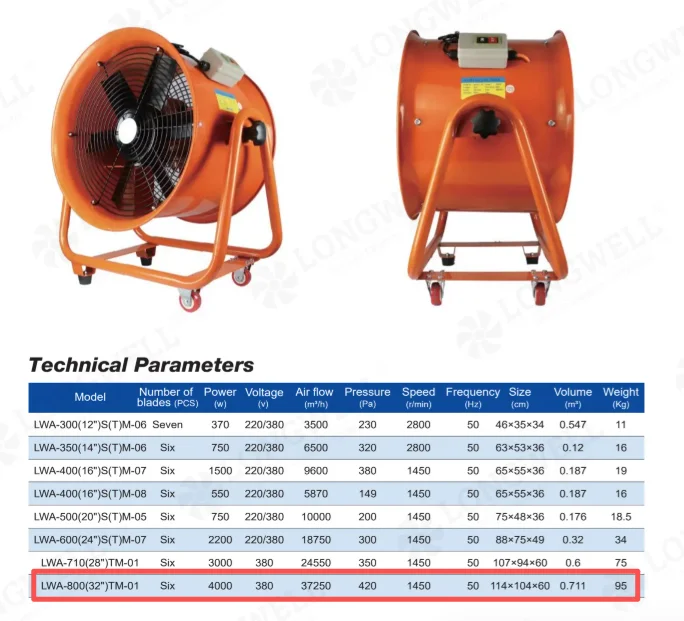
Here the product image shows the LWA-800(32″)TM-01 portable axial blower, highlighting its wheeled frame and protective grilles, which is useful for procurement managers verifying physical configuration.
Download LWA-800(32″)TM-01 Specification Sheet
The LWA-800(32″)TM-01 technical specification sheet provides engineers with key performance data, dimensional drawings, and electrical requirements for system integration.
Why contractors buy these from us
Contractors and rental fleets weigh different things from OEMs. In the end, four points decided this one.
- Capital efficiency across a fleet. A rental company buys the same unit many times over, so unit cost compounds in a way it never does for a single installation. We make the motor and the housing in house, which is what keeps that number stable across a large order.
- Availability when equipment fails. Standard LWA products run 15 to 25 days make-to-order. Meanwhile, when a portable axial blower dies mid-project, that is the difference between a delay and a stoppage.
- Curves you can size ducts against. Performance is tested to AMCA 210/211 and ISO 5801 methods, so an engineer can calculate duct losses against a real P-Q curve rather than a marketing figure.
- Built and tested in one place. We have manufactured here since 1990, controlling everything from motor winding and balancing through to final assembly. Every blower gets a full functional test before it ships.
Browse our blower range, or the industrial axial fan series for fixed installations. Confined space entry requirements are set out by OSHA.
Questions from the field
How much flexible duct can I run from it?
Meanwhile the portable axial blower makes 420 Pa, so the answer depends on duct diameter and friction. With standard 800mm flexible duct, expect useful airflow over 30 to 50 meters. For a real number, read the P-Q curve on the datasheet against a duct friction chart rather than guessing.
Is it suitable for explosive or dusty atmospheres?
No. The standard LWA-800(32″)TM-01 is not ATEX certified, and it is intended for general industrial ventilation only. We do build dedicated ATEX blowers for Zone 2, 21 and 22 work, but an ATEX-compliant unit is a separate project running about 90 days through our NPI process.
Can it run on a VFD?
Yes. The 380V three-phase induction motor works with standard variable frequency drives, so you can trim airflow to suit the site or reduce noise. Ask us for the motor parameters and your engineer can program the drive correctly first time.
Why does static pressure matter more than airflow here?
Because a purging job is nearly all duct. A fan quoted at 37,250 m3/h in free air may deliver a fraction of that through 40 meters of flexible hose with two bends. In practice, the pressure rating tells you how much airflow survives the run.
Technical Documentation & Resources
Sizing something comparable?
Share the airflow, pressure, voltage and control interface, and we come back with a tested curve and a drawing. Meanwhile custom work runs to 90 days for spec sheets and samples. Since 1990 Longwell has supplied fans to HVAC and industrial OEMs.
Browse Related Products:
🏆 ISO 9001 / ISO 14001 / ISO 45001 | CE (TÜV) | UL/ETL | ATEX Zone 21/22 | AMCA 210/211 / ISO 5801 tested
Choose the right blower
Longwell manufactures 247 blowers in-house. Send airflow, static pressure and voltage — an engineer replies with a matching model, performance curve and price within one working day.