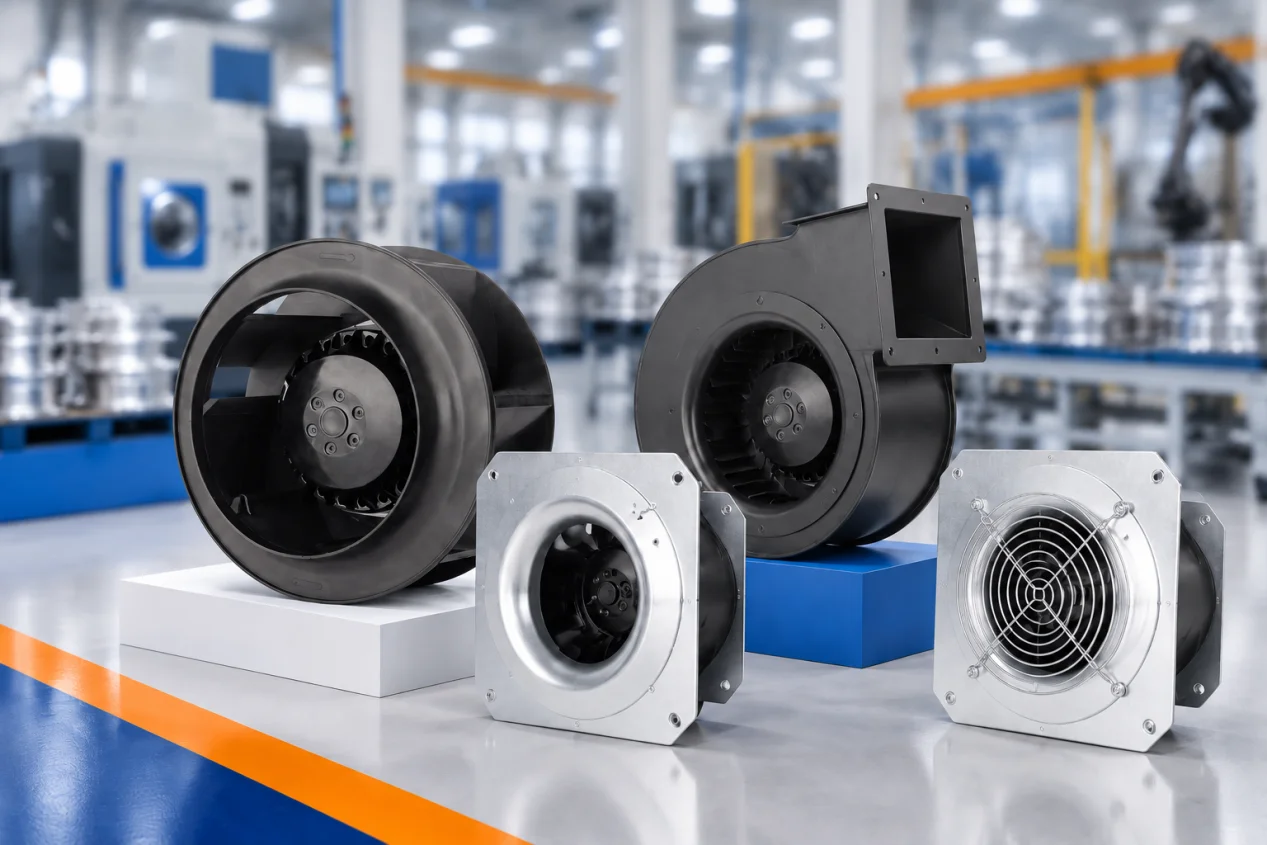
What the OEM was choosing between
An OEM asked us to validate five blower models and supply full documents. Two of them were ATEX blower variants for hazardous areas.
They had pre-selected from catalog data. So the task was confirmation rather than proposal. However, their choice carried two consequences worth spelling out.
What they were deciding
Two of the five were explosion-proof. The other three were standard units.
Meanwhile the range split another way: some models use a 2-pole motor at 2800 RPM, others a 4-pole at 1400 RPM.
Their brief also asked for anti-corrosion capability, which is a separate question from the hazardous-area rating and often gets confused with it.
What an ATEX blower changes mechanically
The models suited the job. Even so, two things needed saying before they finished the mechanical design.
Weight is the hidden cost of certification
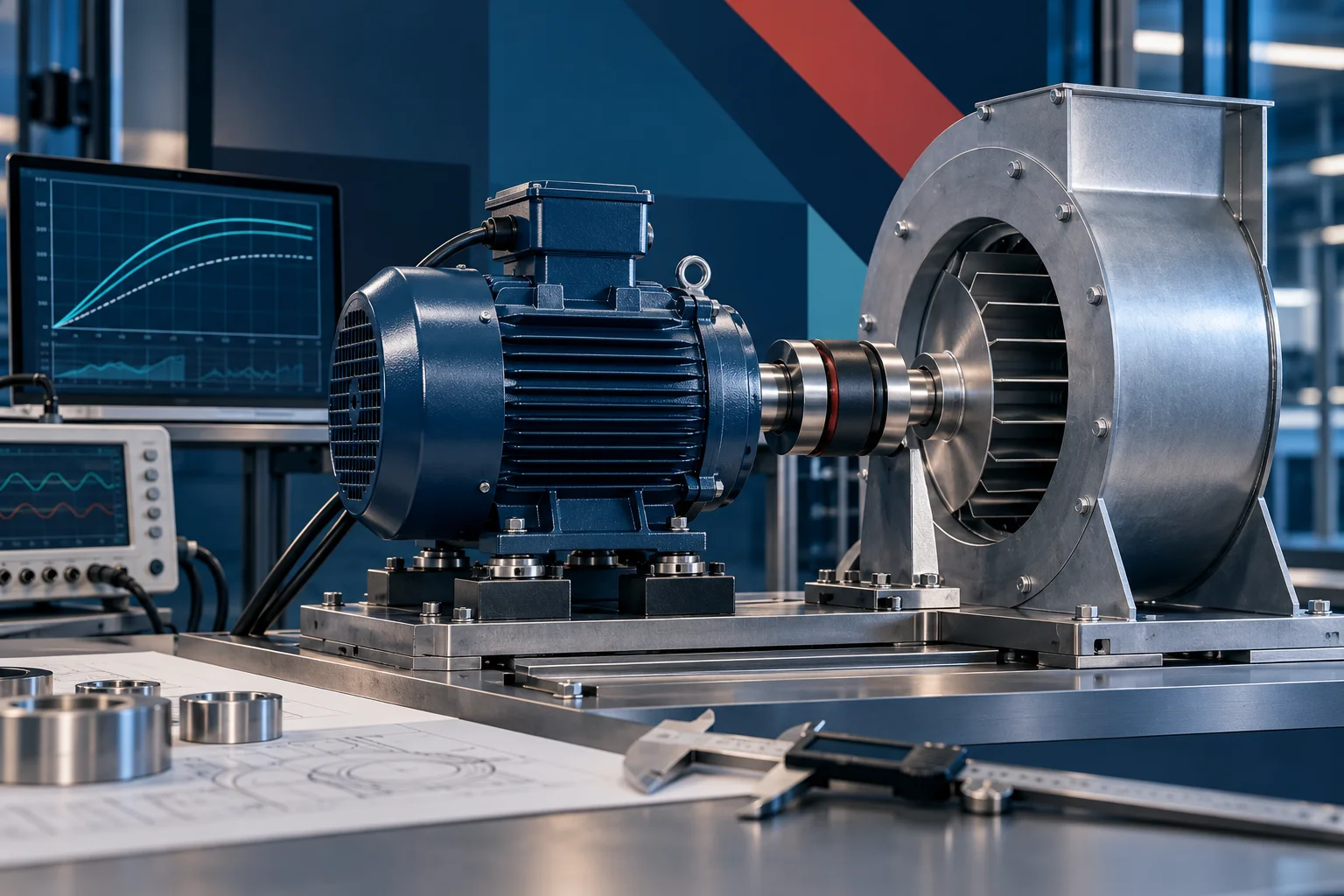
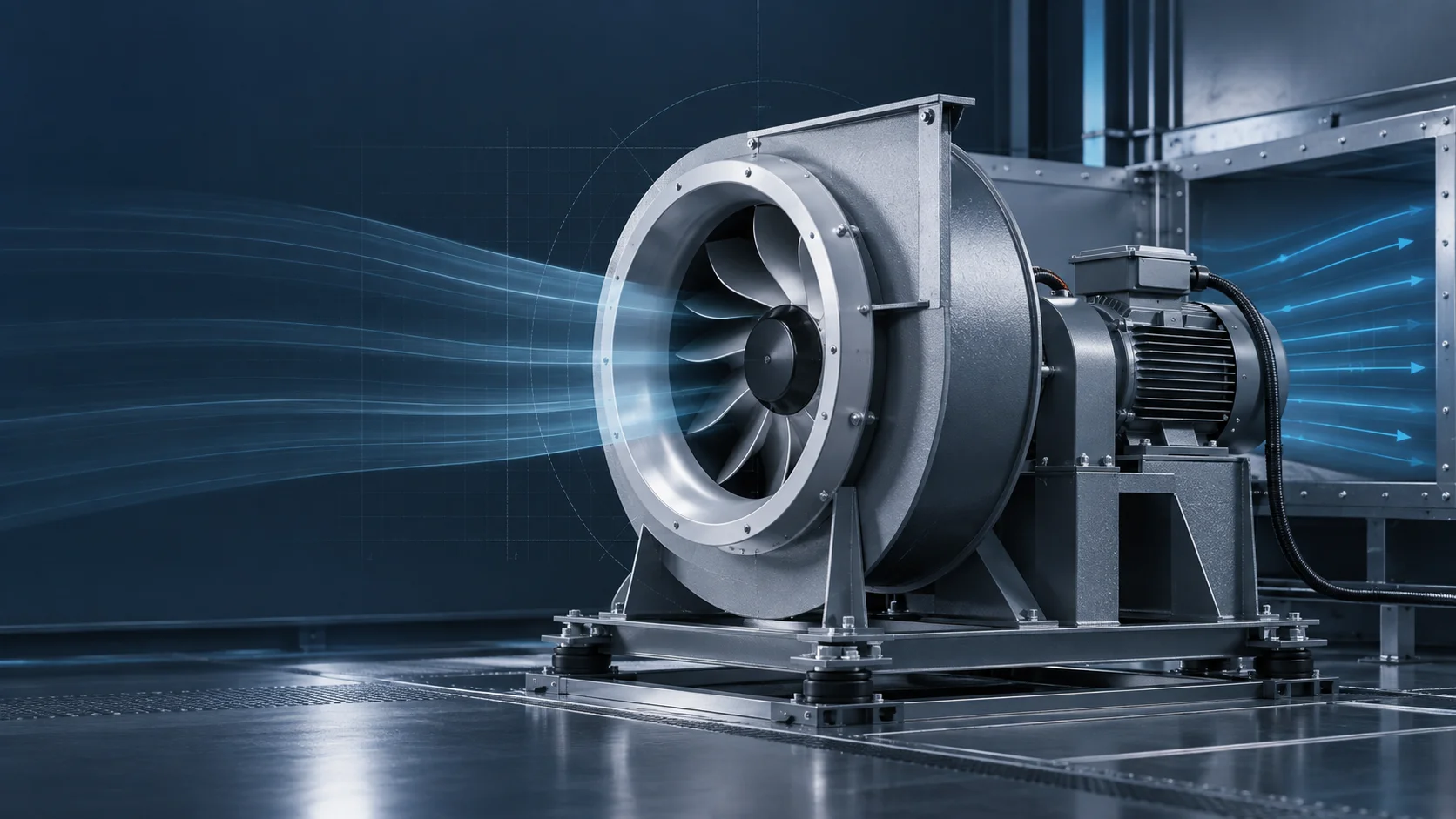
An ATEX blower puts its motor inside a casing built to contain an ignition. That casing is heavy.
Here the 200mm ATEX blower weighs 34 kg. Its standard twin weighs 17.4 kg. So the certified one nearly doubles the mass hanging off the bracket.
That is not a fan detail. It is a structural one. So it needs to reach whoever designs the mounting, rather than sit in a datasheet nobody rereads.
Speed decides which end of the curve you get
The second trade is between pressure and airflow.
Meanwhile the 2-pole models run at 2800 RPM and reach 750 Pa. That suits a tight duct or an extraction system. Meanwhile the 4-pole models run at 1400 RPM for 2500 m3/h at 450 Pa, which suits volume against less resistance.
Neither is better. Rather, they sit at opposite ends of one trade. So picking by model number without checking your system curve is how equipment ends up short.
Corrosion is a different problem from ATEX
These two are worth separating, since they often arrive together and get treated as one.
An ATEX blower rating addresses ignition risk in an explosive atmosphere. However, it says nothing about whether the airstream will eat the impeller.
The anti-corrosion requirement here was met through material selection and durable coatings suitable for moderately corrosive air. Where the chemistry is harsher, name the substance and specify separately. Do not assume the certified version resists it.
Why AC, not EC
These run at a fixed duty, so variable speed has no job. An AC induction motor is simpler and cheaper here. Furthermore, in a hazardous area, fewer electronics is an argument in itself.
What it cost
Weight, price and lead time, all following from the certification. In short, there is no light explosion-proof motor, and no fast route to a certified one.
Here the right response is to design for it from the start rather than discovering it when the fan arrives.
Technical Specifications
Five variants sit below. Compare the weight and speed columns, since those two carry the decision.
| Model | Voltage (V) | Frequency (Hz) | Speed (RPM) | Input Power (kW) | Airflow (m³/h) | Max. Static Pressure (Pa) | Noise (dBA) | Weight (kg) | Dimensions (L×W×H mm) |
|---|---|---|---|---|---|---|---|---|---|
| LW-160-B2S | 220 (1-Phase) | 50 | 2800 | 0.18 | 1100 | 450 | 65 | 9.3 | 415×236×403 |
| LW-200-B2T | 380 (3-Phase) | 50 | 2800 | 0.37 | 2100 | 750 | 71 | 13 | 460×286×506 |
| LW-200-B2T-EX | 380 (3-Phase) | 50 | 2800 | 0.37 | 2100 | 750 | 71 | 24 | 477×286×506 |
| LW-200-F4T | 380 (3-Phase) | 50 | 1400 | 0.75 | 2500 | 450 | 66 | 17.4 | 490×286×506 |
| LW-200-F4T-EX | 380 (3-Phase) | 50 | 1400 | 0.75 | 2500 | 450 | 66 | 34 | 515×286×506 |
Technical Documentation
The following documents were delivered to the customer, enabling immediate integration into their design and procurement workflows.
LW-160-B2S.pdf: This specification sheet details the performance and dimensions for the single-phase, 220V blower model.
LW-200-B2T.pdf: Procurement managers use this document to verify the 750 Pa performance of the high-pressure standard blower.
LW-200-B2T-EX.pdf: This document provides essential ATEX compliance data and specifications for the high-pressure explosion-proof model.
LW-200-F4T.pdf: The specification sheet for the higher-airflow, 1400 RPM standard model.
LW-200-F4T-EX.pdf: This document confirms the specifications for the high-airflow ATEX-rated blower.

Meanwhile the dimensional drawing of the LW-200-F4T-EX is essential for mechanical engineers to integrate the blower into system CAD models, ensuring correct mounting and clearance.
If you are specifying for a hazardous area
Choosing an ATEX blower goes wrong in predictable ways. These cost the most to fix late.
- Get the certified weight before you design the mounting. An explosion-proof motor can weigh nearly double its standard equivalent. Brackets, isolators and access platforms all depend on that number. Meanwhile none of them are cheap to change later.
- Name your zone, not just ATEX. Zone 1, 2, 21 and 22 lead to different equipment categories and different costs. So asking for an ATEX blower without the zone gets you an over-specified unit or a wrong one.
- State the corrosive substance separately. ATEX certification is about ignition, not chemistry. If the airstream carries acids, chlorides or solvents, name them so the material and coating can be chosen against the real exposure.
- Pick pole count from your system curve. Two-pole gives pressure, four-pole gives volume. Decide which your duct actually needs before choosing a model number, because the two are not interchangeable.
See our explosion proof fan range, the centrifugal fan section, or industrial centrifugal fans. Ignition protection follows IEC 60079.
Questions about hazardous-area fans
Why is the explosion-proof version so much heavier?
Because the casing must contain an ignition inside without letting flame out. That means thick walls and flame paths machined to tight tolerances. In short, it is metal you cannot design away. So nearly double the weight is normal here, not unusual.
Does an ATEX rating mean the fan resists corrosion?
No, and conflating the two is a common and expensive mistake. ATEX addresses ignition risk. Corrosion resistance comes from material selection and coating, specified against the substance in your airstream. A certified fan in the wrong material will still corrode.
How do I choose between 2-pole and 4-pole?
By where your system curve sits. If you need pressure to push through restrictive ducting or a scrubber, take the 2-pole at 2800 RPM. If you need volume against modest resistance, take the 4-pole at 1400 RPM. Send us the airflow at your static pressure and the answer follows.
Can I retrofit a standard fan into a hazardous area?
No. Certification covers the whole assembly. Swapping parts into a standard fan does not make it compliant, whatever the parts are. So where an area is reclassified as hazardous, the fan gets replaced rather than upgraded.
Technical Documentation & Resources
Working on something similar?
Send us the duty point, the envelope and the supply, and our engineers come back with a shortlist rather than a catalog. Meanwhile custom spec sheets and samples run to 90 days. Since 1990 we have built fans for HVAC, cold chain, data center and industrial OEMs.
Browse Related Products:
🏆 ISO 9001 / ISO 14001 / ISO 45001 | CE (TÜV) | UL/ETL | ATEX Zone 21/22 | AMCA 210/211 / ISO 5801 tested
Choose the right centrifugal fan
Longwell manufactures 1,130 centrifugal fans in-house. Send airflow, static pressure and voltage — an engineer replies with a matching model, performance curve and price within one working day.