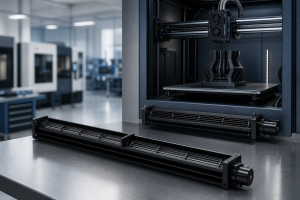
What the elevator OEM needed
Initially a major OEM needed an elevator ventilation fan for a new passenger cabin unit, moving 280 m3/h.
The space available was 381mm of length in the car top plenum. Anyone who has designed for elevators knows that constraint. In practice the ceiling void is always the last thing left over.
The constraints
- First, 220V AC at 50 or 60Hz.
- Next, a 3.5 meter cable with a terminal block already fitted, to speed up their assembly line.
- Meanwhile a resettable thermal protector set at 135C, Class E insulation, and enamelled wire rated to 180C.
- IP20 as a minimum, guarding against incidental contact.
- Finally, noise at or below 45 dB(A).
Notably the thermal requirements are the tell. An elevator ventilation fan runs inside a sealed cabin carrying people, so it counts as a safety component. Consequently the protection must be built in rather than assumed.
One figure in the brief needed clarifying. They asked for 5 m3/min alongside a 280 m3/h target, yet those are not the same number. So we agreed the measurement basis against AMCA 210/211 before quoting rather than after.
Designing the elevator ventilation fan
In truth the binding constraint here is not airflow. Rather, passengers stand within a meter of the outlet.
Why the air must be slow and wide
Move 280 m3/h through a small opening and you get a jet. In a lift cabin that lands as a draught on the back of someone neck. Meanwhile people complain about draughts far more than about stuffiness.
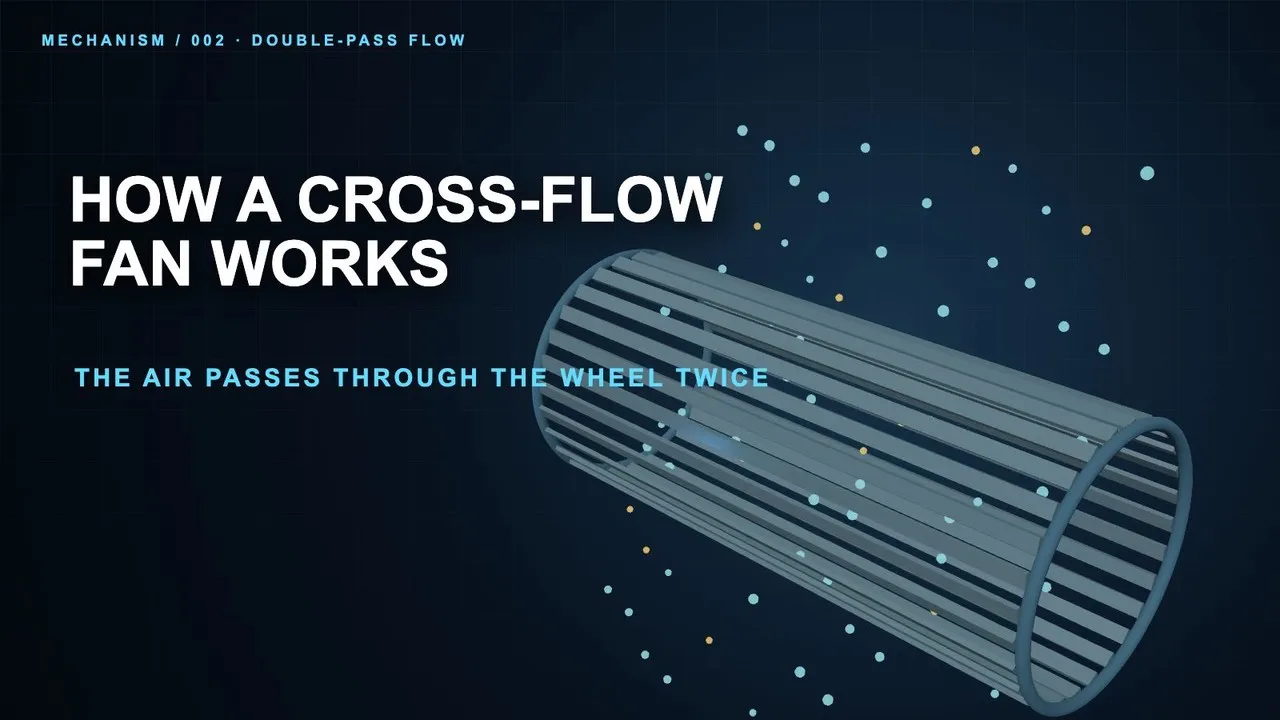
A cross-flow impeller delivers air along its entire length instead. Consequently an elevator ventilation fan built this way sends the same volume out as a broad, slow sheet, circulating the cabin without anyone noticing where it came from.
Usefully the long narrow envelope pointed the same way, so form factor and comfort agreed.
Why AC, not EC
Here the customer specified 220V AC input directly. Furthermore a shaded-pole AC motor is reliable and inexpensive, and nothing here needs variable speed.
So an EC design would have added cost and a controller to a product that runs at one speed for its whole life. We kept AC.
Sizing for the noise target
We chose a 90mm impeller deliberately. A smaller wheel would need higher RPM to reach 280 m3/h, and noise rises steeply with speed.
Meanwhile the impeller is glass-filled AS, which matters over a 300mm span. A flexible rotor at that length vibrates, and vibration in a quiet cabin is audible long before it is a mechanical problem. The housing is galvanized SGCC steel for stiffness and corrosion resistance.
What it cost
Pressure, entirely. Specifically, this fan circulates air within a cabin and cannot push it through ducting or a filter.
That suits the application exactly. Even so, this elevator ventilation fan cannot later be asked to draw fresh air through a filtered intake. Worth knowing before someone proposes it as a product upgrade.
Technical Specifications
Note the thermal protector and insulation rows below. Inside an occupied enclosure, those matter as much as the airflow.
| Model | LWE-90268SA-02 |
| Voltage | 220 V |
| Frequency | 50 / 60 Hz |
| Speed | 1250 / 1400 RPM (±10%) |
| Air Volume | 260 / 280 m³/h |
| Power | 15 – 25 W (Target) |
| Dimensions (L x H x D) | 381 x 131.2 x 125 mm |
| Impeller Diameter | 90 mm |
| Bearings | Ball Bearing |
| Insulation Class | Class E |
| Protection Class | IP20 |
| Housing Material | SGCC Steel |
| Impeller Material | AS+GF30% |
| Cable Specification | 3.5m, RVV 3×0.75 mm² with terminals |
Technical Documentation
The final engineering drawing, LWE-90268SA-02, provides all dimensional, material, and assembly details for OEM integration and quality assurance.
Download Final Engineering Drawing (LWE-90268SA-02)
Meanwhile the image captures the initial customer specifications and dimensional drawings that formed the basis of the project. 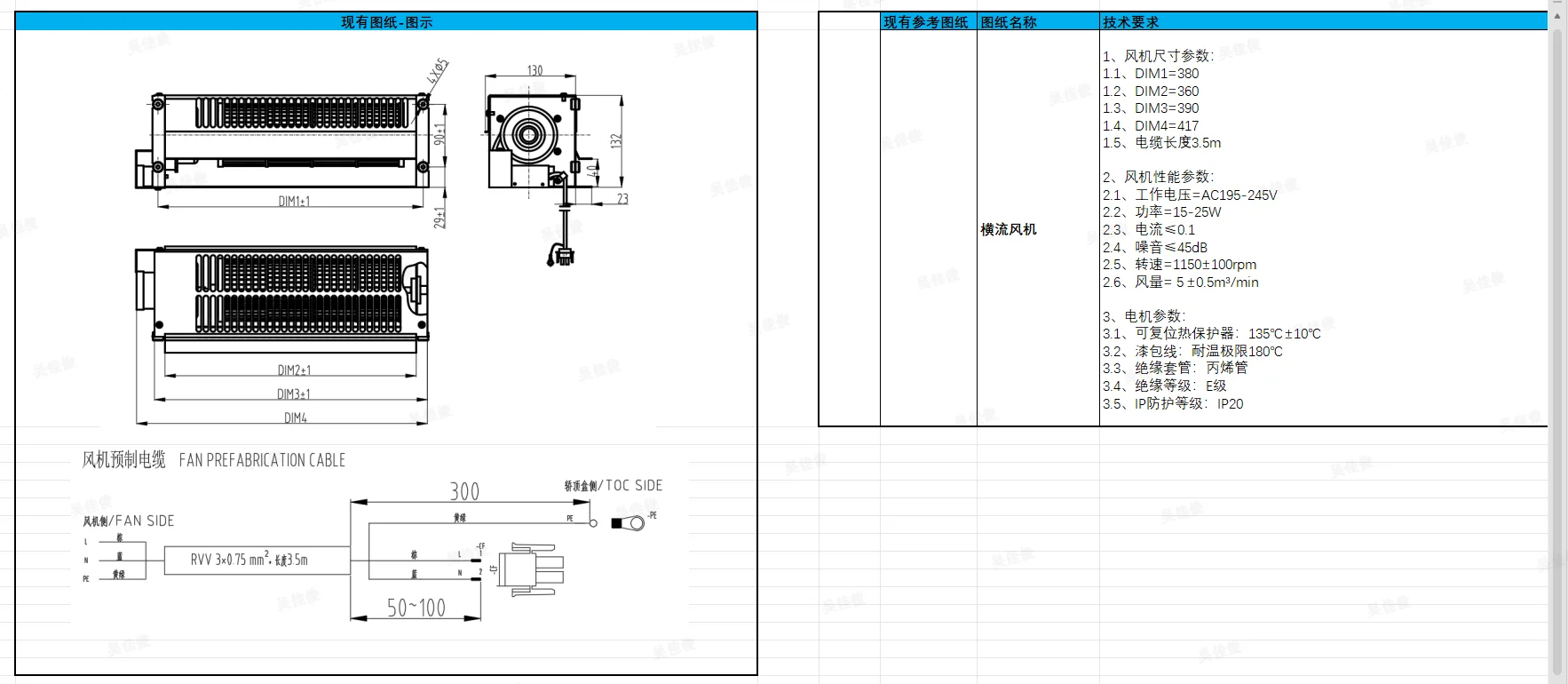
If you are ventilating an enclosed cabin
Specifying an elevator ventilation fan is a comfort problem more than an airflow problem. These are the parts people get wrong.
- Specify discharge velocity, not just volume. Comfort standards care how fast air moves past a person, typically under about 0.2 m/s in a seated or standing space. By contrast a volume figure alone can arrive as a pleasant drift or as a jet.
- Give the noise target with its measurement distance. A 45 dB(A) limit means nothing without saying where it is measured. In a cabin the passenger is roughly a meter away, which is a much harsher test than one meter from a fan in free field.
- Treat thermal protection as a requirement, not an option. Inside an occupied enclosure, a stalled fan that keeps drawing current is a fire risk. A resettable thermal protector on the winding costs little and removes the failure mode.
- Order the cable with the fan. A pre-terminated lead of the right length removes a step from the assembly line and a source of wiring errors. It is a small specification detail with a real effect on production time.
See our cross flow fan range, the AC cross flow fan section, or cross flow impellers. Appliance safety follows IEC 60335-1.
Questions about this fan
Why does the airflow figure change between 50Hz and 60Hz?
Because motor speed follows supply frequency. At 50Hz this elevator ventilation fan turns near 1250 RPM for 260 m3/h. Meanwhile at 60Hz it reaches roughly 1400 RPM and 280 m3/h. Both stay inside the noise target, although the 60Hz build is slightly louder. So specify your supply and the datasheet will match what you install.
What does the 135C thermal protector actually protect against?
A stalled or obstructed rotor. If the impeller jams, the motor keeps drawing current and the winding heats steadily. The protector opens the circuit at 135C and resets once cool, so the failure becomes a fan that stops rather than a winding that burns. In an occupied cabin that distinction matters.
Can this fan draw fresh air from outside the cabin?
Not through any resistance. It is built to circulate air within the cabin, and its pressure capability is low by design. A filtered fresh-air intake needs a fan chosen for that duty, which will be a different and probably noisier component.
Why glass-filled plastic rather than aluminum for the impeller?
Weight and cost, mainly. Over a 300mm span glass-filled AS resists flexing at 1400 RPM while weighing far less than metal. Furthermore a lighter rotor is easier to balance well, and balance is what keeps a fan quiet where people are listening.
Technical Documentation & Resources
Sizing something comparable?
Share the airflow, pressure, voltage and control interface, and we come back with a tested curve and a drawing. Meanwhile custom work runs to 90 days for spec sheets and samples. Since 1990 Longwell has supplied fans to HVAC and industrial OEMs.
Browse Related Products:
🏆 ISO 9001 / ISO 14001 / ISO 45001 | CE (TÜV) | UL/ETL | ATEX Zone 21/22 | AMCA 210/211 / ISO 5801 tested