Three fans, two motor technologies
Our Russian branch client ordered three cross-flow fan assemblies for commercial air curtains and trench heating, and the order itself embodied the AC vs EC fan question: one AC-driven model and two EC-driven variable speed models, in the same family.
Meanwhile the performance ceiling sat at 1530 m3/h against 201 Pa on the largest unit.
The shared constraints
- First, 230 V supply across all three, the AC unit on a strict 50 Hz grid and the EC units on 50/60 Hz.
- Next, hard enclosure lengths: 918mm for the 800mm impeller, 816mm and 840mm for the two 720mm variants.
- Meanwhile 60 dB(A) maximum on the largest models.
- Finally, GB/T 13933 structural compliance and a mandated 500mm external cable for routing to the control boards.
The proposal we made, and lost
We proposed consolidating all three on the EC external rotor platform. After all, one motor technology means one inventory, one testing protocol, one set of spares.
However, the client declined, and their reason was commercial rather than technical. Their product matrix needs an entry-level unit at an entry-level cost, and the 100 W shaded-pole AC motor is what makes that price point exist.
The AC vs EC fan split, tier by tier
The AC vs EC fan decision usually gets presented as a technology upgrade question. In reality, this order shows what it is: a product strategy question that happens to involve motors.
What the AC variant is for
In the AC vs EC fan split, the shaded-pole AC motor is the simple, proven side. It runs at the speed the grid gives it, full stop.
For an entry-level air curtain that switches on when the door opens and off when it shuts, that is genuinely all the sophistication the product needs. Furthermore, adding speed control would add cost the buyer of that unit never asked to pay.
What the EC variants are for
By contrast, the mid and upper tiers sell on comfort and efficiency, and both depend on modulation. An EC external rotor motor takes a control signal and slides its speed to match the door, the weather and the heating element.
Consequently the same customer conversation that rejects EC at the entry tier demands it two tiers up. Neither answer is wrong, because they serve different buyers.
What consolidation would have cost
Our all-EC proposal would have simplified the supply chain, yet every simplification has a price. Here the price was the entry product margin, which the AC motor protects.
Honestly, the customer understood their market better than our inventory argument did. So the right supplier response was to build both well rather than win the argument.
Keeping the family together
Finally, what stayed common matters as much as what split: enclosure interfaces, impeller construction, the 500mm cable specification and the acoustic targets all hold across the trio.
So the customer production line handles three fans as one family with two electrical personalities, and structural compliance follows GB/T 13933 with dimensional tolerances per GB/T 1804. Test methods for the airflow figures follow ISO 5801.
Technical Specifications
One row splits this table into two philosophies: the motor type. Everything mechanical around it stays common.
| Model Number | Motor Type | Voltage (V) | Frequency (Hz) | Power (W) | Airflow (m³/h) | Static Pressure (Pa) | Speed (RPM) | Noise (dB(A)) | Dimensions (L x W x H mm) |
|---|---|---|---|---|---|---|---|---|---|
| LWCE-100720SN-06 | EC External Rotor (EC92) | 230 | 50/60 | 75 | 1530 | 201 | 1500±150 | 60 | 840±3 x 140 x 140 |
| LWCE-90800SN-06 | EC External Rotor (EC72) | 230 | 50/60 | 64 | 1300 | 164 | 1500±150 | 58 | 918±3 x 130 x 130 |
| LWCA-100720SN-06 | AC Shaded Pole | 230 | 50 | 100 | 1300 | 175 | 1400 | 60 | 816±2 x 140 x 140 |
Technical Documentation
Here the following approved schematics and technical data sheets define the final production parameters for the Russian branch project.
LWCE-100720SN-06 EC Fan Engineering Drawing
Details the 840mm overall footprint, 7-wire control harness pinout, and EC92 motor integration for the 1530 m³/h premium unit.
LWCE-90800SN-06 EC Fan Engineering Drawing
Provides the mechanical layout for the 800mm length impeller configuration, specifically noting the EC72 motor casing and 918mm enclosure limits.
LWCA-100720SN-06 AC Fan Engineering Drawing
Shows the SGCC plate construction and 4-wire capacitor connections required for the base-tier shaded pole motor assembly.
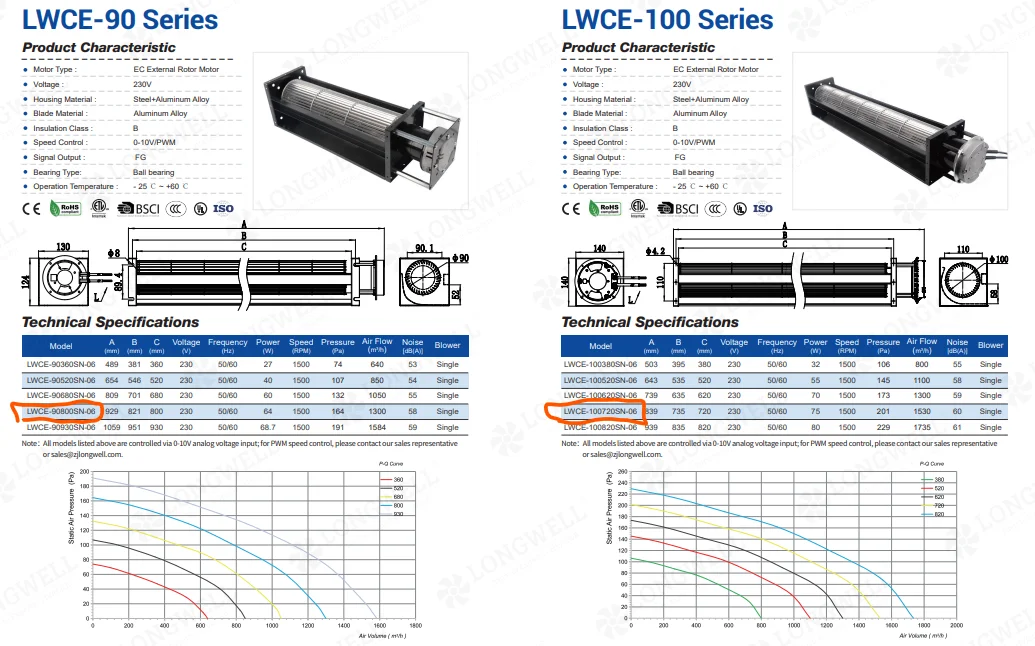
The datasheet lists the full performance curves, static pressure capabilities up to 201 Pa, and precise dimensional cross-sections for the EC motor series.
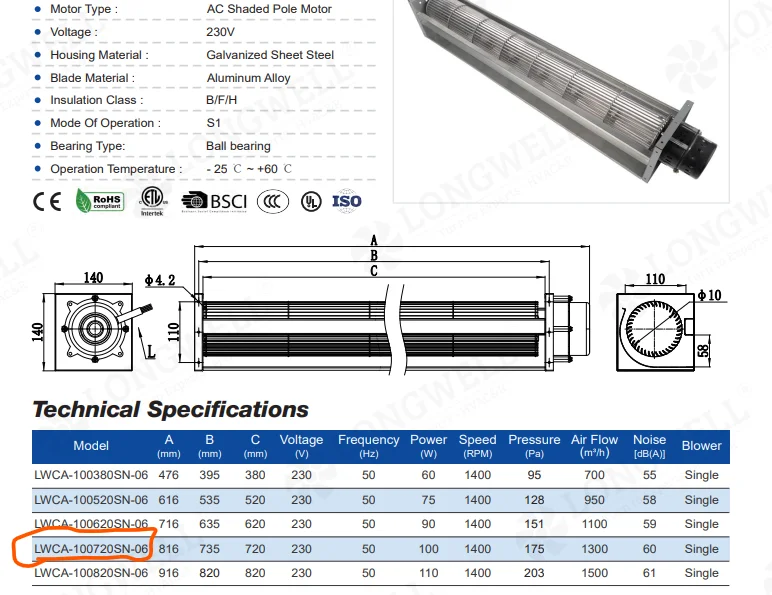
Here the reference sheet confirms the 100W power consumption and 175 Pa maximum pressure limit for the AC shaded pole configurations.
Making the AC or EC call yourself
Meanwhile the AC vs EC fan choice repays being made per product, not per company. In the end, four questions settle it.
- Ask what the product tier can carry. The AC vs EC fan premium is real, and it must live inside the product margin. An entry-level unit that cannot absorb it should not be forced to; a premium unit that sells on efficiency should not be denied it.
- Ask whether the speed ever needs to change. A fan that runs flat out or off gains nothing from EC control. The moment the duty modulates, whether for comfort, noise or energy, EC starts repaying its premium every operating hour.
- Count the electrical infrastructure, not just the fan. EC wants a control signal; AC on a drive wants an inverter and its wiring. The cheaper motor is not always the cheaper installation, so compare complete systems.
- Split the family deliberately if you split it. Mixed AC and EC in one product line works when the mechanical family stays common, as it did here. Two motor types and two mechanical designs is four products, and that is rarely what anyone intended.
See our cross-flow fans range, the AC cross-flow fans section, or EC cross-flow fans.
Questions about AC and EC fans
Is an EC fan always more efficient than an AC fan?
At partial speed, dramatically so, because EC power falls with the cube of speed while a fixed-speed AC fan knows only full power or off. Meanwhile, at a single constant duty point the gap narrows, which is exactly why fixed-duty products keep choosing well-made AC motors.
Why not put a drive on the AC fan instead of buying EC?
A shaded-pole motor of this class cannot be driven by a variable frequency drive, and adding an external drive to any AC fan means buying, mounting and wiring another component. Where modulation is the requirement, integrated EC is nearly always the cleaner installation.
Does mixing AC and EC complicate maintenance?
Less than it appears in the AC vs EC fan debate, provided the mechanical family stays common. The impellers, housings and mountings are shared here; what differs is the motor and its electrical test. A technician stocks one set of mechanical spares and two electrical ones.
When should a whole product line go EC?
When every tier of it modulates, or when energy regulation in the target market effectively requires it. Several markets are moving that way for larger fans. Until the entry tier faces that pressure, a mixed line like this one prices each product for its actual buyer.
Technical Documentation & Resources

Sizing something comparable?
Share the airflow, pressure, voltage and control interface, and we come back with a tested curve and a drawing. Meanwhile custom work runs to 90 days for spec sheets and samples. Since 1990 Longwell has supplied fans to HVAC and industrial OEMs.
Browse Related Products:
🏆 ISO 9001 / ISO 14001 / ISO 45001 | CE (TÜV) | UL/ETL | ATEX Zone 21/22 | AMCA 210/211 / ISO 5801 tested
Choose the right cross flow fan
Longwell manufactures 495 cross flow fans in-house. Send airflow, static pressure and voltage — an engineer replies with a matching model, performance curve and price within one working day.